a division of the Chersonian Institute

Category: Books (Page 1 of 4)

Cher in Fall 2026

Cher has been busy doing cool stuff all season and I have been unable to post about ANY of it and the Cher things just kept happening!

This year was a big lift with the Cher Beauty Book and the Chastity movie deep dive and after doing that I got busy working on a new Poetry PodClass on Big Bang Poetry so that has taken up all my writing time the end of this year.

But let’s get to all the things because we have a lot to recap.

Farewell to Friends

Dolly Parton RIP

On 25 August Dolly Parton passed away suddenly. Well not suddenly but she kept her condition under wraps from almost everybody and the universe was taken off guard by the news. There was national mourning. Everyone was just torn up!

Cher called into CBS to talk about her friendship with Dolly and lots of social posts that week used pictures of Dolly and Cher from Cher’s 1978 TV special.

And after Tim Curry also died that same day, there was a funny meme going around showing Cher wrapped in bubble wrap. All three stars turned 80 years old this year so Cher was on people’s minds.

We felt very fragi-lay that week.

Personal regrets: that Cher wasn’t able to do one of the Rock Star duets with Dolly. Their contrasting voices sounded great together. But Dolly did post on Twitter around that time that it was hard to top a friend like Cher.


Bob Mackie RIP

AND THEN, Bob Mackie passed away on 14 September (not even a month later!) and Cher seemed a bit more prepared for that passing.  My friend Sherry sent me the New York Times article where Cher talks about spending time with him before he died (paywall).

“In recent days, when Mackie was dying, Cher was there with him in Palm Springs, along with Joe McFate, Mackie’s design director. ‘I was with him, and I’m happy for him. Do you know what I mean?’ Cher said. ‘He was struggling. And Joe said it was, like, the best time he’s had in a long time, and I’m so glad I went.’ She said there had been a lot of joy. ‘We were laughing, talking about everything. I’m sorry that he was sick,’ she said, ‘but I know that he’s someplace better–designing dresses.'”

Here is Mackie’s New York Times obit.

Fans were still very sad about the passing of someone who has been closely associated with Cher since the very early 1970s (and so many of her compatriots and colleagues from that era have already passed). I’m glad Mackie had the chance to be feted with a nice documentary before he passed.

More regret: Mackie’s departure makes me selfishly sad that he will not be part of any future Cher tour and that quite possibly another Cher tour might not even seem worth doing for Cher without him. The only tour she did without him, Dressed to Kill, didn’t seem so happy from a costume-creating perspective. Although there were some outfits from that show I liked.

There will never be another Bob Mackie/Cher partnership though. End of an era.

Dinner with Cher

This fall Cher put out charity bids for another Cher dinner (the last was in 2024) for November 7, 2026. Good luck to everyone who entered. I did not enter this time (although it’s a great cause to benefit Cher Cares). My life is a million stressors right now and I didn’t even learn when the deadline was. But I’m sure it will be fun. Here’s the contest page.

I find it funny that the contest promises a good evening with Cher. Not a great one.

Cher Books

Cher: The Memoir, Part Two has been delayed three times. The first release date was supposed to be November of 2025. That was delayed to May 2026. The second delay was to November 17, 2026. The third delay was set to April 20, 2027. And although the cover has not yet been revealed, you can now pre-order the book. So that makes me think words might have actually been slung into paragraphs by now. Fingers crossed.

You can pre-order your book at your favorite bookstore. I am not doing that again this year either. I am just going to schlep myself down to a bookstore the day the book comes out. (It will be a Tuesday.) I wished I had done that first time.

Cher is getting a 33 1/3  book by Lior Phillips. (Thanks Robrt for notifying me.) This is a big deal for music nerds who have been eyeing the 33 1/3 series for years and wishing to see a Cher one. (Like the Funko Pops.)

You can pre-order a copy for the 12 November release.

Cher Albums

Cher has been very savvy about keeping her Christmas album alive among the fan base year after year (almost too savvy) with new variations and singles and remixes every November. This year’s offering is a limited-only DJ remix LP (with not only remixes but the inclusion of last year’s non-album single “Christmas Is Here”).

Apparently this LP goes on sale Black Friday (very annoying for those of us who try to not buy anything on Black Friday). And it felt kind of fly-by-night for a few days, only showing up on officially on Record Store Day’s website and not on the Warner Bros site or Cher’s own store.

But Cher sort of confirmed it on social last week:

I might take my chances and try to buy it the day after the release. Or next year used.

While searching for official news, I was surprised to learn how well her single “Christmas Is Here” did last year. It made it to #2 on the Dance Digital Song Sales chart! I did not know. To hear the song if you missed it last Christmas.

Cher at the Airport

Apparently catching Cher at the airport is like a free runway show (according to a Cher fashion book I read last year). And honestly, it kinda seems like that through the year. She’s still a paparazzi magnet for better or worse.

Cher was spotted at the JFK airport in New York City this 13 September sporting Chrome Hearts casual wear.

The Moncler Ad

On 10 September Cher attended the luxury outerwear Moncler’s Fifth Avenue Manhattan store opening party. She wore a very cute puffy jacket and matching skirt. Who wears a puffy skirt? Cher does.

Videos:

This was all a preview for the Pioneers In Moncler ad campaign which kicked off on 15 October with Grace Jones and South Korean singer Jennie.

So many great photos from this campaign which was directed by Gabriel Moses, shown with Cher in the last picture below.

(Click to enlarge.)

Apparently there’s a big ad on the building at Park Avenue and 23rd Street in Manhattan.


Videos:

The Cher Ad

The Cher Q&A

This is a great campaign. The choreography on the commercial is beautiful.

Articles:

https://www.designscene.net/2026/10/moncler-re-icons.html

https://www.complex.com/style/a/tracewilliamcowen/jennie-cher-grace-jones-moncler

Cher also did an interview for the campaign in Vogue.

US Vogue (paywall for me): https://www.vogue.com/article/cher-moncler-campaign-interview-10-14-2026

UK Vogue: https://www.vogue.co.uk/article/cher-on-being-a-style-icon

In the interview Cher talks about getting nervous before the shoot. She says black is her favorite color, followed by cream and white. “You’d never see me in orange,” she says, (except all those orange polyester outfits during The Sonny & Cher Comedy Hour…literally the show’s signature color). She says she likes the simplicity of the Moncler coats. She credits the choreography of Luam Keflezgy and the help of her stylist Patti Wilson. Cher says she kept tripping on the skirt which was very long. She was promised one of those pair of sunglasses but never got them. (I wonder if it’s even difficult for her own brands to “get something to” Cher.)

Cher says she and her kids all ski and she likes to go to Aspen with family and friends. Cher is usually the person who is always feeling cold so she layers. She has a favorite pair of cowboy boots she always wears. She has them in multiple colors and materials.

Cher maintains that “switching” (or being a chameleon, reinvention basically) doesn’t make you an icon. Good point to make. Because many have tried. But she does say you have to be willing to push yourself into “the uncomfortable zone–sometimes it works and sometimes it’s a mistake.” And she talks again about her bumper car theory.

She talks about Mackie and says “Without Bob, I would certainly not be a fashion icon, because Bob really was so important in making me have my own look. I did things on my own but Bob was really the person that pushed me into those real glamour moments….Bob’s clothes, you could wear them inside out: they were so beautifully made.”

Cher talks about her 1986 Mohawk Oscar dress and that Don Ameche (whom she upstaged) was one of her favorite actors.

She claims  she’s “about to make an album” but we’ve been hearing that for years, even before the Christmas album. I’m convinced when music artists say “coming soon,” those words don’t mean what they think they mean.  They must live in an alternate time-scape than us.

Cher also hints about a song collaboration that is possibly iconic. Everyone in the rumor-sphere thinks this might be with Madonna, particularly a remix of Madonna’s single “One Step Away” but plenty of others (including A.I.) think this is unlikely.

We’ll know when we know.

Precious Moments Refurbished

I’ve saved this for last. Growing up everyone in Missouri had a plethora of Precious Moments figurines (like Hummels) about their houses. My family didn’t have them because we were from New Mexico and our house was a gallery of conspicuous Southwest- in-the-Midwest. But so many family’s I knew collected them. They were Christian-themed bisque porcelain figurines created by illustrator Samuel J. Butcher. There was even a Precious Moments chapel in Carthage, Missouri, with a gift shop. They were cute but kind of creepy like Margaret Keene’s big-eyed children paintings. 

Anyway, recently a friend of mine posted something on Facebook by a woman who repurposes old Precious Moments figurines into celebrities. I wasted no time getting my ass over there to request a custom refurbished Sonny & Cher.

Here is the picture she used, the figures she stared with and the final piece.

I love this! Genius!

2025 Cher Books

As I said earlier, the fall of 2024 through 2025 was a very welcome, embarrassment-of-riches vis-a-vis Cher books.

I am reminded of something Sonny said in his memoir, that he could gauge how well Sonny & Cher were doing as an act by the way the hotels where they performed received them. If they made money for the hotel, they would be received more deferentially.

And similarly, I think you can tell how healthy a career legacy is doing judging by the quality of the writing from people who write about you. As Cher’s reputation has iconified over the last 10-15 years, the quality of mass media writing about her has improved measurably. Although this is getting harder to parse during the age of A.I. I’m not talking about grammar and sentence structure necessarily but also the thinking itself being done to conceptualize Cher as a performer, and also where this writing appears, not in A.I. results but in the mass media press.

These two books are a good example of that.

I Got You Babe: A Celebration of Cher by Annie Zaleski

By the way, Annie Zaleski also did the Cher chapter in the Hall of Fame program from 2024.

This slick-designed book of photographs and mini essays is a great overview of the Cher-universe for those who don’t have the patience to read her bios or memoirs. There’s a fun intro by Cher-friend Cyndi Lauper who talks about how professional, disciplined and encouraging Cher is, how basically pleasant she is and yet “if there was a problem, you’d hear about it,” how talking to her doesn’t feel like you’re talking to a famous person “even though she is one of the most famous people in the world.” Lauper calls Cher “sweet, kind and wise…and admirable.”

Zaleski has a good way of chunking the Cher story: breaking it up into digestible pop culture categories. She notes the multiple generations that have grown up with her and how: boomers (IGUB), Gen X (Variety shows, specials and movies, the rock diva), Millennials (Believe), Gen Z (tweets, RuPaul’s Drag Race, DJ Play a Song). Zaleski calls herself a longtime fan and music journalist. She calls Cher resilient, funny, brilliant and inspiring. The book is full of new quotes from Zaleski’s interviews with Cher and some new-old photos.

The book is color-coded by alternating chapters on Cher themes: personal life stories (much of Cher’s biography), Music, Television, Movies, Stage, Business (fitness, perfume), Fashion, Culture (being a gay and drag icon, the stuff like the dolls), Charity and Politics, and Cher stats.

Biography: Zaleski captures the core themes, that as a child “no one looked like me” and how Cher struggled for role models. There’s a great Cher’s quote about Sonny talking her “scattered energy” and “he focused the energy.” “I had such hero worship of Sonny, long after we were together…I just thought he was great.” Cher notes how they started out performing as the “100th on a bill.” Zaleski captures Cher and Tina Turner’s first impressions of each other and Zaleski notes that they “brought out the best in each other’s voices and stage presence.” She explains how David Geffen helped Cher “pivot.” “I was really, really lost,” she has Cher saying.

Zaleski has a knack for showing the iconic photographs and picking the best highlights of the Cher story.

Gregg Allman could be a “real louse” or he could build Chastity a tree house, Cher says. (There’s a Dr. Seuss poem in there with they rhyming louse/house.) “He split 9 days into the marriage.” Cher’s memoir makes it seem like the day after. Cher on Georganne: “My sister is the scholar in our family” Discussing Robert Camiletti (18 yr. difference) and Alexander Edwards (40 year difference), Cher says of younger men that they are “more supportive, less demanding” and give you more of their time.

Music: The book covers Cher’s Christmas album and major achievements.  Zaleski covers some of the early songs with her adjective-laden succinctness.

  • The swaying, harmony-rich “The Letter”
  • The Everly-Brothers-esque “Love is Strange”
  • The dramatic noir classic “Bang Bang”
  • The horn-peppered song “The Beat Goes On” – the message of which to Zaleski means “don’t’ stand still; the world is always changing and evolving.”
  • The easy-going “All I Ever Need Is You”
  • The theatrical “A Cowboy’s Work Is Never Done”
  • The dreamy “A Love Like Yours” (her vocals dusky and delicate…a perfect match for Nilsson’s own keening tone”)
  • Blazing disco-rocker “Hell on Wheels”
  • A hungry bar band singer in “Dead Ringer for Love” and she quotes Meatloaf saying “I didn’t think she could do it…I couldn’t believe it.”

She calls the music of Sonny & Cher “low-key…hewing toward kaleidoscopic ‘60s pop. She calls them “stubborn individualists” and notes one chaotic and “frenzied” concert where they had to escape by sitting in the middle of a river on a motorboat.” She quotes a journalist to say “Gypsys, Tramps and Thieves” was “one of the greatest pop songs of the last century.” And Cher’s retort: “No.” (I would argue it’s literature to boot.) Cher says it was the A&R men who brought the songs, not necessarily Snuff Garrett or Sonny.

Some songs Zaleski thinks didn’t flatter Cher like:

  • The treacly “You’d Better Sit Down Kids”

But she liked Cher’s “quiet confidence” in Dylan’s “The Times They Are a Changin’” and her “soulful performance over  scratchy electric guitars” in “Hey Joe.” She also loves the “horn-driven R&B” of the Jackson Highway album, including the “gorgeous vocals” on “Sittin’ On the Dock of the Bay” and “For What It’s Worth.” And these songs, Zaleski says, “laid the foundation for her vibrant career.”

Zaleski assembles a haphazard list of her musical successes in the charts. She talks about her “rock star phase” starting with Black Rose (and the book includes that unfortunate shirtless promo pic), opening for Hall & Oates, where Cher “held her own” with “no-frills hard rock with a dash of glam, power-pop and new wave.” (Oy, that’s some mash-up.) Theatrical howls and biting shrieks in “Never Should’ve Started,” a song which continues with “ferocious growls”. Zaleski creates her own 50-song best-of list and lists all the people Cher has collaborated with (not including studio musicians).

She does a segment on Cher’s live shows and residencies which she calls “uplifting” and notes revenues and tickets sold. There’s a separate section on soundtrack music and her guest appearances.

“Her legacy and impact are still felt today,” Zaleski says.

Television: The Television segments put Cher’s shows in context of Fred Silverman’s lineup of Mary Tyler Moore, Bob Newhart and All in the Family and him saying in 1971, “They’re the kind of young new talent we must have.”  Zaleski  talks about Sonny & Cher’s deadpan, edgy insults. She quotes Meryl Streep as saying Cher on TV was a “natural talent as an actress…she made everybody else on TV look like they were trying too hard.” (And she did.) Streep also called Cher’s acting “immediate…canny…skilled, but it was invisible.”

Zaleski also rounds up the awards and ratings and notes “The Sonny & Cher Comedy Hour would “become known as the Gold Standards by which all musical variety shows were measured.” (No one talks about that very much now but it’s true.)

Zaleski gets the name of Sonny’s solo show wrong but reviews both Sonny and Cher solo shows and has ABC president remarking that maybe it was “too soon” for Sonny’s show. And there are pictures from the first show attributed to the later day show. (Deep breath.)

There’s also a segment on the TV specials at the end of the decade and how tabloid problems with Gregg Allman meant that “mothers wouldn’t let kids watch.” (There was very little my mother wouldn’t let me watch: the movie Grease and the TV show Soap.) Zaleski calls the specials “equally amazing” and talks about Cher’s Letterman appearances. There’s a section on the music videos (including “Hell on Wheels”), the John Wilson cartoons and even the guest appearance on Pee-Wee’s Playhouse and Will and Grace among other things.

Movies: This section take us from Come Back to the Five and Dime Jimmy Dean through the aminated movies and Mama Mia 2. We begin with Cher’s struggles to break in to acting and how Jimmy Dean “gave me professional credibility for the first time.” Reviews for Silkwood include “the script was dense and smart” and “one of the most wryly clever performances on film in a good while.” Zaleski notes that Cher thanked her mom, Sonny and her children for her first Golden Globes win.

Reviews for Mask include “a sensitive, empathetic actress” and Cher saying, “I go out of my way to try to do women who are heroic people that would never make the cover of any magazine,” about Bagdanovich Cher saying, “I never did really understand what he wanted” and Bagdanovich on Cher saying, “she can’t act” and that she was “the most difficult actor I ever worked with,” that she “won best actress because I shot her well.” Zaleski  mentions Cher’s lifelong friendship with craniofacial kids. She calls Witches of Eastwick “underrated.”

Zaleski calls Moonstruck a modern classic. Zaleski also mentions the movies Cher barely missed out on including King Kong, Thelma and Louise, War of the Roses, The Drop Out and Catwoman.

She separates Cher’s main movies from her cameos and movie segments like If These Walls Could Talk. She has Cher saying she has “a narrow range. My characters, they’re me.”  (I would say this is only consistently true of the latter-day movies.)

We learn that Cher picked Andy Garcia as her mate for singing “Fernando” in Mama Mia 2.

Zaleski includes all the animations on one page (TV, video and movies, except the John Wilson ones which appear with the TV videos): her appearance with Beavis & Butthead, Zookeeper (which wasn’t animated though but does classify as voice work), Home: Adventures with Tip & Oh, Bobble Heads, and both appearances on Scooby Doo.

Stage Work: This includes the 2018 jukebox musical and a cast member saying about Cher, “to be vulnerable and yet have the most power in the room, that’s a really hard place to stand in.”

There are sections about her other cultural influences including:

Fashion and her years with Bob Mackie on stage, television and on the red carpet (and with the dolls) and how Bob Mackie said he was always “attempting to present to the world this…creature in her own right” and Cher talks about the confidence he gave her. Zaleski lists the iconic fashion moments and calls her “a fashion plate for the free wheeling, forward looking 1970s” and says she’s been pushing the envelope since the 1960s. Another great Mackie quote is “she’s a chameleon, but you can never lose her.”

There’s a whole section on Cher wigs, a whole section on the dolls. Zaleski notes that back in the 1970s they called it the Cher Barbie doll and has Cher saying “they made about 30 dolls before I was satisfied.” Zaleski interviews the Mego Toy president.

The Social Causes: There’s a section on her support of LGBTQ community and her status as a gay icon. Separately Zaleski has a section on Cher’s influence and importance to the art of drag, including how she incorporated drag into her late 1970s shows.

The Business Ventures: This includes the fitness commercials and videos, Lori Davis, Aquasentials (where Cher says she felt she lost her soul), the Sanctuary catalog, the two perfumes, MAC cosmetics, Cherlato and a roller rink Cher started that never opened. (I didn’t know that.)

The book also has a stats page that covers her auctions, awards, chartings, record sales, tour receipts, awards and honors.

Charitable Interests: This list includes AMFAR, Pediatric Aids Foundation, Habitat for Humanity, COVID Pandemic Response, a village school in Kenya, Intrepid Fallen Heroes Fund, Operation Helmet, political support to Hillary Clinton and Joe Biden, saving Kaavan, Free the Wild and her continued work to save Billy the elephant.

There are some new and rare pics, quotes and perspectives.

Some other great quotes from the book: “Cher is pop culture” and that she is “a model for staying true to yourself…brash, outspoken, unapologetic. The world is finally waking up and realizing that she’s one of the most influential and important artists of our time.” and video director David Mallet saying “she is probably one of the most unaffected people in entertainment.” (Very different from what Bagdonovich said.)

Style Codes: Cher: A Guide to Dressing Like a Fashion Icon by Natalie Hammond (2025)

I’m always looking for ways people talk about Cher’s fashion style because, like for music, I don’t feel real adept at talking about fashion. I don’t have the vocabulary. Although I do enjoy dressing up for occasions, I spend most of my time in jeans and a t-shirt. I did a lot of outrageous-wear in high school but it wasn’t modeled after Cher as much as Molly Ringwald. She wasn’t a bad guide either.

My only criticism of the book is that it’s so over-designed, it’s hard to tell where sections begin and end.

The book starts by considering Cher’s 1982 live show headdress and Hammond calls it an “extravaganza of camp” and she notes how that show’s outfit changes happened in front of an audience. She also notes the show’s “big mule sandal” and calls Cher a fashion “risk taker.”

Next she considers the 1986 Oscars dress and says Cher’s variety shows were “always source of controversy for CBS” but that Cher and Bob Mackie were adept at creating “a moment.” (An unforgettable moment at that.)

Hammond talks about how Cher’s album cover always provided a “glorious sense of escapism,” particularly Take me Home and Prisoner.

Hammond explains an episode when Cher was on a Barbara Walters special explaining what her 1988 Oscar dress would look like and it was supposed to have a motorcycle jacket instead of the wrap she eventually wore. ”I feel that’s really me.”  (I didn’t know that.)

The book is broken up in to 10 Cher codes along with tips as to how to use them yourself. “The average person has no Bob Mackie. So what’s a girl to do?” Generally this means pushing yourself out of comfort zone but still feeling like you. The book encourages you to throw in an “occasional curve ball” into the mix. Hammond talks about the word “appropriate” and how this concept doesn’t apply to Cher. To those who judge Cher’s fashion decisions, Hammond says, Cher judges you right back.

Cher says she didn’t set out to be scandalous. She was simply trying to be herself. (That’s a complicated idea.)

Hammond says first you need to take stock of your wardrobe (t-shirts and jeans) and do a cleanse and list out the gaps. (Anything that isn’t t-shirts and jeans. Jk, I have some sweaters, too.)

If Cher has only  one legacy, it would be the naked dress, Hammond says. Now naked dresses are standard practice on the red carpet. But in the 1970s nobody was showing that much skin. But Cher was already using “see-through fabrics, peekaboo lace and decolletage-clinging sides.” Hammond quotes Mackie about Cher’s fantastical armpits. There’s the comment about the appearance of Cher’s navel during television’s family hour.

Cher was accused of corrupting the morals and had to hide her navel again by 1975. Her variety shows spent $30k on the costume budget per episode. But in the process, she became a style icon in the 1970s. Not a pinup (as if to differentiate her from Farrah Fawcett). Hammond talks about the Cher silhouette,” slinky to the point of making her look statuesque”  with the elongations, the crisscross designs and the fluid maxi skirts.

Hammond provides mix-and-match options charts, tells you how to shop and what to pair with what. This book has mostly illustration and very few photos of Cher, as if the book is on a budget. But there are enough. And the illustrations are helpful.

There’s a section on makeup and Cher’s heart-shaped face and how empowering it was also to see Cher out-and-about wearing no makeup, similar to how it is also empowering to see RuPaul and Pamela Anderson without makeup today.

Hammond takes us through the decades.

1960s

After the “staid fashions” of the 1950s, “modest was out, megawatt was in.” There’s even a color-scheme page for each decade, with the primary colors of the 60s, the paisleys, Cher’s vinyl minidress in sunflower yellow.

She calls Cher “queen of the crop tops” and talks about Cher’s early use of bell bottoms.

1970s

A glamourous approach, “gone were the garish or girlish” and how Cher wore a “lustrous spectrum that dazzled under lights.” Hammond focuses on her “jewel tones,” an example being the ruby-red Ringling Brother’s outfit.

Hammond talks about the artist who worked on the first variety show (or with Cher during that time):Jim Ortel (hair), Ben Nye II (makeup), Renata Leuschner (wigs), Minnie Smith (manicurist of the stars) noting how Cher started the squared-off nail trend.

She mentions the Beatles Tribute dresses.

And “the kaleidoscope effect” of Cher’s butterflies outfit.

“By 1978 Cher had laid three shows to rest” Hammond says and she calls their next variety show in 1976 “the ex-couples second bite of the cherry as a double act.”

By the late 70s Cher is “dressing with a devotion to the razzmatazz.” She turned the volume up, Hammond says and her “outfits were brief and the colors were bold.” As Cher struggles to launch and acting career, Hammond says her clothes were “a visual sucker-punch that would have done little to quell the doubt about her suitability for cinema audiences.”

An example she notes is the 1978 turquoise body suit and its pose, “a starfish in spandex,” the silver knee high boots and the whole thing “a swaggering kind of energy” (which, btw, is where real rock and roll style resides).

But it was “the flame dress that really set pulses racing.”  Hammon notes that a version had already been made for Tina Turner inspired by the tendrils of sequins already worn by Raquel Welch.

Here’s a slide-show of women who have worn a version of the dress.

Cher as “Prime Time Queen” wore all those jewel tones and “showgirl getups” but Hammon notes all the times she wore white and later in the decade purple and pinks. And the gold on 1979’s Take Me Home.

1980s

Black was Cher’s color in the 1980s. Hammond says, because she was in her serious Hollywood phase but that she “makes the shade her own”  and that “the genius of Cher” is to turn black into a statement or even everyday wear. She notes the “Turn Back Time” leotard and that silver belt, noting this was the only outfit Cher was ever nervous about because….all those sailors.

Someone on The Phil Donahue Show asked Cher if she had shed her “Barbie doll image.” She was wearing a studded leather jacket, short shaggy hair and leather mini skirt.

Hammond provides advice on wearing all black, how to mix textures and that “black doesn’t have to mean boring.”

She talks about the “I Found Someone” video’s black peekaboo body stocking paired with a leather jacket and the chain-mail suspenders and the armor minidress.

She notes that the record label, Geffen didn’t want Robert Camilletti in the video so Cher funded it herself “and if that isn’t rock and roll, what is?” Snap. Hammond talks about how her outfits seem effortless and Cher’s “utter disregard of the rules” which is “better than leather.”

Later in the decade, Cher wears more florals.

1990s

Hammond talks about the Love Hurts bodysuit with all its rivets and charms and high cut crotch.

The was a decade of animal prints for Cher. She notes the 1993 CFDA event with the crystal buckle. She calls Cher “the mistress of I don’t give a damn.”

There’s a section explaining Cher’s use of slightly oversized biker jackets, “the definition of rock and roll,” going “loose and louche” with extra zips, belt, cuffs to the knuckles, and always falling off her shoulder.

She gives tips on vintage shopping.  She notes the 1997 Met Gala outfit.

2000s and 2010s

This was a decade with the return of color, of “Believe” silver and the 2000-2005 Living Proof Tour metalics.

She notes the 2002 MTV Icon award honoring Aerosmith.

2020s

Hammond talks about the idea of “owning your own sex appeal” and how Cher does all the “no-nos” in outfit combos.

She mentions the Versace show where Cher wore blue leather in 2021.

And her appearance at the opening of the Academy Museum of Motion Pictures wearing two prints. (One of my favorite recent ensembles.)

And her Chicken Shop Date jacket.

Hammond talks about how Cher has worn denim across all the decades and how Cher says denim is the “longest relationship I’ve ever had.” She calls out the flared jeans Cher wore on her first appearance of Will & Grace and of Jack: “He should have know better. Who could pull off those jeans but Cher.”

Or the jeans she wore opening night at Studio 54 on April 26 1977, coming downstairs with Steve Rubell.

The 1987 photo session on shag rug in her Egyptian house.

Cher can made double denim okay, Hammond says.

There’s a section on “embracing your alter ego” and Hammond calls out the outfit Cher wore on the cover of Paper Magazine in  2023.

Hammond calls Cher an “airport influencer” and how she has made airport appearances into “her own personal runway.”

She calls out a 1974 appearance with a cowboy hat.

A 1977 airport appearance wearing snake skin boots.

A 1978 appearance in a checkered shirt and a 1984 with leather pants and a 1988 appearance with a velvet scarf.

Hammond says Cher has even mastered dressing down (and I’m reminded of how she does interviews with jogging pants,  track pants or jeans and a t-shirt .

Like the outfit she wore on The Dick Cavett Show in 1982 (where she shows him all her tattoos).

Hammond talks about film roles that featured “a grittier kind of realism” and that “Cher was more than capable of playing a ‘real’ person.” She calls out Dolly Pelliker’s t-shirt, workman’s pants and cowboy boots from Silkwood which “couldn’t have been more of a departure.” Hammond calls it a “make-under.”

She calls out the 2018 Met Gala dress when she talks about how Cher has a “sparkly me” and “the quiet me.”

There’s a whole section about add-ons and her Hammond features the 1985 Met Gala dress with the black skirt and beaded top with ear cuffs. Hammond says for Cher “more is more.”

She tells us the “Believe” video head piece was an accident of walking by an artist who happened to be on set crafting to pass the time. (I did not know that.)

There’s a section on hair and hats: Charlie Tweeddle cowboy hats, cowboy hats with plumes, halos, war bonnets, headdresses.

A final section is on prints and of course Cher’s character Laverne is featured with the bra strap always exposing itself (Bob Mackie’s genius idea) and how the outfit is “loud and unapologetic.”

“Clothes never eclipse Cher,” Hamond says, whether she wears rock-and-roll studs and beads, sequins, crystals, pearls.

On page 184 Hammond promises that by following these codes “you’ll look a little like Cher” but on page 1986 she admits “there can’t be more than one Cher.” All we can do is emulate her style codes and “perhaps push yourself out of your style comfort zone….Cher didn’t take her wardrobe too seriously.” And if you do, “snap out of it.”

In Hammond’s acknowledgements she says, “this one felt personal because to me Cher is the ultimate in so many respects—a person who lives fearlessly. I hope this book encourages you do to the same.” Hammond also has done books on Dolly Parton and David Bowie. She is currently the Senior Fashion Editor of Grazie but has written for many publications about fashion.

End of 2025 Catchup

I checked Cher’s merch page and unfortunately there is not yet a Cher snow globe available. But wouldn’t that be swell?

Music

Since I’ve been working on my own Cher rabbit holes (with books and dolls), I’ve been delayed in posting the latest Cher news. And there has been quite a lot of it, the biggest of which maybe happened yesterday.

I had no idea when I woke up Sunday morning that I’d be greeted with news of new music that very day. Cher completely surprised us with a  new  Christmas single!

Some fans, me included, worried that after months of really aggressively fake Cher news on Facebook, that this too was fake news. In fact, I spent the better part of Sunday morning lying in bed trying to find confirmation on this story. I didn’t even think to go to straight to Cher’s YouTubes. Eventually I just had to rely on the reliable sources of Cher Universe and Cher Brazil. They get the scoops, those young whippersnappers.

I spoke with another Cher scholar and we wondered is this was actually a 2025 recording? There has been no context around this release (interviews, advanced press) and so it’s hard to know. Or is this an outtake of the 2023 Christmas album? Will it be resold and repackaged into the old album to tease fans into buying it once again? The song is heavy on auto-tune, which feels like Cher’s continued middle-finger into the face of auto-tunes detractors, but its also not new.

On the other hand, the lyrics speak to the from-ennui-to-anguish her fans may be dealing with in 2025 in a sort of general way that covers all of our possible scenarios.

I always appreciate the Cher-as-Mother-Figure songs. Her Cheer-Up-Kid gestures always get me. This could be because Sonny & Cher were my fantasy parents. But songs like “Chiquitita” and “Stop Crying Your Heart Out” I find very comforting. This is another song in that category. It’s been quite another rough year from this end (ending with a roof leak among other dramas), rougher probably because it’s also been rough for all my friends too.

Sometimes I feel like I’m losing my resistance and elasticity. (Don’t tell my non-Cher mother. She’s got enough to worry about.) But songs like this are very appreciated from Cher’s own brand of public surrogate motherhood.

This is also a good time to visit the Cher Scholar Christmas Page.

The new song also explains why Cher will be on Saturday Night Live on Saturday December 20, their year-end Christmas show. She’s a musical guest alongside Arianna Grande, but hopefully she’ll also appear in some of the skits. Would a duet be too much?

Let’s touch base next year on how all that turns out.

A Grammy Salute to Cyndi Lauper aired on CBS on 5 October. It was a great special all around with some fabulous and unexpected duets. Cher came out for the finale of “Girls Just Wanna Have Fun” in a visual tribute to Yayoi Kusama which I love, love, loved!

Last week, Cher also received another victory against Mary Bono but this time at the federal level. Bono plans to appeal all the way to the top! (Just wow. Will the Supreme Court eventually take on this case someday? Let’s hope not.)

Cher Books

CBS Mornings (which has confusingly rebranded since I last looked from the previous title of CBS This Morning) had Cher on the show in November to talk about the paperback version of her Memoir just out. There is an appended story at the end of the paperback version, (to get us to all buy that again) about Sonny and Cher at Martoni’s Restaurant, a very funny one but not the “Laugh In” story that was left out of the hardback version, which is significant I think. Did that even happen at all?

Cher’s Memoir part two was postponed earlier this year until spring of  2026 and now reports are saying it’s furtherly postponed until fall of 2026, which will be two years after part one came out. (That’s the way it is and you’ll like it!)

Anyway, 2025 was sort of an embarrassment of riches on the Cher book front. In another post (this week) I’ll talk about Annie Zaleski’s picture bio and Natalie Hammond’s style guide.

But this week, the children’s book on Cher (from the Little Golden Book people) came out, written by Candice Ransom and  illustrated by Laura Catrinella. It’s so brief, it didn’t have the chance to print any egregious errors. Which is nice.

Some of the best drawings include:

And then there’s this picture. I’m sure many Cher fans will fight me on this one but that is definitely me in the lower left-hand corner of this picture. That’s even my facial expression at Cher concerts!

Outings 

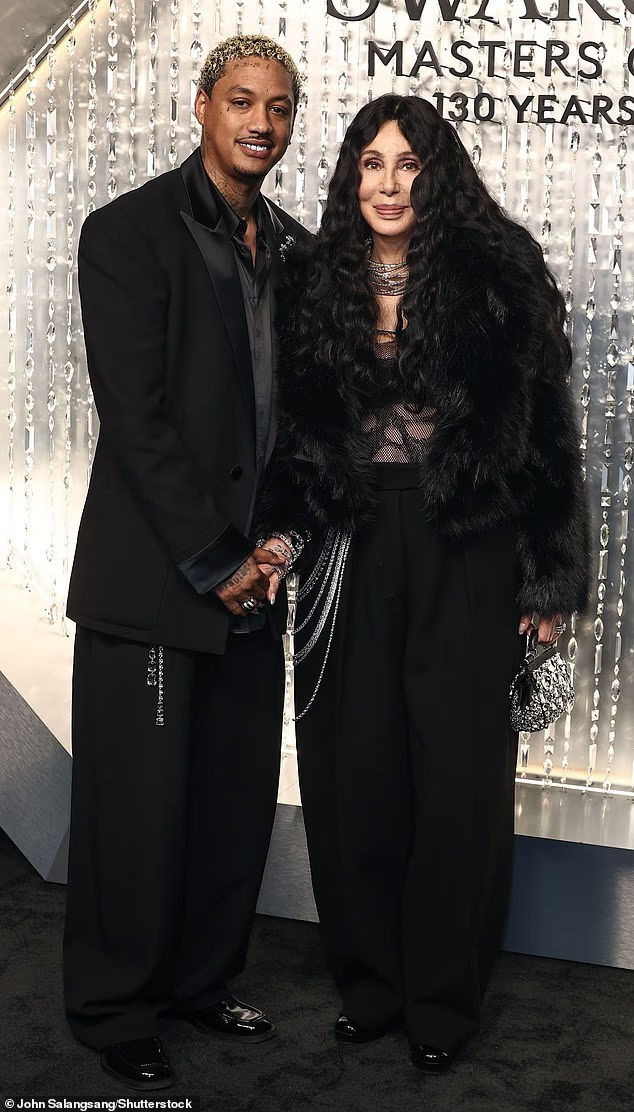
Cher attended the Swarovski Masters of Lighting Opening Celebration in Los Angeles with Alexander Edwards on 28 October. “On the day, Cher donned a black see-through bodysuit paired with a fur crop jacket and wide pants adorned with chain decorations on the sides, exuding her unique charisma. Her signature black wavy hair and glamorous jewelry highlighted her presence as the ‘ageless diva.'” (chosun.com)

Cher was also presented with a Bambi Legende Award in Germany on 13 November.

Cher was introduced around her iconic status and humanity. In her speech Cher said she was proud to be there and felt she had a special relationship with Germany, where people seemed to always been interested in her during her career’s low ebbs. She talked about her inability to save Billy the Elephant from the L.A. Zoo. She kept saying, “I’m just a singer; I can’t do anything.” But then after telling the successful Kavaan elephant story she ended with, “I’m not just a pretty face, am I?”

Movies

Someone reached out to me from Peru about the movie Suspect.

A man named Anthony told me he had recently watched the movie on VHS and “found it very entertaining,  full of suspense and interesting moments. For example, the scene in the library” and yes that scene was very delectable!

Anthony said he searched the internet for reviews and found my Cher Zine review “full of details and very interesting observations.”

He said he was “grateful to be able to read it and that there are unique opinions” and he hoped I could read the email “and feel grateful for filling the world with culture.”

I was indeed very grateful he reached out to me. Suspect is a bit underrated as it includes a very bookish character against Cher-type and I think she does a fine job in it alongside a young Liam Neeson.

More About Me

So my friend in San Francisco and I finished reading Healing The Child Within by Charles L. Whitfield (which Cher recommends in her book Forever Fit) and we started on the comparatively very large workbook.

Oy vey! It has been a shocking experience because when I started reading the book, it felt so dated, so 80s. My friend and I have read so many other self-help books between when this one was published and now. And it seemed very substance-abuse related, which was not my family history, (in my childhood anyway). But then it turns out the childhoods explored encapsulated many more kinds of dysfunction under “also ran” where I could find my little self. The book is full of tables and charts and I could see exactly where my therapy in Los Angeles stalled when I left to move to New Mexico. I never got to core issues! Or letting the feelings go!!

So I’ll be restarting therapy next year when my insurance is sorted out. My friend and I are now deep into documenting our true and public selves. Many surprising revelations for us, I must say.

I’ll be making an unexpected visit to Cleveland next weekend so I wasn’t going to finish putting up my Christmas trees. But then I did it anyway just to cheer myself up.


Memoir vs. Memoir Part 3: the 1970s

I just need to say this again: if you had told me when I was six or seven or eight years old that one day I’d be reading Sonny’s memoir alongside Cher’s memoir, each discussing their days as Sonny & Cher, I would have fainted across my Raggedy Ann bedspread. It was inconceivable to me that such an amazing thing would happen someday in this world. That’s how much I loved Sonny & Cher.

I now think either Cher eventually read Sonny’s book or one of her ghostwriters did because their opinions, even minor ones, seem so point-to-point.  And why would they not read everything, just for research. I guess it could be an amazing coincidence, like Sonny’s image of Sonny and Cher connected to the same umbilical cord.

Anyway I’ll try not to replicate Cher’s book here because you should go out and buy it. The paperback is out now with an additional story. But let’s continue…

If you want to go back:

The Nightclubs

So Sonny admits it was Joe DeCarlo’s idea to try out nightclubs. This is big. Cher and the world usually give that idea to Sonny. Sonny calls the period a “bumpy road personally.” Cher says they actually got back on track as a family during this period. And Cher calls it Supper Theater. The Supper Club circuit. Places like the Flamingo in Las Vegas and the circuit of hotel and casino dinner theaters.

Cher remembers she was “relieved to be working” and they traveled with Chas in a wicker crib and their nanny Heidi, “the sweetest woman in the world.” Chastity’s first two years were on the road and her first milestones all in motels and hotels. Cher says Chas was our early entertainment and “such a gift.” The band and hotel staff held her all the time and her “feet never touched the ground. Cher says, “she was the sole focus of our long road back to who we once were. “ Even though they had no money or house and had hotplate meals, the three of them hung out together and “no matter the circumstances, Sonny could always make me laugh.” Cher is unequivocable: “struggling again helped revitalize our relationship…being poor narrowed our focus—how to best spend our time, made us feel three of us against the world.” (This is the “backs against the wall” era.) Cher says Sonny was a big kid, very creative, and she could happily watch him play with Chas for hours.

“Our world consisted of the three of us.” This sounds very happy but Sonny portrays it all unhappy and remembered only the struggle.

He says, they “struggled to find chemistry off stage” and he says he took some of the act’s barbs personally. He does start to worry he is being too bossy and that he lives too much in fantasy land. He admits he was “obsessed” with Cher’s “steamy love scene” with Steve Whitaker in the Chastity movie. He worried that his jealousy meant they didn’t “get it on film.”

Later in the book Sonny will claim that Cher’s unhappiness came out of left field. But here he acknowledges their fights over the busy schedule he arranged and he admits they “worked their asses off” in the summer of 1970 and that may have “cost us our relationship.” He mentions making the Dick Van Dyke TV special (he doesn’t mention its name, The First Nine Months Are the Hardest) and how it was hard to be on the road again and playing two shows a night. “We were up and down on planes…packing and unpacking…walking through smelly kitchens late at night…not connecting well.” He says Cher saw it as “a treadmill going nowhere.” He also says, “our enthusiasm for life was too low to pick up” and “you feel miserable.”

Cher does say ”every night was like a war” but she’s talking about with the audience.

Only Cher mentions the Love American Style appearance in January of 1971. Cher talks about how kind Sonny was during her panic attacks and his “odd” experiments like having her sing Puccini’s “Un bel dì, vedremo” from Madame Butterfly.

Cher explains how the new act developed from drunks in crowds and how she started talking to the band and making them laugh. She didn’t get the side eye from Sonny because it was working and at least they were entertaining each other. Cher calls it “always hit or miss” and that very “slowly we developed a [20 minute] act people would line up to see.” She notes it was “not our singing. “They wanted to hear our jokes.” Cher talks about her heritage of wiseassery. But that “never in a gazillion years did I imagine that I’d become a standup comedian.” Cher explains the type of jokes they told: about Sonny’s mother, his height, his singing, his hopes of becoming a sex symbol, her nose, her body type. Cher says it was accidental and “We got excited again.” They both tell some of the jokes they did.  Cher says, “Timing was everything” and she could “make Sonny laugh so much he couldn’t sputter out his lines.”

Sonny’s version: “We gradually developed a humorous and fairly sophisticated repartee.”

Cher again says their stage personas were the opposite of their off-stage relationship. Cher tells a story of trying to confide unhappiness in Sonny and his explosion and threat to divorce her.

Cher does talk about the discomfort of it, how that “felt horrible.” They would be in motels across the street from venues and casinos. Train whistles would keep them up at night. Bad plumbing. Mildew on the walls. Paper thin walls. Sonny would make them hot-plate pasta for the family and the band because they couldn’t afford restaurants. Cher admits sometimes “I wanted to curl up and die.”  Cher says they’d take the service elevator and then navigate their way through the busy kitchen trying not to slip on any grease or wok into a waiter flying past carrying five plates and standing by the swinging doors and trying to keep out of the way, listening for their cue. Then walk out smiling.

She says her sister was  traveling with them, too.

Sonny admits that although they were feuding, they were also other’s best friends. He says there are talks of a TV show but nothing came of it. Cher talks about the Century Plaza comedian night and working on The Nitty Gritty Hour special, which she says felt formulaic and nothing came of it.

Sonny’s August 26 1970 diary entry admitted Cher was complaining that he was pushing too hard. He says that during weeks in New Orleans they barely spoke unless they were fighting. (Later he will say he had no idea she felt this way.)

Cher says, “I felt permanently tired.”

Sonny says they would dress up to play to 12 people, where they used to play for tens of thousands. He says they were “not concerned with putting on a good show” but “how can I get out of this situation?”

Cher says it’s a “thousand times harder to come back than become, almost impossible.” And she concurs that they were used to 30 thousand screaming fans and were lucky now if they had more than 100. One of the midnight shows at the Elmwood there was only 4 people. Some “real dives.” They were used to kids who “knew every word of our songs” and now played “to people who didn’t know us,” people who were coming for dinner and drinks, not to see a show.

At this time Sonny said he felt Cher’s “admiration for him was zip” and that he was worried about the survival of Sonny & Cher but she was only worried about her own survival.  It’s in the middle of this, (not at the massive tax debt episode where Cher puts it) that Sonny says he asked Cher for 3 years (not 2) to get them back on top.

They both agreed they communicated better in Sonny’s diary.

He shares his September 11 diary entry (paperback, 1812) which has similar verbiage to the one Cher mentions in her memoir (hardback, 207) , the one that talks about Cher being “my stability, my generator. I need you to believe in me Cher” and Cher responds: “I am you. That’s scary to me. Even if you left me, you couldn’t rid your body of me. I can’t believe I’m saying this out loud.” Maybe these are two different entries they’re talking about. They don’t read the same in each book. This also wasn’t one of the ones Mary Bono republished in People Magazine.

But in hindsight Cher felt she did believe in Sonny because “Sonny believed in us…he kept pushing,” getting them TV appearances and shows.

Sonny says they were “popping” and “generating heat” and selling out shows and “drawing” in Las Vegas, where they shared a bill with David Brenner and Frankie Avalon. They didn’t even have a hit record, Sonny marvels. He says the true benchmark of their worth was “how hotels received us.”

Both end chapters before they start to talk about their new TV show, The Sonny & Cher Comedy Hour.

The First TV Show & Records

Sonny says TV executive Fred Silverman, a “genius programmer at CBS Television” saw them at the Waldorf Astoria.

Cher says it was around 2 years to the day that Fred Silverman saw their performance at The Royal Box Supper Club in the Americana hotel. Cher says by this time their act was “razor sharp.” Then they were sub-hosts on the Merv Griffin Show.

Sonny says, “Silverman arranged for us to serve as guests on the Merv Griffin show and they went over big. Silverman sent a congratulatory letter.”

Cher says Silverman wanted younger viewers. He sent producers Bearde and Bly to the Fairmont Hotel where they saw some raw talent and all hit it off. On their way back to LA on the plane, they sketched out the show. I remember Bearde and Bly saying the same thing on some Cher documentary, maybe Behind the Music.

In the meantime, Sonny says, a friend from his record promo days, Johnny Musso, signed Cher to Kapp Records and Sonny says, “he was taking a risk.” Musso “didn’t want me to produce.” This is the second time Sonny is asked not to be producer. “He wanted to use Snuff Garrett. I was bored by the studio and Snuff was a friend back to Liberty Records.”

Because of the TV schedule, Cher says, they had one week to finish this first record. Cher “loved Snuffy” because he was funny and great at his job, a “get it done” kind of guy. Sonny was busy with other things, Cher says, like arranging the tours.

Silverman arranged for a replacement series of 7 shows, Sonny says, and their ratings were good.

Cher calls it a summer of 6 shows and their show led into the miniseries about six wives of Henry VIII, every night a different wife. Fact check: there were 6.

Then in September the single “Gypsies, Tramps & Thieves” was released and 7 weeks later it hit #1. Sonny counts every chart position and he gets them right. Cher tends to get them wrong. Cher talks about the cover, the accent on her name, how it was her first top ten solo (“Bang Bang” went to #2 and “You’d Better Sit Down Kids” to #9). The album went gold and the song was nominated for a Grammy. She was working so hard she doesn’t remember how it felt. She only remembers being on the road, country fairgrounds and “huge crowds for us” but also being exhausted.

Sonny is frustrated with this. “Cher was sleeping” he says disparagingly at ever milestone of good fortune. He feels he is the only one enjoying it. Then he fires Joe DeCarlo because he’s taking 20% (the combined 10% each that 1960s managers Stone and Greene were getting). Besides, he has his road manager Denis Prognolato who he says was doing all the work anyway.

Remember Denis was the spy in tennis-lesson-gate, friend to Sonny. Not so much to Cher.

Cher says around this time Sonny changed. He hires lawyer Irwin Spiegel and is always in meetings with him smoking cigars.

The album Sonny & Cher Live comes out and goes to #35.

The “All I Ever Need Is You” single goes to #7 and the album to #14. The single “When You Say Love” goes to #32. This is all Sonny recounting.

But we could have used more of Sonny’s view about his own songs here, just like with “I Got You Babe” and “The Beat Goes On.”  He had three songs on All I Ever Need Is You. He says nothing about “A Cowboys’ Work is Never Done” except that it was a top 10 song in April of 1972 (#8).

Things are going good, Sonny says. The Comedy Hour got a greenlight. Their Vegas shows are sold out with “traffic backed up nightly.” But he feels deflated when Cher says she “wished they were really big, like the Rolling Stones or Dylan.” They are selling seats for $500. He says he feels invalidated and Cher is always the victim. (Which is neck-breaking projection in one paragraph). He thinks Cher is tired of S&C and hates sharing the spotlight. Cast and crew of the variety show, including Bob Mackie, the producers, the first hairdresser, just don’t back this up. There is the famous story about how Sonny would say “jump” and Cher would say “how high,” plus the fact that he said himself Cher had anxiety and hated performing without him, and in the 1970s would prefer to perform through him.

Sonny sees they are drifting apart. He wants you to know he sees and yet he also reserves the right to be completely taken by surprise later.  He feels they are still connected, intwined, “still drew life from the same umbilical chord and to think of severing ties seemed suicidal.” (Which shows he was thinking about it.)

Cher agrees and says they had a strange relationship as husband and wife, best friends, parents, partners and strangers.

Sonny says they went “from hasbeens to hot stuff “ and that he reinvested most of “our salary” into show, which had a 35k weekly budget. Which he said was “peanuts in prime time.” How’d they afford The Big House then? Because they were broke at the start of this decade. Sonny talks about their nose jobs and Cher’s breast reshaping and the infected scars that resulted.

The both agree they loved their televisions show. Sonny says, “the show was a blast to do. Even on our bad days we had fun.” He says Cher had her dream gowns of Bob Mackie.

In Cher’s version she had to fight for Bob Mackie. Ret Turner was already assigned to the show. She got Mackie to intervene and persevere. Cher became friends with both men. Cher says the small budget gave the show a family dynamic in the beginning.

Her first favorite dress was the red one with the open stomach, but that she loved the beautiful beaded shimmery gowns, which later came to cost 5k per dress. Cher says she was a size 6 at 108 pounds and her body type had come into vogue. (We could argue she helped it get there with her TV show.) Cher talks about John Wilson, the set, their coordinated outfits, how they both walked on stage with interlocking fingers, and her feeling “this is what I’m supposed to do.”

Cher has much more room to talk about the details of the show, what they did on which days, who the guest stars were, the role of Chastity, the innuendos and the lack of censorship, about the audience feedback. She said she could look back at the script Sonny wrote (“virtually by himself”) for Good Times and suddenly see it was “way ahead of its time.”  She talks about the first taping, the issues with her skin and hair.

Cher said Silverman was like a father figure. She talked about the difference between their written lines and their improvisations, how Sonny didn’t memorize anything and relied on cue cards, whereas she would memorize the scripts “on first sight.” She said she “let him flounder,” go along and then get him with a one-liner. She said the show was set up for Sonny to be the straight man. And they encouraged him to be silly. “He knew I had his back,” Cher says. She felt they were more equals on the show. “Sonny learned his own style of comedy and was hilarious. People loved him.” Cher says when they went to work, they got along. “I don’t remember a single show when we were angry with each other.”

Sonny says they had “top-notch writers” but he doesn’t mention any names of the cast or crew. He says Cher still had stage freight and worked to the cameras and through characters. But it gelled, was “hip and kooky.” Sonny talks about his “Fair Cher” poems and Cher’s impeccable timing” but he says now Cher is “impossible to read.”

Cher says they had a great crew and the producers did a great job. She says the reviews improved and they were renewed for 13 more shows. Critics said they were “endearingly mismatched” and they liked the screw ups and ad libs and the married-people affection like Sonny brushing hair from Cher’s face. Cher talks about director Art Fisher’s pioneering chroma key/blue screen, her iconic Vamp and Laundromat skits. She mentions Ted Zeigler, Freeman King, Peter Cullen, Murray Langston and Steve Martin “who went out tour with us after shows.” She talks about singing the old songs. She says she needed Sonny for those solos and couldn’t have done them without him. (This doesn’t sound like a woman who had been trying to distance herself from him.)

Cher says they were a Monday night institution and a top 10 hit with millions of viewers at a time. Market research found  Sonny loveable and Cher beautiful with her array of clothes. Cher then talks about recovering on weekends with Chas. After a show wrap, she would “go home, go look at the baby, wash face, brush teeth, watch TV, go to sleep.”

She remembers their days at their house at Oxnard Beach which were “some of our happiest days.”

Sonny agrees that at that time they felt like “a cozy family unit.”

Cher talks about being TV famous and how work was a safe zone, that they never fought on the set. [Charo tells a story of overhearing fights on the set and there were those Battling Bonos rumors.]

The Big House

Architectural Digest reported in 2019 the house was on sale for $115 million. More history (considering the short time they lived there, all tenants considered, it’s interesting that the house is still referred to as the Sonny & Cher house/estate) and updates through the years.

They were living in the 34-room mansion known as the St. Cloud house and it was 8 weeks into season 1 of their show and Tony Curtis, ever the opportunist Sonny says, sold them another house known as The Big House, now known as Owlwood or sometimes Carolwood Estate. Curtis said to Sonny, “You’re stars. You should reside in heaven!” The house was $750,000. Both houses seemed like a trophy, Sonny says, and that the Big House was 54 rooms and 30,000 sq ft. [Wikipedia says the house is 12,000 sq ft.]

Sonny says the purchase was a grave mistake and there were lots of misfortunes associated with the house and it was too big for a tiny family. He said the house had cold, bad vibes and was only good for hiding troubles. You wonder then why he later wanted to fight for it. He says Cher furnished it in three days.

Cher says “I don’t think anyone ever sat in the living room.”

Cher admits she broke down in tears asking Sonny if they could buy it. Cher says she rarely cried or asked for anything.” She says, Sonny wanted the house too because it was “a gargantuan symbol of our comeback,” their “castle on the hill” and that it would change things. Cher admits she had the house decorated with antiques from Europe. She says, “it was stunning” and she lists the outdoor buildings and describes Chas’ bedroom, although notes that Chas preferred the tack house to her bedroom (famously depicted on Sonny & Cher’s last duet album). The kitchen was her least favorite, Cher said and that the paneled library was her favorite space and one of the smallest. Cher correctly notes the 12, 200 sq ft of the house with 9 bedrooms, 10 baths. Sonny never wanted to throw parties, she said, except for Thanksgiving, Christmas and Chas’ birthday.  Sonny stopped her friends like Joey from coming over.

Busyness & Las Vegas

Cher says Sonny was “turning into one of ‘the suits.'” He wasn’t happy being an entertainer but wanted to be a mogul. She missed the old pasta-making Sonny with Chas on his hip. Now he just spent hours in meeting with lawyers. Cher talks about “The Benevolent Army of El Primo,” the jackets, all which was kind of a joke but kind of not a joke. Cher feels herself disconnecting, shutting down in fights. The CBS family “kept me going” she says but she longed to have own opinions and make friends. She felt closed in. They had no dinners out, no concerts, no movies. Their relationship was all work. Outside of that she had shopping and Chas.

Sonny feels Cher is ungrateful. Cher says Sonny was on a mission never to be poor again.

Sonny acknowledges it was a hectic calendar. “If there was a break in the TV show, I booked out of town concerts…That’s where the big money was.” He said they made 50-60k on a good night. They made 4 million that way, he says and that “Cher’s complaints were a broken record.” [But during the breakup story below, he will act dumbfounded.]

Cher’s defense: “Work was hard on me” and she said she had a more demanding TV show schedule than Sonny did. Sonny also wanted them to be recording new [solo and duet] music and doing shows on the road. “We have to make the most of this second chance…this is our time,” Cher remembers Sonny saying.  Everything became “a big blur,” all the TV work, fittings, photoshoots, interviews, tours, recordings, being a mom. She said they did 50 shows that year and Sonny arranged it so they would have to tape 2 shows a week sometimes, film two shows in 3 days show so they could spend 9 days on the road. It saved the producers money but Cher felt she had no time to catch a breath and it was double work for everyone on the show. She said they did that about once a month. She quotes producer George Schlatter as saying, “If Sonny & Cher were driving into Hollywood from the valley, Sonny would take a gig on Mulholland to break up the trip.”

Sonny says he was “building our savings” and he understood that “she hated the grind” and how she never could play in Vegas without getting sick, which Sonny took as “an excuse to cut the run short.” Sonny loved Vegas. “We were huge there…broke house records.” Sonny loved the “Disneyland for adults” aspect, what he called “the dark artificiality” of it. He admits Cher hated “everything about it” and that she hid in hotel room with room service and the TV. He pictured her as reclusive as Hugh Hefner, which is a tragic misreading of a person desperate to go out and have some fun for a change, just not in anyway like the way Sonny wanted to have fun.

Sonny went to see Elvis with Denis. He’d never seen Elvis but they often played Vegas at the same time. Sonny was fascinated by his power over an audience. It’s interesting to compare how Sonny and Cher each describe seeing Elvis perform. They are both mesmerized by it.

Elvis invited Sonny and Denis backstage “I’d never seen anyone like Elvis,” whom Sonny said had the charisma to transform a mediocre show. Sonny said Elvis “didn’t give a shit” and like Cher he would probably rather trade handshakes for money than perform. Sonny doesn’t mention this but like Elvis, Cher would also become a mesmerizing and hypnotic personality.

Sonny is actually great at explaining Elvis in his book, though. He said Elvis told him he liked the S&Cs version of “What Now My Love [Sonny mis punctuates the title] and that he listened to it before recording his own version (which sounds more like the original French version to me).

Sonny said he and Cher had a private plane and would be mobbed at airports, and that they had packed shows. But that Cher was “absorbed in needlepoint” on plains and in dressing rooms and always looking bored and disinterested.

Cher says she needlepointed herself half to death from the stress.

Sonny says romance became a commodity. Both agree they were suppressing their relationship troubles.

Cher felt alienated, not allowed to have friends over or “fraternize with the band.” By this time her sister was busy working as an actress. Cher tells about the Tupperware story and this is one of the final straws.

The Breakup Story

Sonny begins his breakup chapter with two diary entries that look back on the implosion, his November 4, 1972, entry where “Everything has exploded. Chastity doesn’t know mom and dad are on the ropes.” He says he’s been so worried about their careers, he’s never worried about their relationship.  [Sonny, even your own diary begs to differ].

Then a few days later on November 11, “Cher wants to run like a racehorse but she can’t find a track. I used to be the jokey. She shoved the saddle up my ass.”

[This is a terrible analogy because it kind of proves Cher’s point. She’s not a horse. WTH.] He says Cher was “admittedly miserable.” He talks about the worst time in his life, when he was married to Donna and lost his job before Christmas and then his car broke down.

They both take time to tell this story.

Sonny introduces the day by talking about Cher being antsy and unhappy (for no reason he can understand).

Cher introduces her version by talking about her breakup catalyst, not Bill Hamm (Sonny never obscures his name), but her soon-to-be best friend, Paulette, who was a 21-year-old worldly Armenian, sophisticated and dating their road manager, Jerry Ridgeway. They’ve been best friends for over 50 years now, Cher says. And Cher was initially allowed this friend because for some reason “Sonny never saw her as a threat.” [And he never acknowledges Paulette’s role in their breakup in his own memoirs.] Cher enjoyed listening to Paulette’s life stories. They each wanted the other’s life. By that time Cher says she wasn’t eating or sleeping. (In Forever Fit Cher Cher says she was suicidal and down to 94 pounds, only eating a few bites of egg a day.) Cher says she feels the TV show changed Sonny completely but that she still loved him. “He didn’t notice me anymore” because he was trying to be a mogul. This is a consistent Cher story in interviews (from at least Believe-era on). Cher felt she couldn’t trust him anymore and she was needlepointing herself “to death.” She is candid that she had no desire to have more kids with Sonny although she admitted he was a great dad and that he and Chaz had a special relationship that “didn’t include me.” Chas was El Primo, Jr.

Cher says that they had back-to-back shows in Reno and Las Vegas. At the Sahara they had two shows a night in the Congo Room. She was feeling trapped. Paulette was starting to help her as a gofer and a dresser. After shows, Paulette would hang out with the band smoking pot, drinking beer, playing guitars. Cher was envious of her stories.

Cher says she was exhausted and asked Sonny for a vacation to Europe and he rolled his eyes. He called her selfish. Cher says she was crazy with loneliness and had been sitting on the balcony rails of hotel rooms ready to jump “five or six times” (!!!) But “one morning everything changed.” Between shows that day she figured she could just leave Sonny. Paulette was oblivious to Cher’s condition and told her about Bill Hamm’s crush on her. There’s a story with the Etch-a-Sketch and the song “Superstar.”

Sonny says It was a Saturday night. “Cher and I were breaking attendance records while ignoring our personal differences.” Between shows, Sonny remembers that he, Cher, Denis and our guitarist Bill Hamm went over to the Hilton to see Tina Turner. They then went back to Flamingo and did their late show and received three standing ovations. David Brenner was their opening act and jokes about “the dough we were making” and “our opulent suite.”

Cher says it was The Righteous Brothers that the band wanted to see at the Hilton Hotel and that Cher went with Paulette and Ridgeway. Not Sonny. Everyone acted like she was crazy for doing something without Sonny. She sat next to Bill and he put his hand on her knee. (I can’t wait for this movie.)

In Cher’s version, she returned from the Righteous Brothers and had to ignore Sonny’s fury. She left for her dressing room, ignoring him. After the show she told Paulette she wanted to hang out with the band and they hung out in Jeff Porcaro’s room. None of this is in Sonny’s book. Cher said the band was “nervous as hell.” Bill and Cher left to go look for cigarettes. They ran into David Brenner. Cher says David and Brenner were close and Brenner was nervous about seeing Cher out and about without Sonny, too. Bill asks Cher how she can live this way. Some kissing happens. They go back into the room. Sonny calls pissed. Cher says she’s just hanging with the guys. “You could have heard a pin drop in the room,” Cher says. Cher says she told Sonny on the phone that she was bringing Bill up to their room.

Sonny says they were exhausted after the second show and there was strained conversation at the elevator. On the road, Sonny says, they had a truce to engage in “shallow chitchat” because they were “forced to share close quarters.” (How does he not see a train wreck coming?) Anyway, Sonny says he is looking forward to sleep. [This must be one of the nights he wasn’t out with other women.] Cher shot me a pained look. “Bill Hamm is coming up,” Sonny remembers Cher saying. He figured they were working on songs together. [How was that allowed? Working on music without Sonny?] When they get to the hotel room, Sonny has Cher saying, “I’m in love with Bill Hamm. I want you to leave.”

Says says he wanted to talk about it. “Let’s talk, okay.” Sonny says he “never suspected” was “shocked” and felt “flat-footed.” He admits he thought of killing Bill Hamm or hitting him. Sonny says when Bill came in to the room, he was oblivious but soon figured it out. (Sonny is always more sympathetic to Cher’s boyfriends and husbands than he was to Cher somehow.) He said Cher had a “fearless nerve.”

Cher says the nerve was all Bill Hamm’s who must have had “balls the size of something huge.” (That’s how much everyone was afraid of Sonny.) Cher doesn’t have Sonny asking to talk about anything. She has him in a chair staring her down and she remembers shocking herself by saying she wants to sleep with Bill in their room. She says she didn’t mean it but it seemed like an expeditious was to escape The Sonny. Cher says Sonny returned silence (not a plea for dialogue) and that he asked her “how long to you think you’ll need?” Cher said two hours and not another word was spoken and Sonny left the room.

According to Sonny, he fantasized about breaking whiskey bottles over their heads or perhaps destroying the suite (which would have been a real rock star move for him). But he just left, felling defeated, like a “zombie.”

Cher acknowledges that she had put Hamm in jeopardy. She said they just spent the night talking. Cher appreciated his friendship and sympathy and she cried on his shoulder.

Sonny says he went to play Blackjack (which is kind of odd) and that Bill’s girlfriend tapped him on the shoulder looking for Bill. Sonny says he told her what was going on. Sonny said, “let’s go to your room” and “she did not hesitate.” Wow. They had retribution sex which was unsatisfying. Sonny says, because they “bumped into each other with the enthusiasm of two people who had just been mugged.” (Very good metaphor though.)

Sonny says Bill returned in the morning. Sonny and the unnamed “girl” where still together in bed. “He brushed by me as if I was not there.” When Sonny returned to the opulent S&C suite, it was 5 am and Cher was asleep in bed. Sonny says he took off his wedding ring (and you wonder if he had it on all those times he was cheating on Cher) and had a “disturbed” sleep next to Cher.

In Cher’s version, Sonny returns at 5 am. They agree on this.

But Sonny says he wanted to talk to Cher when they both woke up and he remembers telling her it wasn’t too late to change things. Cher asked him what he did last night and he said “I screwed Bill’s girlfriend.” And Cher said, “that’s funny, we didn’t even go to bed together.” Sonny said he wanted to ring her neck. (You have to admit, he was easily played into that situation. In his own version of it, anyway.)

Sonny says they then talked the entire day about everything, how the love was gone and he says Cher was “calm and casual.” Sonny says he tried talking to her because he says he knew she didn’t love Bill Hamm. “He was a pawn in her game,” the last “straw to break my back…he was her way out of Sonny & Cher.”

This is all very strident projection because there is no outside collaboration and Cher denies ever wanting to “escape Sonny & Cher,” although she did want to escape the schedule and the loneliness.

Sonny admits he was “also stark, raving mad…the closest I’ve come to real craziness.”

According to Cher there was no conversation. He treated her very coldly when he came back and by then she knew he didn’t love her anymore. She says while she was half asleep Sonny pulled off her wedding ring. (which is very creepy). She says she woke up in the afternoon and Sonny was gone and she knew there was no way she could perform that night. It was then, Cher says, that Sonny sent Chas and their nanny back to L.A., “another of his unilateral decisions.”

Sonny says Cher insisted on her love for Bill during that day-long conversation. Their next showtime was approaching. Sonny says he asked Cher to have Bill come up and they all talked in the dressing room but the “discussion was a futile waste of breath.” Sonny admitted he couldn’t perform until there was resolution to the drama. Their manager had been calling them all day on the phone and leaving notes under their hotel door. At 4 pm, they cancelled the remaining shows that night and for the rest of the run. Unfortunately no one told their opening act, David Brenner, Sonny says, and so he showed up for his cue   at 8 pm.

[It was due to the cancellations that rumors started in the press about Sonny having assaulted Cher. See the Rolling Stone interview of 1973.]

Sonny says, “Denis went off to kill Bill.” (I should watch that movie.)

Sonny says Denis spoke to Cher, saying she wanted to leave town. Dennis agreed it was a good idea. They feared CBS would hear the news. Cher wanted to go to San Francisco with Bill. “Dennis made the arrangements.” He also hired a P.I. to follow her but the P.I. lost Cher at the San Francisco airport.

Sonny says he booked Chas and the Nanny on a plane to L.A. (making it sound like he did that after Cher left town). Sonny says he was “too numb” to function and when he got back to L.A. he stayed in bed depressed for two weeks and got down to 130 pounds.

According to Cher, her exit day happened differently. That day she went walking on the strip alone, but she was sent back into the hotel by autograph seekers. She found Sonny sulking in his dressing room. She asked him for $500 in cash. He gave her the money without saying anything except that America would hate her for breaking them up.

Cher says she left for Paulette and Jerry’s room as a safe hideout. Bill was there getting ready to leave for Texas. It is here, Cher says, when she found out Sonny slept with Bill’s girlfriend in revenge the night before, not from a conversation with Sonny earlier that morning. Cher asked Bill to go to San Francisco with her instead of back to Texas. All she could think of was going to Sausalito. Cher says nothing about Denis Pregnolato arranging anything with Sonny’s blessing. And it’s doubtful she would trust Denis (after Tennis-Lesson-gate). According to Cher is was Jerry Ridgeway who loaned Cher his rental car and he was worried about it, afraid of losing his job. Hamm and Cher then took separate cars from the San Francisco airport but got lost in that fog. Cher knew the P.I. was behind them and they got lost too, she says. They all ended up back at the airport hotel.

But then Sonny says Cher called Denis a day after they left saying she wanted to come home but that she feared Sonny’s reaction. Cher came back to their bedroom but Sonny says they were “strangers, zombies, enemies.” Luckily, Sonny says, they had 54 rooms to spread out in.

In Cher’s version, she says Denis found them at the San Francisco hotel and called to threaten them, saying it would be “really bad for Bill if you don’t come home.”

Cher says within a week they were back filming the TV show. She confirms Sonny looked bad when she arrived home, exhausted. She said he had the demeanor of being beaten and looked gaunt. But immediately she was pulled into a meeting with Irwin, the lawyer, about breaches of contracts and costings of millions.

Sonny says this all happened right before taping the 1972 Christmas show. And that the producers knew but they kept it a secret. At the end of November, Sonny says he went traveling for two weeks to clear his head. He went to France, England, Nassau and Miami but he had no fun. (If only he had only consented to this trip with Cher when she pleaded for it, maybe none of this would have happened.)

In his December 1972 diary, Sonny talks about how they look like a “warm and loving” couple but the situation “felt cold and hateful.” Sonny admits that his next conversations with Cher were about keeping the business together (and that begs the question of why she would agree to that if she was trying to get out of the act). He says he did most of the talking “in a familiar repetition” of past conversations. (So how did he ever know how she felt about anything ever?) He says Cher agreed they were in a “lucrative business” and they agreed to have separate personal lives.

(So either Cher wanted out of the act or she didn’t. It doesn’t sound like she did. She was willing to keep it going.)

A later Sonny diary entry talks about how neither Cher nor Sonny had any kind of family life and that Cher used to worry about that, according to Sonny. “I would tell her we would build our own. Now again I have no family.” Sonny does seem to feel victimized but likes to attribute that to Cher. But it is a sad diary entry, nonetheless. Sonny’s diary gets a bit  melodramatic (understandably): “She’s not mine anymore. Nothing has any meaning.”

Sonny claims Cher was a changed person (too) but that he wouldn’t trade those ten years because “they were the best of my life.” (I do feel Sonny is being honest here but that he has serious blind spots in hindsight.)

Sonny says they each moved into one half of The Big House. Sonny claims they did the same thing “with our money, our daughter and everything else.” (Except, stay tuned, they never did divide the money.)  And, he says, they attempted to separate without disaster. He understands by then that Cher wants freedom. “I thought I was teaching; she thought I was intimidating.” [But then so did the whole band think he was intimidating.]

Cher says she had no money and never did receive her share. Leaving Sonny was losing all the money. (That alone makes you believe she would have stayed if she could). Cher says she was given $5,000 a month (no chump change) while they were separated and a rented condo in Malibu near Moonshadows where she spent a lot of time sleeping. Bill Hamm came to visit there (and you get the sense that here is where she learned what a good relationship could be like) but they weren’t allowed to go out to dinner or to movies and she was never allowed to be seen in the company of other men in public. Sonny had no such stipulations it would seem.

After the Breakup

By the summer of 1973 Sonny says he was no longer trying to get back together with Cher. (Which is a strange thing to say but Cher has reported in the past that there was a period when he was doing that, trying to get back together.)

It seems like pretty soon he moved their secretary, Connie Foreman, into the Sonny wing of the Big House. Sonny mentions Cher didn’t seem upset by this. Sonny calls Connie a former cigarette girl at Pips (that club where Lucille Ball would show up and they would all play backgammon) and I’m reminded here of his violently slapping the cigarette tray into the face of the cigarette girl in their movie Good Times.

Cher says Connie was their assistant and agrees with Sonny. She liked Connie and says Connie would get tired of Sonny’s rules and come over to hang out in Cher’s wing to listen to music and smoke cigarettes.

Cher says she became friends with Sonny again, that they could enjoy each other again. Sonny tells her he thought about throwing her off the balcony back in Vegas and says he would have pleaded insanity. Then getting a book deal and TV show from it. (Yikes!) Cher said living with him made her want to jump off the balcony. They laughed.

Sonny says friendliness on his part was an act “deserving an Academy Award.” Ouch. At home, he says they were two strangers. Sonny says he still saw Bill as her pawn. He thinks the same, he says, about future boyfriends Robert Camilletti and Richie Sambora. Neither of these men have said they felt like pawns and have pretty much only good things to say about their time with Cher (Sambora commenting pretty recently). Gregg Allman’s worst comment about Cher was to say she wasn’t a good singer. (Imagine!) Sonny says Cher “wears men like ornaments.” Then he goes on to admit he went out to party at the clubs after they broke up, “hitting on chicks right and left.” (I think this man has previous sentence amnesia, but we can all see his stripes, right?) Anyway, he says Cher and Bill broke up after several months and she started dating their keyboard player David Paich. Then Bernie Taupin.

This all happened around the time of her hit “Half Breed” and what Cher calls a “grueling summer tour.”

Cher talks about “pianist David Paich,” whose father Marty was their orchestra leader. (Sonny doesn’t mention this.) Cher said this only lasted during the grueling summer tour. Cher says it was during this tour that Cher, Paulette, Paich, the Porcaro bothers, Hungate and Lukather (I will now start calling them Proto-Toto) were hanging out in a playground on the  swings after which Sonny via his loyal guy Denis called each member of the band individually to threaten to break fingers and blow up cars for hanging out with Cher.  The band and even Paulette stopped talking to Cher upon threat of being fired. Only David Brenner would talk to Cher and even he was afraid, according to Cher. But Toto ostensibly could weigh in on this if they would ever admit to working for Sonny & Cher.

So Cher started singing with her back to Sonny. This was around the time of their second Live album at the Sahara in Las Vegas. Cher notes that Sonny’s comments and stories during that show were designed to make her feel guilty. But she maintains that “he was the one who caused it to end.” Cher says she always thought he would come to realize she “was the one who was always there for him, who loved him” and that she knew “he loved me, just not enough to be faithful or kind.”

Sigh. Did he come to realize that?

Sonny says their lawyers did all the real fighting and he moved on thinking about how to survive without S&C.

Cher tells her Lucille Ball story and adds she used Lucy’s lawyer, Mickey Rudin. Sonny calls Paulette “our secretary” and accuses her of spreading rumors that Cher wanted to get back together with him. Cher has Paulette telling Cher “good for you.”

Sonny talks about a “bad” trip to Paris. He doesn’t mention Cher being there but Cher says around this time she went to Paris with Sonny. They stayed at the Raphael hotel and this is where Sonny’s was taking a bath and Cher is telling him modern girls won’t put up with his bullshit anymore. Cher talks about Sonny’s M.O. of gift-buying to placate the cheating. Sonny doesn’t mention any of this.

They go to the 1973 Golden Globes together to give the award for Best Musical or Comedy Series. Cher mentions a fox coat she wore and  multicolored skirt which she says is one of her favorite looks of all time.

Cher talks about Captain Spike Nesmyth, the captured pilot who was a Sonny & Cher fan and the POW/MIA bracelets they wore. Sonny doesn’t mention this. Cher talks about Chastity’s 4th birthday party. [There’s a magazine article depicting one of those birthday parties. I’ll try to dig it up.] Cher talks about going to the 1973 Academy Awards with Sonny in the gold dress to present the award for best song, “The Morning After” from The Poseidon Adventure.

Cher tells the therapist story and Sonny’s interloping. He doesn’t tell this story. Cher admits going to Joe DeCarlo again for friendship and advice. DeCarlo tells her about Sonny’s infidelities with all the womens, including hookers, waitresses and dancers, how he would book an extra room. Women started telling Cher these stories too, saying Sonny claimed he had an open marriage with Cher.

Cher tells the Jack Benny/Johnny Carson party story where she went with Sonny and got kicked out for laughing at Lucille Ball’s irreverent political commentary. Sonny doesn’t mention this story.

Cher talks about feeling liberated and independent and adventurous, dressing how she liked, learning how to shop for food and sign checks. Poignantly she talks about not having to worry about whether she was laughing too loud. The laughing-too-loud thing. This is always a sign of an uneven relationship and I’ve witnessed it with couples within my own family and in song.

One page 214 of the paperback Sonny talks about the Mother Nature skit and the tension on the set. They both talk about this skit. They both agree Cher ad-libed telling Sonny to go fuck himself. Sonny has nobody laughing and the director suggesting they try it again and Sonny saying “not without our lawyers.”

Cher talks about the skit on page 288 (hardback). She said it was a Chiffon Margarine commercial spoof and it was a few days after leaving Sonny. “What’s the secret of life?” Sonny asks. “Go fuck yourself,” Cher responds. She says Sonny collapsed in hysterics and she did too, along with Sonny’s comment “not without our lawyers.”

She says later Sonny called her act of leaving him in Vegas her “Nagasaki moment,” words he had printed for her on a gold dog tag. In disagreement with Sonny (who feels he should get an Oscar), Cher maintains they weren’t acting affection after they separated. “You can’t fake that shit,” she says.

But in any case, they both agreed they could easily be Sonny & Cher professionally. Cher says she liked working with him but didn’t know “how to read him” anymore. They say the exact same thing about each other.

By December of 1973, she was seeing David Geffen.

David Geffen Susses Out Cher Enterprises

Sonny says Cher turned suddenly into “an ice maiden” and was testy to the whole crew, less of a team player, less approachable and kept saying things like “I have to talk to David.” Sonny thought she meant Proto-Toto’s David Paich but it was this producer fellow. The irony of all ironies is this Sonny comment: “I wrote him off as a little wimpy guy.” (First off, it’s totally wrong and second it’s almost verbatim what the mayor of Palm Springs wrote off Sonny as in the 1980s at his first running for mayor). But Sonny quickly admits now he misjudged the man who would become “the most powerful, respected, wealthy and feared man in Hollywood…one of my great misjudgments.” That must be his second biggest misjudgments after thinking he could mistreat Cher for so long and keep a golden rainbow coming out of his ass. (Too much?)

Anyway, Cher says Sonny was uneasy when he found out about Geffen being as smart and powerful as Geffen was, “much more than himself.” Cher starts hanging out A-listers now: Bob Dylan and his wife, Jack Nicholson and Anjelica Houston, Warren Beatty and his girlfriend Julie Christy, Lou Adler.

Cher says it was Sonny who began to change. At work, things had been friendly but he stopped being friendly. Not his goofy fun self on the set. (Someone from the show needs to weigh in here.)

Sonny saw Geffen as in a conspiracy to get Cher a solo CBS show (and solo record and movie deals). Cher denies this. Sonny admits Cher denies this but he believes it anyway. Cher says that Sonny & Cher’s agent pitched the idea to them once at Geffen’s house but that they asked him to leave and never spoke to him again because he was ostensibly Sonny’s friend.

But Geffen was exploring her existing contracts. David and Cher then learned about Cher Enterprises and how Cher had zero votes, rights or stake in the company and was entitled to none of their income over the last ten years. Sonny owned 95% and their lawyer owned 5%. Cher was an employee and she received the noblese oblige of Sonny plus 2 weeks vacation. She also has no way to make money outside of this enterprise without Sonny’s permission.

(Just the name of it sounds demeaning and exploitive.)

Sonny talks about contracts. He says their TV contract had 3 more years. They had just finished year 2. Cher agrees with this. She says she was was locked into the contract for 2 more years. She says she had stayed during the bad times, Sonny’s movie dramas, the tax fiasco and was heartbroken and “so mad” and “thank God I had David.”

They each represent each other as cold. And Sonny, we have seen, has a tendency to project. Not that Cher was probably the best communicator there ever was at this time.

Sonny has Cher saying he and Geffen should get into a room together and whoever wins wins. Cher has Sonny refusing to renegotiate during her attempts to talk it over and being met with Sonny’s cold eyes and his smoking cigars. She had a child to raise, her sister and her mother to worry about, she says. She couldn’t work for nothing.

By January of 1974 Sonny says he is tired of faking a marriage and that Cher was refusing to work anymore “for our corporation Cher Enterprises.” (Our.) A few pages later he says “Cher and I were employed by Cher Enterprises. Cher and I were 50/50 partners. That is not only how the corporation was set up, that is the law of community property in California.”

Then a page later Sonny contradicts himself and says, “when Cher wanted out of her contractual obligations, when she wanted to split Cher Enterprises 50/50, I said no.”

Sonny has the gall to say about himself in the third person, “Cher decided to shoot Sonny in the back.”

Anyway, his reasoning was that he had managed them all those years for nothing. Plus, he feared Cher would step into all those deals he worked so hard to make, leaving him out (just as he was leaving Cher out now). That he did all the backstage work was not an insignificant or untrue claim. Cher admits he did all the heavy lifting behind the scenes. A fair deal would have been to pay him out for what would have been a manager’s salary.

But listen to me, trying to figure a way through for Sonny & Cher.

No biographer of Cher disputes that the contract was 95/5 Sonny and his lawyer. This doesn’t seem like a situation of Cher’s word against Sonny’s. But I suppose former biographers all could have taken Cher at her word and not researched the actual contract.

But here’s the thing: Cher received no money on the corporation’s earnings after its demise, leading us to believe…she did not, in fact, have an ownership stake in it. She finally got The Big House (no small thing but she says she had to buy it from Sonny) and a portion of the publishing royalties off Sonny & Cher songs, which Sonny will soon express disgruntlement about.

Cher says, “Sonny undoubtedly was responsible for making us who we were…[but] he could never have achieved that without my voice….He made me leave.” No Cher without Sonny.  But also, she says, no Sonny without Cher.

And it does sound like Sonny brought about the disruption he insists he feared the most. Sonny says their act had contracts out for 10-15 years (at Caesar’s Palace and on MCA). And, I think, it would have been amazing to see if they could have survived very bigly into the era of MTV. I doubt they would have. But in any case, Sonny says Cher told him she refused to honor the contracts.

Cher did call Fred Silverman and ask him not to pick up the TV show for another season, later insisting to him that she would never leave to do a solo show on an another network (there had been rumors), which is kind of an implicit negotiation to do a solo show on CBS. Cher told him she couldn’t work as an employee with no salary. This was around the time of their opening number “Will You Still Love Me Tomorrow” and Cher noting that his smile did not quite reach his eyes.

Sonny says, “I was not going to be the one to end it. But Cher refused to work anymore.” (For nothing, he forgets to say.) Two paragraphs later he says, “the week of the final episode of The Sonny & Cher Comedy Hour, I filed for legal separation from Cher. I’d absorbed enough. I wanted it over.”

So much for “I wasn’t going to be the one.” Cher says he filed for divorce on 18 February but I think Sonny is right and that it was legal separation. Some editor should have looked that up as public record?

After the Friday taping, (Cher says it was in January 1974 and everyone was crying, her mom, sister and the crew, but Sonny doesn’t mention it), Sonny says they took separate jets to their final Houston Astrodome concert. Sonny says they earned $150,000 that day. He says they were the biggest, hottest act in the country at that time and they were playing what was the largest indoor venue in America.

The both agree the show was miserable, a rodeo venue that smelled like shit. Cher says it was a working rodeo with Elvis and the Jackson Five on the bill too. This is where her hair got caught in her dress’ zipper and Sonny had to cut it free with the scissors.  Sonny says Cher left the venue without a word to Sonny or their crew and he was left to say all the goodbyes and farethewells. Cher says all the people they worked with were loyal to Sonny.

Sonny says Cher filed for divorce on February 20 and claimed involuntary servitude. Sonny calls her a “characteristic victim” (says the complaining victim) Cher doesn’t dispute the divorce filing and says Sonny countersued for lost earnings and sued Geffen for interfering and asked for a temporary restraining order against him.

Cher says the news was “brutal” against her but Sonny continually complains that he was the one Cher successfully made out to be the villain. At the same time, Sonny was suing Cher for 14 million and Geffen for 13 million. Cher is just suing for divorce and contract freedom but Sonny keeps claiming for Cher it was all about the money.

The Big House, Part 2

Sonny also says Cher changed the locks on the house. But Sonny doesn’t mention that he kicked Cher out first and Cher no longer had the Malibu lease so she was homeless and moved in with David Geffen. (This was the era of Joni Mitchell being there all the time too while making Court and Spark).

Here is where Cher contradicts her own story when she says, “he never wanted that house. It was my dream house…” But back on page 268 (hardback) she says “Sonny wanted the house too.” And he did at least want to keep it from her. But by the time of his own memoir, he never liked that house. Cher was advised to return to the house and she says at that time she did change the locks and Sonny & Connie had to move into the St. Cloud house which “he made me sign over to him.”

In his diary, Sonny says “I have no good feelings left for Cher.” He finds it all confounding because “Cher is not a fighter” and he doesn’t believe Cher and Geffen are in love, that it’s a relationship of convenience and Cher has made him her pawn.” He sees Cher as, and I quote, “either a subservient Geisha girl or a killer.”

Wow.

Cher eventually sells The Big House fully furnished (a few months after Elijah’s birth) at a price “too low” and to a “carpet baron.” But she doesn’t say why she sells it.

Parenting Chas

Sonny says Chastity is confiding in him that she feels neglected because Cher has become a surrogate mom to Tatum O’Neal. Cher barely mentions Tatum O’Neal aside from one dismissive sentence. Cher says she and Sonny are civil when discussing Chas on the phone but Sonny says “Cher, in true passive-aggressive form, forced me to deal with Geffen in order to spend time with Chastity….So I wound up negotiating with Geffen over when I could and could not see my daughter.”

Cher says Chas was friendly with Geffen at first and then something changed and she took Sonny’s view of Geffen. Later,  Cher said, they both decided not to trash each other’s lovers to Chastity (if not in memoirs). Sonny said he applied for full custody, which Cher said “shattered me.” She had taken Chas to Hugh Hefner’s to play in the pool and Sonny used this as the reason. Cher says Hugh Hefner had known Chas her whole life. And it’s true, Sonny even booked Sonny & Cher on his Playboy show and had been pictured as a family at his house. So WTF Sonny.

In the end, Sonny got even less time from the judge than Cher has planned to give him. But they worked out a cordial deal between themselves.

In Chas’ three books, he has not weighed in extensively on this time period.

The Solo Shows, The Settlement & Gregg Allman

Now here is where reading Sonny’s memoir the first time I completely lost confidence in him as a reliable narrator. Sonny claims that in the summer of 1974 Cher announced The Cher Comedy Hour. No other Cher biographies mention this and neither does Cher in her memoir.

Sonny says Cher immediately went to work on a new series and it was “an instant smash,” that she was on the covers of People and Newsweek (it was Time, Cher wasn’t on the cover of Newsweek until the 1980s), and “women embraced her as a role model and everything I knew she was capable of began happening. I had no problem with Cher’s success.”

I actually believe this part. I think in some ways Sonny was Cher biggest fan and her worst friend and lover. And, as a big Cher fan (and a big Sonny & Cher fan), it makes me feel very torn about Sonny.

Sonny continues to lament that Cher cast him as the bad guy and that Cher basically “walked off with the franchise” and with it took away “his whole sense of identity.”

I believe that too.

But here’s where I lose sympathy with Sonny’s  chronology. He says his friends, manager, agent and just general people said ‘look at Cher’s successful solo show. There’s no reason why Sonny Bono cannot have a hit TV show, too.’ So in the summer of 1974 he says he presented a solo show to ABC with the pitch “if CBS was having success with the Cher variety hour…”

Sonny’s show debut was on August 14, 1974. He excerpts his diary to say “I have been knocked down more times…and now I’ll have to be judged all over again.” (No victim here.)

The big problem is that his show premiered and was canceled after 13 weeks in 1974 and Cher’s solo show didn’t even begin airing until February 1975 and this is because Sonny’s lawsuits kept Cher from working on anything new for almost the entirely of 1974. There was the Dark Lady album on MCA, her last album on that label, and some modeling work with Vogue.

So his whole long story is false. Cher’s show did not happen before his. How could he misremember that?

Of course Sonny’s solo show didn’t succeed, although it had the majority of the cast and crew of The Sonny & Cher Comedy Hour and the same formula. It was just missing that one magical thing that was maybe worth at least 50%, the star power.

Cher said it was “a copy of our show” and had rotating female guests to stand in for her. She expresses sympathy that the network put him in an impossible timeslot at ABC, on Sunday against Kojak and Disney and that she didn’t want him to fail. She says she was backstage with Chas for the first taping of the show.

Sonny says, “It didn’t work for a lot of reasons.” (Another example of Sonny knows; he wasn’t caught not knowing.) “It was the only game in town, so I played it.” (A far cry from ‘why can’t Sonny Bono have a hit TV show like the Cher show that’s only happening in my head.’)

Cher said while Sonny’s show was on the air, CBS announced her new show would air on 8 pm Sunday’s against Sonny’s show which Cher thought was cruel to them both. But his show “was cancelled before mine began.” Which is the truth. And how Sonny could have published a different story is mind-boggling since it was an easy thing for any editor or fact checker to look up in any library’s reference section. (I was doing that in the late 70s, so I know how easy that was.)

This also confirms a childhood memory that I’ve always had that I could never explain, that for a minute the public thought they might have to choose between watching a Sonny show or a Cher show.

Anyway, then Cher tells the Average White Band overdose story.  She said Sonny was furious about it. But he doesn’t mention it in his book.

Sonny laments that at the cancellation of his solo show he was “alone now” and “it was a bitch.” He says by now Cher’s show was in its second season and that the first had done well. (But it hadn’t even started yet.) Connie is gone by the end of 1974 and he’s very down about his situation, says his diary. But then he tells a story about going to David Geffen and Cher’s 1974 Christmas party where he meets Raquel Welch and they leave the party to go to a movie together. They saw The Towering Inferno and left early because they both hated it.

Let’s pause to consider Sonny’s comments about Connie. “I was trying to get Con off my back. The only thing she did well was fight.” He blames the relationship on rebounding. He admits he’s still friends with Cher, (which is why he was invited and went to her Christmas party).

He then tells about his PR man Jay Bernstein (who “was better at launching Farrah Fawcett’s career than mine”). He takes his variety show on the road with Richard Lewis because David Brenner wasn’t available. Later Tim Conway opens for him and they become friends. But the show didn’t do well. He says Cher kept bashing him in the press. He says he’s not the dictator Cher said he was but he never mentions the whole El Primo thing and his own 1960s diary entries about “keeping her in line.”

And interestingly, it’s here where Sonny brings up the big fight they had after going out to see The Dirty Dozen. This is the fight Cher mentions occurring in the 1960s. He said it was their worst and funniest fight. He says the fight was about whether Cher had a killer instinct. Sonny thought she did. Cher didn’t think so. This led to a shouting match where Sonny commanded Cher to let him out and she did and then drove off “leaving me to walk 10 miles home.” His guy Denis picked him up. That was “the extent of his irate machismo she found necessary to criticize.” Oy vey.

In Cher’s version she let him out at Dead Man’s Curve (on Sunset Boulevard) and he was upset that she liked the movie and he accused her of being “sexually frustrated.” Cher attributed the fight in hindsight to Sonny’s tendency to force a riff so he could leave and go out on a date with someone else.

Sonny contends Cher never complained (except he has spent pages telling us that she always complained, that ingrate). He blames her for not communicating her unhappiness to him, (after complaining that she was always telling him she was unhappy). He admitted he knew she hated Vegas. But still Sonny chalks it all up to Cher’s villainization and lies.

He then goes into his own victimization: his ego was shot, he felt sorry for himself. But then he meets the model Susie Coelho in Palm Springs via Jay Bernstein.

He then talks about Cher’s new “peculiar relationship” with Gregg Allman and how “nothing attracted Cher like a mean, tough and potentially dangerous rock and roller.” (Uh…well, Sonny…err…are you describing yourself here too inadvertently?)

Another funny thing is that pages back Sonny says, “Geffen was exactly the kind of man Cher was attracted to—a powerful guy who took charge of her life and made things happen. To me he was a ruthless cutthroat.”

So…yeah. That’s how Cher likes ’em: dangerous and powerful and Sonny. Yeesh.

Cher says she and David Geffen had stopped living together in January of 2025 although they were still dating when she met Gregg Allman at the Troubadour one night.

Sonny and Cher kind of do describe her relationship with Allman similarly though in its “ups and downs.”  Sonny says it was “red-hot” to “non-existent” and that’s not too far from how Cher defines it too. Sonny admits Allman is a “gifted blues man” but also a “coked-out druggie” and a “southern cracker.” He uses the same hyperbole he used about Geffen to say Allman was “one of rock’s most volatile personalities.”

Cher has always insisted Allman was very gentle and sweet. So they disagree about that. But Cher admits “I had never been with a bad boy and he had a reputation as one quintessential bad boy.”

Sonny says Allman was “bent on self-destruction” and mentions the suicide of Jenny Arness, (a topic Cher avoids in her memoir). Sonny reminds us that Cher is not a drinker and was “as antidrug as I was.” He makes fun of her use of the name  “Gregory” instead of Gregg. Sonny thinks there’s some connection between “Greggory” and Cher’s father, John Sarkisian, who Sonny claims Cher did not say goodbye to before he passed away even though her biological dad had “cleaned up by then” because she “never forgave him for deserting her in childhood.” (Cher seems pretty ambivalent about Sarkisian in her memoirs but maybe there’s some kind of psychological connection there.) Sonny says he was happy that the new relationship pushed aside his “nemesis David Geffen.” With Geffen gone, Sonny says the two of them started chatting again and Cher was always asking him for advice.

Cher agrees that she would reach out to Sonny in a crisis and he knew how to handle the press.

Cher says Sonny called her up to invite her to appear on The Tonight Show hosted by George Segal as a surprise guest and they fell into their usual banter. This appearance helped Cher’s bad press around her Gregg Allman troubles. Sonny also helped with Chastity when Cher needed to spend time with Allman in a Buffalo rehab.

“As far as I was concerned, Cher and I were equal partners.” Sonny says he still “resented she was able to go on with her career, capitalizing on our past success and continuing to make millions while I was slogging my way across dime-sized stages for gas money.” That is a great sentence but it’s also ridiculous because he had the chance to keep making money with Cher if he let her actually make money on the act. He says he was 50% responsible for her stardom.

So is he saying he should get 50% of all her earnings in perpetuity? Now he’s all 50% guy.

The divorce breakdown according to Sonny: Cher got the 54-room Big House (although Cher claims she had to buy him out for that). Sonny got the 32-room St. Cloud house, which he says he had been renting out until he needed to move back into it with Connie. Cher was allowed to void all existing Sonny & Cher contracts but in exchange had to pay Sonny $750,000 in cash or work it off performing as Sonny & Cher, a combination of which she did in 1976 and 1977. Also, “she received 50% of all publishing royalties from the songs I wrote, checks she still cashes,” Sonny says as if that’s incredible.

But to think about it, the only money Cher received from 10 years of performing as Sonny & Cher (aside from gifts Sonny gave her when they were together, houses they lived in and shopping she did with their money), was nothing. The company structure put her in debt for 750k (according to Sonny; Cher says it was higher). The only money she ever made for herself from ten years of working as Sonny & Cher was from the publishing royalty agreement in the divorce, the very same one Mary Bono tried unsuccessfully to null and void a few years ago by arguing that a divorce agreement should die with the death of the spouse. Cher ended up having to sue for unpaid royalties (so at some point she stopped cashing those checks) and it’s unclear whether that was before or after Sonny died. He had no will and his estate was divided up between Mary Bono and his four children.

Here are two articles on the Mary Bono lawsuit:

The divorce was finalized on 26 June 1974 and 4 days later she marries Gregg Allman. From Cher we find out this was because she was pregnant but Sonny doesn’t know that yet. Sonny says her marriage and filing for divorce 9 days later was a “public joke.” Sonny says she confided to him in tears that Allman was mostly upset that she worked so much and was “no fun” and “never there.” This tells us more about the situation than we see in Cher’s memoir which kind of hedges around their issues.

Interestingly both Susie Coelho and Gregg Allman get not-nearly the ink you would expect they would as the next Sspouses to follow Sonny and Cher.

Sonny said Allman and Cher would come over and use his pool, which was more private than hers and that Cher would suntan there nude, which shocked Sonny. Sonny says, “Cher had become very liberal.” But then he admits he doesn’t really know her anymore and gets more information about her from People Magazine.

Sonny says Cher’s show took a dive in the ratings. Cher agrees with this and explains what happened. In the beginning Cher was a bigger hit than the Comedy Hour, according to Cher. The premiere had 21 million viewers and the show finally beat out The Wonderful World of Disney, which CBS had been trying and failing to do. But the show also had 2 censors that the Comedy Hour didn’t have, which made work difficult. But during the summer break, CBS played Joey & Dad in her timeslot and it bombed. So when she came back, her ratings fell from 23.3 to 7 and suddenly she was competing with The Six Million Dollar Man (which Sonny did a guest appearance on.) Also, Cher admits, David Geffen had left in aggravation over her relationship with Gregg Allman and without his contacts, they couldn’t get the A-list music acts anymore. Plus doing a show solo was too much.

Reuniting as Sonny & Cher

Sonny says Cher pitched a reboot of the Sonny & Cher show and he was incredulous but that Cher and Denis talked and worked things out. Sonny seems like he did it for opportunist reasons. He said Primtetime Network TV was “the kind of exposure I needed.” He said neither of them had made it solo (except Cher had kinda made it solo and would go on to make it solo, she just hit the first bump in the road). He said their friendship was like American and Soviet spies sitting on a beach; they could kill each other but they liked each other.”

Cher agrees that she asked Sonny back and he “instantly” said yes. She said Sonny negotiated with CBS the new deal and that it allowed Cher to repay Sonny for those cancelled contracts by way of the new show plus “road gigs.” He also had to square the pregnancy situation with CBS but Cher admits that Allman was “otherwise out of my life” at that time. Later, during show opening dialogues, they would mention him from time to time (as if he was backstage). Allman was at that time upset by the show’s press and that Cher was again working with Sonny. He told her he felt “heartbroken” and “made a fool of.”

Sonny talks about the the CBS press conference which he says occurred at Television City. Cher says it was the Beverly Wilshire.(It happened on 4 December 1975).

The new show premiered on 1 February 1976. Cher said it was one of the most watched programs in TV history at that time, up there with Who Shot J.R. (I remember hearing that statistic in other bios too but unfortunately there is not much online about this fact of TV history.) Cher says she thought the show was sharper and more relevant. They lost the mother-in-law jokes. She’s right. The second show is better. She said Sonny persuaded Harold Battiste into becoming their musical director. Cher said there was a lot of discussion about what songs they should sing as divorced people.

During the second show, Sonny said they got along better and he was sympathetic about Cher’s problems with Allman. He said their ratings were in the 20s but then CBS switched their time slot, which is what led to lower ratings and cancellation of the show. “Both Cher and I wanted to continue with the show.”

Cher agrees with this and talks about the last episode with a retrospective of 1960s Sonny & Cher singing “Baby Don’t Go,” which Sonny said he we wrote for her. Cher says they were on the road when they heard CBS wasn’t renewing the show. During the tour Cher said Sonny took pictures of Elijah learning to crawl down hotel hallways (just like Chas). Cher used a lot of Sonny’s photos and footage of Chas and Elijah on her first solo tour for Take Me Home and her Vegas/Monte Carlo shows. She has always always maintained Sonny was a good father and very good to Elijah.

Sonny says the show cancellation freed them to do concerts in huge arenas but Cher hated the road and got bored and sick, depressed and “insular.” She missed Elijah and at the halfway mark called off the rest of the tour and paid Sonny cash. And that was the end of Sonny & Cher, according to Sonny. Cher agrees she cut the tour short and paid her debts from her own pocket. She says she ended up paying him 1.4 million in cash, not $750,000.

Cher says after the tour, Sonny moved to Palm Springs where he would host BBQs and Cher would go sometimes with Chas. Sonny never ate, Cher said, just tasted things. Cher says he went through girlfriends and cheated on all of them. After one breakup he came to Cher tearful and gave her an apology in her kitchen. Sonny and this woman got back together, Cher says, and married and Chas was their bridesmaid. Cher calls the woman “Sarah” which, interestingly, is the name of one of Sonny’s girlfriends on The Love Boat (it’s that Deacon Dark episode where his girlfriend is deaf and he sings a sweet song to her at the end.) But Sonny’s next wife was named Susie.

Sonny says Cher was supportive Susie in Sonny’s life and he blames her for that, too, saying that “given her track record” he shouldn’t’ have listened. He says Susie and him were with each other for the wrong reasons and he was just lonely. (I’ve read Coelho’s book; she has nothing but good things to say about Sonny in it.)

Sonny comments on Cher’s albums around that time, Cherished (“a flop”) and Allman and Woman, Two the Hard Way (failed), and he dismisses her attempt to suppress her name on the Allman album cover as “something wrong” because she “hates to share the spotlight.” (Why would she even do the duet album then?)  Those two albums were probably the nadir of Cher’s 1970s output by they are the only post-breakup Cher albums he mentions: not Half Breed or Dark Lady (both which earned #1 hits), Stars or Take Me Home (which had another top 10 hit).  We’ll see later if he has anything to say about her 1980s comeback records.

Cher says it was her idea to drop her name because she wanted people to focus on the music and not her life in the tabloids.

Sonny says they became neighbors when Cher purchased the “Moorish mansion” (the Egyptian house) on Benedict Canyon Drive. Cher and Susie were friends and Cher would again sunbathe at their pool (nude again). It was here where Sonny first saw Cher’s large butt tattoo of the butterfly. He attributed that again to Cher trying to generate shock value and create controversy so she could then tell critics to “stick it.” Which, Sonny says in a moment of honesty, was “a trick she learned from me and I learned it from Phil Spector.”

Cher talks about going on tour with Allman in Japan and Europe but after he had a relapse she left the tour to return home to do final shows with Sonny in Hawaii. There Sonny had invited Bill Hamm back to the band to “mess with me,” Cher says. But they ended up reconnecting. It was here the Sonny & Cher act ends in Cher’s story. Of her experience with Allman Cher says she has to “learn things the hard way.”

Sonny talks about Chas’ school problems and finding out she was grades behind and this triggers his feelings of neglect (and particularly his neglect of Christy). But he doesn’t yet mention the dyslexic diagnosis.

In Cher’s version of the story, the principal called her to talk about Chas’ emotional problems and bad grades. Cher was shocked because Chas was always “level headed and responsible.” A teacher took Cher aside and told her to get Chas tested for a learning disability and they discovered Chas had dyslexia. Cher then suddenly understood her own learning disability.

And that’s the end of Sonny & Cher in the 1970s in both of their memoirs. Neither of them mention the Mike Douglas Show reunion they did in 1979, but there are two more public reunions ahead: Cher at the opening of Sonny’s La Cienega Italian restaurant Bono and their iconic reunion on Late Night with David Letterman in the fall of 1987. Sonny will still be with Susie Coelho when his restaurant opens but that relationship will end and he will meet 22-year-old college student and restaurant customer Mary Whitaker there. Those two had a 26-year age difference but can you remember anybody ever talking about that? No. Because they didn’t.

I forgot how much Sonny villainizes himself, unintentionally, in his book. Cher is the “killer” and he is the perpetual victim, taking very little responsibility for what he does. But, it all kind of came to roost for him anyway, as it often does. If he had been fun to work with (and if you read Murray Langston’s testimony, maybe only Cher thought he was fun to work with) then he would have continued to work in Hollywood, despite his divorce from Cher. Cher said extensive CBS audience research showed the public liked him. I don’t think it was evident that Cher’s comments to the press were the biggest issue for Sonny and his show-business career. Two record labels requested he stop producing Cher and he didn’t go on to become a TV or movie mogul despite all those meetings. By Sonny’s own admission, Cher wasn’t involved with any of that so how could she have ruined it?

That said, Sonny did a lot of brilliant things for Sonny & Cher and he did turn a raw, anxiety-ridden teenager into a glamourous superstar with an iconic career trajectory. And that’s not chump change either.

This level of detailed Sonny & Cher obsessing was immensely pleasurable. My little 7-yeard old self can die happy now.

Forever Fitness of the Heart and Mind

Because I dug out Cher’s book Forever Fit recently for pasta sauce recipes, I decided to sit down last week to reread it. The last time I read it I was 21 years old (right when it came out) and I didn’t know nothin’ about nothin’ so I’m sure a lot of it (ok, all of it) went right over my head.

But I would like to say a few things about it now as it is probably the first really memoir-like thing Cher ever published outside of Sonny & Cher’s reality TV and video moments. And since it was at the end of her big movie spree, it has mostly stories about the 80s and where her head was at in the 80s, which I don’t want to get into yet because Cher hasn’t finished her “official” memoirs.

But I do want to talk about the book in context with all the other celebrity beauty books that came out in the 1980s. It was the golden-era of celebrity beauty self-help books and my St. Louis library shelves, Thornhill, were full of them.

Like the Susan Dey book we discussed last year,  I was really into celebrity guidebooks when I was a teen in the 1980s. I was seeking mentors for adulthood and I poured over the instructions. Took notes even because that’s completely nerdy. I tried out all the products, advice and exercises and loved every minute of it. I think this is why I loved the Cher informercials so much. It’s like a self-help beauty demonstration come to life.

These are the books I mostly remember, Christie Brinkley’s Outdoor Beauty and Fitness Book (which I just reordered for a song on Thrift Books), Revlon’s Art of Beauty, The Raquel Welch Total Beauty and Fitness Program and (I forgot these once iconic, now forgotten) The Beauty Principal and The Body Principal by Victoria Principal.

The whole trend started with Jane Fonda’s Workout Book (which I also had and followed lazily), which was a real phenomenon and started a whole high-impact aerobics craze which unintendedly is now requiring copious amounts of boomers and Gen-Xers to have knee and hip replacement surgeries. These were coffee-table sized books, some paperback, some hardback. Linda Evans had one. There was one by Joan Collins and Cheryl Tiegs. Vogue had a few.

Brinkley even has a new one out called Timeless Beauty. And yes, I’ve today purchased a used copy of that, too. These beauty books were also exercises (punny!) in biography as they always had long preambles and lots of personal stories. Jane Fonda talked about her journey through bulimia for example. Cher talks about her history with diet and exercise too and that sometimes leads into stories about food on movie sets or skin care under television lights.

I purchased Raquel Welch’s book and tried to learn yoga from it. And Cher is right in Forever Fit when she says you need to see video of people doing the poses and exercises (or see them live and in person). Exercise, as Cher says, is not a recipe. To that very point, I found the Welch’s book indecipherable. You couldn’t tell which pictures where poses that flowed into other pictures or how long you were supposed to hold poses. It was so impossible to follow it felt mystical. But she looked great anyway.

I don’t know how well Forever Fit did commercially when it came out in 1991 because it just wasn’t like those other large-sized celebrity beauty books with lots of pictures of Cher applying her own makeup and eating healthy things and especially exercising. That would come later in the 1990s with her two workout videos. It was novel-sized and had very few photos at all, and those are just publicity stills of Cher to start off each chapter.

I read now that reviews were mixed at the time. Some liked the book’s comprehensive approach but Cher was always a target for plastic surgery, which she addresses in the book,  and the ironic charge of inauthenticity, which has followed her all her career but has ultimately proven to be her core superpower and her kryptonite. She has always been unable to be anyone else but herself. So whatever.

More recent reviews call the book “old school” but that its advice stands the test of time….because it was based on science and not fads. For example, the book was already talking about the dangers of high-impact exercising.

But anyway, it’s so much more wordy than the other books were, which, at times, makes it feel like a slog when Robert Hass goes deep into body chemistry. Food science seems like frontier science, constantly evolving. So recent reviewers have noted some of the advice is dated. But the book wants you to understand food science so you won’t get caught up in the diet fads that come and go with eternal and predictable regularity. And for that, I think, the book has earned some lasting respect.

And as I’ve said earlier here, Cher never presents herself as the expert or guru. She always works alongside real experts who have helped her on her own journey.

So in some ways I found the impulse of this book more generous than the other beauty books (if also less fun) and less “be like me.” I had absolutely no way to be like the California sunshine of Christie Brinkley (who does that better?), even less than I had a way of becoming Cher. But I never had the sense Cher would want me to. In fact, the book implied being Cher wasn’t always a bed of roses.

It’s also interesting to me that there are no makeup tips in the book. None. Zero. And Cher has, since press for Burlesque, talked about her love of watching her mother and her mother’s friends put on makeup. In the memoir we find out she’s been doing her own makeup for much of her career and was as obsessed about it as makeup artist and friend Kevyn Aucoin. So that would maybe be something she would be an expert at, but we don’t get such tips from this book.

In any case, the impulse for this post isn’t about the beauty or exercise aspects of the book (which just reading it has gotten me once again off my bookish ass and onto my treadmill) or the biographical snapshots, both aspects that I want to delve into later sometime within a broader context.

What I really want to focus on now is how the book constantly makes connections between the mind and body. Cher constantly brings exercise back to her mental health, her situational and recurring anxiety and depression.

At the very end of the book, Cher starts talking about spirituality and trying to do one spiritual thing every day, how she does this with books, books-on-tape and meditations, all of which she brings with her on tour as part of her post-show, makeup-removing rituals. Talk of this bleeds into self-help and she gives a list of her self-help book recommendations:

  • Each Day a New Beginning: Daily Meditations for Women by Karen Casey (Hazelden Meditations)
  • Mediations for Women Who Do Too Much by by Anne Wilson Schaef (there’s now a journal version and one for men too by Jonathon Lazear with an introduction by Anne Wilson Schaef)
  • Healing the Child Within by Charles Whitfield (which, as Cher says, comes with a workbook)
  • The Road Less Traveled by Scott Peck (he’ll come back in again later)
  • Stranger in a Strange Land, the novel by Robert A. Heinlein (which I read in high school)
  • You Can Heal Your Life by Louise Hay
  • Love is Letting Go of Fear by Gerald G. Jampolsky
  • Codependent No More by Melody Beattie  (This was one book in my little, remaining self-help stack, one of the excellent transforming books recommended by my own L.A. therapist and years later I loaned my underlined copy to a colleague at IAIA in Santa Fe and her boyfriend ripped it apart in a violent rage of anti-self-help-books, she said, and so she couldn’t return it to me; and that was a few weeks before the historic 100-year restraining order of Santa Fe.)

So I decided to try one of these, Healing the Child Within, because Cher says this is one of the best books she’s ever read and because it comes with a workbook which is like luring nerd-crack under the nose of a scholar (Jane Fonda Workout Book had the same effect subliminally unfortunately). And I found both the book and workbook on Thrift Books for around 5 bucks each and talked a friend of mine yesterday, one who I do these kinds of self-help explorations with, into taking the journey with me.

But then….then the self-help paragraphs of Forever Fit metamorphize into Cher talking about beyond books and tapes and about therapy and how she once thought it was “a bunch of crap” and “horseshit.” But at a particularly bad time she reached out to the author Scott Peck (listed above) for a therapist recommendation. She was experiencing a build-up of medical, personal and career issues just “a few months” after winning her Oscar for Moonstruck. (You would imagine that being the most blissful time in a person’s life, endless months of basking in an Oscar win.)

Cher says she didn’t want a woman therapist because she thought they would not be smarter than she was and that you need a therapist who is smarter than you are (even if you have to try a few bad ones out first). She admits this was “unbelievably sexist and stupid” but “that was my experience” and the author Scott Peck ended up recommending someone, a woman, who ended up being just what Cher says she needed, someone who taught her a lot and uncovered things she had been suppressing.

I’ll end with Cher’s own amazing words:

“I was afraid of change for a long time. But as I changed, I found it more comfortable than I anticipated. And so it seemed more intelligent to keep changing. I was always really critical and demanding of myself and other people and got really angry when people didn’t do what I wanted. I learned they can’t always do what I want. The expectation is stupid and childish….I learned to observe without judging. I am now a much nicer person. Everybody comments on that now. I used to go through life completely tough on the outside and never reveal my insides to anyone. I always loved other people but I could also be curt and critical and showing love by criticizing.”

Cher says she felt it was her job to fix everything all the time because ever since she was 6 years old in her family unit, that was her job. “Everybody came to me with their problems.” And she would get overwhelmed and cranky.

I don’t know. I just thought it was really brave to say all that.

Oooh! Shortcuts!

Things Are Percolating

Things are a bit crazy-making this fall. When I’m overwhelmed with projects, I tend to want to make lists, in this case all the things percolating at Cher Scholar. Everything’s coming along…if only in baby steps.

The Autobiographies

Soon I’ll finish out the 1970s with the two memoirs (Sonny’s and Cher’s). Then I’d like to go back to the food bios found in Forever Fit and Cooking for Cher. And then go back to the childhood, 1960s and 70s stories Cher gave us in The First Time. Rabbit Hole 1.

Food

I’ve been making a few more recipes from the Cher cookbooks:

Rabbit Hole 2. But I’m not going to make every recipe in the Cher cookbooks. I would like to finish out the pescatarian recipes in Cooking for Cher, like the Fiery Pepper Shrimp Fried Rice and the Shrimp Borracho recipes. In that cookbook, there’s also Georgia’s cornbread stuffing I’ll try this Thanksgiving. And I have one more spaghetti sauce recipe to try in Forever Fit.

Dolls

I don’t have much more to add to the Cher doll fashions breakdown (Rabbit Hole 3) except to say that it occurred to me this week that my fleet of Cher dolls have nicer clothes than I do.

Conceptualizing Cher

Rabbit Hole 4: Soon I’ll do a review of Anne Zaleski’s 2025 Cher book. I liked how she categorized Cher stuff. I’ll be organizing my own media studies notes for a long while for my own project. I’ve moved on from books about videos to fan theory to books on movies to camp and now I’m moving on to the books on pop-culture slumming (high vs. lowbrow) and then maybe I’ll organize the music or television stacks next. I like to do small category stacks first (low hanging fruit).

Along this vein, I’ve been watching Captain & Tennille variety shows on DVD, which is both illuminating (variety shows aren’t easy) and disturbing (that Daryl Dragon guy) and this has led to me purchasing Toni Tennille’s memoir from Thriftbooks to find out what was going on with that very un-Sonny & Cher-like musical couple.

And then Ben Stiller’s documentary on his parents Jerry Stiller and Ann Meara is coming out on AppleTV at the end of this month. This will be another fascinating look at the married showbiz couple.

If I had to put these three couples on a continuum concerning how best to navigate a backstage relationship within a married-couple showbiz act, it would be Captain & Tennille on one end and Stiller and Meara on the other, with Sonny & Cher somewhere in between.

Memoir vs. Memoir Part 2: the 1960s

This is the second blog post where we compare Sonny and Cher’s respective memoirs, And the Beat Goes On and Cher, The Memoir (parts one out now). In Part 1 we looked at how the books were organized and how they each talked about family history and childhood.

Now we’ll look at their lives together in the 1960s. Fair warning, this is going to be looong. Often when I start a blog I think, should this be an official Cher Scholar page or a blog? For instance, this is too long for a blog post but it also doesn’t rise to the level of a permanent page.

Oh crap. It’s even longer now.

Let’s get starting. First, reading these books side-by-side really shows the unusual complexity of this relationship. The second read, I feel Sonny is not as cold and calculating as I remember (although he is often factually wrong and rationalizing). He does some mea-culpas, especially when he’s about to tell a story where he’s going to look bad or sexist. These two disagree on many more “facts” than I thought they would and not over things you’d assume (like fights) but over who enjoyed what and when things even happened, like big important things, like their legal wedding.

I had to remind myself Cher is remembering her life back from the age of 77 in 2024 and Sonny, with the help of a diary, was remembering back from the age of 56 in 1991. Some of the disagreements are solely between them. We’ll never know what the true answer is if there even was one (what they said to each other in private moments). Then there are the disagreements maybe colleagues or family could resolve. And then there are those discrepancies anyone could have easily be researched and verified (like the name on a record label). Those are the most mind-boggling disagreements.

But it’s fascinating to me that for the most part they tell the same stories, they both think the same stories are important and life-defining but maybe they each remember different details about it. Aside from that it is interesting to note which crucial stories each one leaves out of their timelines (Cher doesn’t tell the “Laugh At Me” story and Sonny doesn’t say a word yet about Carol Kaye’s famous bass line).

We have to remember these are two separate people living separate but intertwined lives. Sonny is not perfect (and is often unlikable in Cher’s book and Cher is often unlikable in Sonny’s tale) but neither of them ever rise to the level of a big, bad villain.

The pages  dealing with how Sonny and Cher met up through the end of the 1960s were pages 57 to 178 in Sonny’s paperback book and pages 124-240 in Cher’s hardback book.

The Meet Cute
Sonny describes their “meet cute” with those words, like it was a RomCom. I was shocked by this. I only just learned the term “meet cute” from Substack and here Sonny was using it back in 1991! And then Cher uses the very same term in her memoir. Where the hell have I been?

It was November of 1962 and Sonny says they met at Aldos, “an Italian restaurant.” Cher correctly identifies it as a coffee shop above a radio station. It was Cher, Red and Melissa as a group meeting Sonny.

Sonny describes Cher as “gorgeous” and Cher comments on Sonny’s “amazing smile,” his beautiful hands and that he was wearing a black mohair suit and a mustard shirt with a white collar and cuban boots. Sonny thinks Cher had “character” but was “unreadable.”

They both mention Cher’s comment about Cher admiring Sonny’s wearing “black on black” but in Sonny’s version, Cher says this at the coffee shop and in Cher’s version she tells this to Sonny later when they go dancing.

Cher remembers that they went to the Red Velvet Club right after meeting at the coffeeshop and that Sonny was more interested in Cher’s friend Melissa (who was actually gay they both tell us). But in Sonny’s version they all four went to Club 86 (a lesbian club) the next night and it was Melissa and Cher poking fun of the boys by taking them there.

Their Past Histories
Sonny says Cher had been working at See’s Candy Store. Cher correctly identifies his first pseudonym as Don Christy (the pseudonym he muffed in his own history).

Sonny’s Apartment
“It wasn’t long” (Cher), three weeks (Sonny) before they ran into each other again when Cher spotted Sonny moving in to his apartment at the “sprawling complex” (Sonny) at Franklin and Vine in Los Angles. They both tell a story about looking through the windows of their respective apartments and seeing each other. After hearing about Cher’s living situation woes, Sonny offers to let her move in with him. “No funny business” (according to Sonny) but Cher has Sonny saying, “I don’t find you particularly attractive.” Sonny doesn’t mention this. He insists that front the beginning he felt something for Cher. He says she was gorgeous, “flawless except for a big nose, which I thought gave her character, something perfect-looking women lack,” and that she was statuesque, coquettish, alluring, streetwise, had an “intoxicating aura,” magnetism and “incredible strength” and that he was “already deeply smitten.”(Lots of good adjectives there.)

Sonny talks about Cher’s chronic fears how she needed to have a TV on all night to sleep and how hard it was for him to plug the TV into the bedroom for her because there was no outlet. Cher mentions needing the TV on all night too and that she was full of phobias, one being that she was afraid of silence. Cher says their relationship was like brother and sister/father and daughter at first.

Cher tells the bathing-suit story, that Sonny’s face was “crestfallen” when he saw her shape and then says, “my kind of body wasn’t in style yet.”  “God, you’re skinny,” she remembers him saying. Sonny mentions nothing about this or the other women he was dating while Cher first lived with him.

They both tell the story that Cher lied about her age and said she was 18 and then 17 but was really 16.

Georgia
I think where the memoirs probably differ the most is in their depiction of Cher’s parents, John and Georgia.

I don’t know if Sonny was too hard on Georgia or if Cher glossed over a lot. Cher admits her mother once bought her new clothes and then returned them in a fit of anger and Sonny tells this story as one of the stories about how Georgia was a less than great mom. Sonny describes her as a “pretty party girl” who “measured success by men and cars” and was very competitive with Cher. Cher glossed over their periods of not-talking or Georgia not talking to Cher as things she just can’t remember.

Although allegedly Sonny and Georgia got along off and on (even after the divorce), Sonny does not have much nice to say about Georgia. And his comments are mostly in defense of Cher. It’s possible he was upset with Georgia again when he was writing his memoirs. But you also get the sense that Cher has left a bit of drama out of hers. By her own admission, she could go long periods without speaking to her mother and this was all really vague in her memoir.

Of Georgia Sonny says, “she defined the phrase ‘a real piece of work.’” He admits she was “striking” and “beautiful” and had the attitude of a star.

He pulls no punches: “Motherhood wasn’t high on Georgia’s list of priorities. She liked men, parties, fast cars, and fancy restaurants. She preferred the high life. That she had a daughter, Cher, who turned heads on her own was almost too much for her to handle. There was room for only one beautiful woman in her life—Georgia. That explains the volatility of her and Cher’s relationship. It explains why Cher was so rebellious and anxious to get out of her mom’s house that she dropped out of school after the tenth grade and set out on her own. It was a long time before I heard Cher say anything nice about her mother.”

Wow. Cher doesn’t really take it to the level of volatility.

Another thing completely different is that Sonny says Cher’s biological dad worked for them when they were on the road as road manager. I vaguely remember a story Cher told about her Dad working with them and then trying to sell pictures of himself with Cher and Chastity to the press to support his drug habit and this is how Cher became estranged from him yet again. Sonny says her father died with him and Cher died not talking. Cher says nothing about this. Her comments about John Sarkisian are not terrible but not particularly fatherly either. More bemused and annoyed. She might mention his death and those later-day circumstances in her next memoir, when he dies.

Early Love
Sonny says their relationship was all a tease for the first few months until a kiss on the couch occurred after a conversation about Cher’s lesbian friend, Melissa. Cher doesn’t mention this, but recounts a significant kiss with him after seeing the movie The Balcony. This was after their forced separation by Georgia. They both tell this story of Georgia trying to separate them. Cher says it wasn’t until she was whisked off to Arkansas that Sonny began to have feelings for her.

At first, they slept in twin beds. How Sonny could have been such a ladies man with twin beds, I’ll never understand. But anyway, Cher says she would get scared and was allowed to crawl in bed with Sonny but he would say, “Don’t bother me.” Sonny says he didn’t “make a move” until one night he got into her twin bed.

They both agree this early time was some of their fondest memories of the relationship. Sonny recounts it as “two lost kids found direction in each other” and says somewhat poetically, “I wanted to be the boy who walked the fence to impress the girl. And Cher believed I could do that.”

Cher tells stories of doing art projects with Sonny and acting like kids.

Sonny mentions that their relationship was not very physical or sexual, but he keeps getting Cher pregnant somehow. The both talk about the pain of three early miscarriages which began before they started recording together. Cher admits she “went into herself” after those miscarriages. Sonny says they was hard on him, too, and because they couldn’t talk through it, Cher being so withdrawn. They both wanted to have children together. The first miscarriage was particularly heartbreaking for them and scary. During a later miscarriage, Cher says she was out shopping with her friend Joey when problems started and that she had the miscarriage in their bathroom. Sonny was at a Mohamad Ali fight that night, Cher says, and she spent the next day in the hospital. Cher doesn’t mention a concert date in Minneapolis that Sonny was obligated to perform without her or, according to Sonny, the promoter would sue. Sonny tells the story and how horrible he felt about it. “Shitty” he says. Cher said each miscarriage was worse than the last and she dreaded talking to her friends about them, seeming to support Sonny’s theory that she withdraws when in pain.

They both talk about their non-legally-binding bathroom wedding. Cher says their rings were from a souvenir shop on Olivera Street. Sonny says they were from and Indian souvenir shop at Sunset and Vine.

Sonny describes Cher as often very withdrawn and elusive. He says she would go into a “black hole” for days. But also that she was smart instinctually, just lacked education, poise and confidence. He says her only job had been at the candy store. (He either forgets or doesn’t know about Robinson’s department store.) He says she didn’t become the independent, “who gives a damn” woman until after their divorce, after she continued to work on herself. But then Cher calls Sonny the most private person she’s ever known. “He hid so much of himself.” Cher says that after the very beginning, “he never asked much about me.” She feels he became less and less interested in her as a person and that she started to feel like a shadow. Sonny said Cher was “a tough read”, “impossible to read,” that there was a pattern of her not wanting to talk to him. He says Cher had “the grace, mystery and independence of an ally cat.”

They both agree Cher could dance. Cher says Sonny got jealous of the fact she was a better dancer and didn’t let her go out dancing anymore. Sonny says, “people were always paying compliments to Cher about her dancing.” Sonny admits he was insecure.

Cher remembers every house they lived in, the style and sometimes décor (and sometimes about Sonny’s decorating skills). Sonny mentions a few, but not each one.

Hero Worship
Cher admits she stared to hero worship Sonny but the feeling wasn’t mutual. Sonny says “there was no question that Cher had stars in her eyes, [about Sonny] but for the life of me, I didn’t know what she had in her head.”

Christy Bono
Cher contends that Sonny was a great Dad with Christy and that she visited once in a while and they would all hang out together. Sonny laments often in his book that he was not a good Dad with Christy and that he didn’t give her enough of his time. He says this over and over again.

Specialty Records
They both tell a story or two about Little Richard and the day Sonny brought home the Cadillac. They both mention the crappy Chevy Manza Sonny was driving. Sonny talks about creating the song “Needles and Pins” with Jack Nitzsche and having Jackie DeShannon and The Searchers record it.

Working With Phil Spector
They both have a “working with Phil Spector” section. Cher says he wasn’t “unstable yet” but alternatively moody and funny. “You had to read the room,” Cher says and that if he was mad he would act like he didn’t know you. Sonny confirms this (in his story about the end of their working relationship). Cher says she could give as well as she got with Phil Spector and that this could irritate Sonny (who was the only one of them who was officially employed there). Cher claims Spector told Sonny that she “was funny and showed spirit.” In Sonny’s version, Spector and Cher had “no chemistry” and that Spector was jealous of Sonny’s relationship with Cher.

Sonny starts his Spector session by saying he wanted Spector to produce Cher. “I was convinced that this skinny teenage girl with bad skin, a big nose and an unusually deep voice was star material.” Is he being ironic? No, I think he’s serious. But what happened to “gorgeous”? Sonny spent more time with Spector than Cher did.  Whenever Spector was lonely, it seems he would call Sonny to hang with him in silence. And Sonny alludes to “dark and troubled thoughts,” a “troubled mind,” “odd behavior” and “an explosive temper.”

Sonny says Phil Spector called him his “funk.” Cher says Spector never considered Sonny much of a singer and called “Cher, Sonny, Gracia, Fanita and Darlene” collectively his “funk element.” Who is right here? Maybe Darlene Love could weigh in on this one. I have a feeling I know what she’s gonna say.

Speaking of which, Sonny and Cher both agree that the only person Phil Spector took crap from was Darlene Love, who Sonny says had “the balls of a buffalo.” But only Sonny talks about how racist Phil Spector was to his own wife Ronnie Spector, the reported separate toilets and dinnerware he made her use at home and how he locked her in her bedroom for days. Sonny says in public he lavished her with attention but not in private.

They both tell the same story about leaving for a hamburger one day without Spector’s permission but in Cher’s story Sonny wasn’t with them and was just as angry when they returned. In Sonny’s version, he took the girls and it was Spector who was furious.

Sonny mentions the Wrecking Crew but not by that name (the documentary which coined the term hadn’t come out for decades yet) but Cher calls them that.

They both talk about recording “You’ve Lost that Loving Feeling” (Cher calls it a “once in a lifetime song.” and the time Leon Russell came in drunk and belligerent which was a showstopper at the time because he was normally so quiet and shy.

Early Sonny & Cher
They both agree that Cher was terrified to sing alone. Sonny says she would cry if asked to do a solo and would wilt (his word) when asked to sing. Cher doesn’t dispute this. She says her voice would get locked up from stage fright.

The both tell the story of Sonny finding Sonny’s cheap, broken piano. Cher has him finding it at a pawnshop for $85 and “I still have that ugly thing.” Sonny talks about a $100 pawnshop diamond ring he found for Cher but not a piano at a pawnshop. Sonny says the $50 piano came from a used furniture store. But then Sonny says it was the “85-dollar piano” when he introduces the song “I Got You Babe” on both of their Live albums.

One: “7 years ago they had three things: an $85 dollar piano, a philosophy and each other.”

Two: This is in 1973 and by this time they are separated but not divorced. They are still working on the TV variety show together and are publicly together but they are living in separate wings of The Big House. In this second intro, it’s “ten years ago” and now they had a brass bed Sonny mentions (from a junk store or a drug store). Cher talks about this bed in her memoir.  It was from an A-frame house they rented on Sycamore Trail behind the Hollywood Bowl. The shower leaked and the rug “was kind of hatchet,” Cher says. The bed was from a secondhand store and they thought at first it was an iron bed. But it was just filthy and when they started cleaning it together Sonny said, “Cher, I think this is brass!”

“Excited, we ran out and bought about twenty boxes of steel wool Brillo pads, scrubbing it all night long until it was gleaming. That damn bed was brass and it was beautiful.” Sonny probably invokes it here to remind Cher of the talismanic power of this lucky object  and the excitement of their early romance.

Cher says Phil Spector didn’t think Cher had a commercial voice. She said Sonny liked the movie Cleopatra and decided on their first moniker should be Caesar and Cleo. Sonny agrees with this story. Cher said she cut his hair into that Caesar style. She said Sonny learned from Spector that b-sides should be instrumental numbers with silly titles so as not to detract from the a-side. And that Sonny inserted the “corny dialogue” in their version of “Love Is Strange.” The b-side was “String Fever” by S. Christy. Arranged by Jack Nietzsche. Sonny talks about recording “The Letter” (which Sonny says “bombed…our families didn’t even buy it”) and “Love is Strange” with Harold Battiste arranging. This was late 1963, Sonny says ashe talks about the “bare-bones” record making he learned from Spector. They both talk a bit about Sonny’s friendship with Jack Nietzsche.

Cher talks about their early gigs on the “DJ circuit” at rolling rinks and bowling alleys looking like Dick and Dee Dee or April and Nino. Very clean cut. Sonny is more specific: their first gig was a roller rink; their second was a bowling alley; there was no third gig.

They both agree Sonny wasn’t a genius songwriter but Sonny wrings his hands over this more than Cher does. Sonny goes into his feelings of imposter syndrome, mostly because he was surrounded by geniuses like Jack Nietzsche, Leon Russell, Brian Wilson and Phil Spector. Plus Bob Dylan and the Beatles were everywhere. In Cher’s memoir she talks about how even so, Sonny could make it happen and that was one of his superpowers in a way. Sonny says he had heard once that Cher said his songs “sound like shit until they’re unraveled” and that he often had trouble communicating his songs to Cher and others.

Cher said her early stage fright was torture. They both talk about her locked voice and resistance to walking on stage.

Sonny is definitely smarting from Cher’s later charge in portraying him as a “controlling Svengali.” In Cher’s defense, I actually think that part comes later in their relationship. Sonny feels Cher always portrays herself as the victim. By the way, Cher took great pains not to do this in her memoir. And Sonny talks about all the pressure he was under to launch their careers, although he admits Cher never complained about anything. He could just sense it, she had big goals. They both agree Cher was happy to let Sonny “chart their course.” And Cher looks back and can sympathize with his moods and stress levels during times they were struggling. They both agree they felt like it was “the two of them against the world.”

They both talk about recording “Ringo, I Love You.” (Cher’s first solo but not her first recording as I had always assumed.) They both agree Phil Spector loved the Beatles. At least Cher gets her pseudonym right: Bonnie Jo Mason. Sonny misremember it as Bobbie Joe Mason.” (Yesh, Sonny. Another thing you can look up!) Cher says they recorded it at Gold Star Studio B, “the size of my car.” Cher says she cringes at the early records and how nasal she sounded. She blamed teenage allergies. She talks about an album of covers they made for Liberty Records. “Nothing came of that.” (Where is it??) Sonny doesn’t mention any of this.

Cher talks about how ‘devastated’ they were when the first records went nowhere. How it made Cher stop singing around the house and then Sonny stopped working with Phil Spector. Later she says Sonny felt it “was time to leave” almost as if it was Sonny’s idea. But Sonny actually details his last phone call with Spector and a disagreement they had about the changing music scene that Spector didn’t want to acknowledge and how the Beatles were changing everything, Sonny says, “the Beatles ended Spector’s reign,” how this led to his being immediately frozen  out, if not actually fired.

Cher talks about Sonny’s relationship with DJ Sam Riddle from his promotion days. Sonny is pretty honest about what that “promotion” entailed which was a lot of ways of describing payola.

They both talk about meeting Brian Stone and Charlie Greene, with similar assessments of their characters. In fact, they both start new chapters at this juncture. chapters 7 and 11 respectively. Cher equates them to characters like in the Tony Curtis movie, Sweet Smell of Success. Cher says they re-energized Sonny and were “a match to our fuse.” They both talk about living with them for a while to save money. Sonny talks about Greene and Stone helping them get their Atco contract with Ahmet Ertegun.

Cher talks about her “vocal freeze” during the recording of “Baby Don’t Go” and they both talk about Phil Spector’s financial investment in it.

Sonny & Cher both talk about meeting The Rolling Stones. They both talk about the bus trip to their first Los Angeles concert but Sonny doesn’t mention Cher almost getting pulled out of the bus by a female crazy fan. They both say the Stones wanted to stay with them but that they didn’t have any furniture. (I thought that actually happened and I envisioned Mick Jagger sleeping on their floor. Turns out Sonny imagined that too and that’s why he said no.) In Cher’s version, they all met in a lobby of a hotel where the Stones were staying and they were innocently flirting with her, which Sonny didn’t like. In Sonny’s version, the desire to crash with them came by phone. Sonny contends he never met them until the bus trip concert. But maybe all this happened on the same day.

Cher tells the story of Mo Austin signing them twice by mistake but Sonny doesn’t mention this. Cher talks about the role Bridget and Colleen played in their early style and how they lived in Sonny and Cher’s garage apartment. Sonny doesn’t talk about them at all. Cher admits she dressed up Sonny in outrageous clothes first because he was already dressing experimentally, that she actually wasn’t brave enough at first to wear the looks she persuaded him to try. Sonny doesn’t talk much about clothes.

First Fame
Things started looking up when Cher made “All I Really Want to Do” on Imperial. Sonny says that Imperial wanted just Cher. This is different than all the stories of Sonny masterminding two recording contracts, one for Cher and one for the duo.

Cher talks about how Sonny wrote “I Got You Babe” and how she didn’t love it at first. Sonny remembers that she did like it and claimed she was going to keep that piece of cardboard it was written on forever. (She didn’t.) Sonny claims they both knew it would be a hit. Cher says it was only when they were recording it in the studio, when people were coming around to find out what they were doing, that she knew it was good. It almost sounds like she still isn’t fully convinced.

Cher says it was released as a single. Cher is wrong about this because Ahmet Ertegun fought for “It’s Gonna Rain” to be the a-side against Sonny’s wishes. It was Sonny’s behind the scenes promotion work with Sam Riddle (again) that got “I Got You Babe” played instead.

At this time, Sonny & Cher appeared in the movie Wild on the Beach to sing “It’s Gonna Rain” (giving weight to that being the single) and Cher says Sonny was convinced that this song “would cash in” and that he was also fascinated and absorbed in learning from the movie’s director. Sonny doesn’t mention this movie experience at all.

They have dramatically different London stories. Cher tells a very simple story that Mick Jagger and Jack Good ((of Shindig) both advised them to go to England. She says they hocked their furniture to go. She tells the story about the London Hilton turning them away as soon as they arrived and their being reporters outside wanting to talk to them about it (that’s the suspicious part), but she doesn’t believe this was a set up because the man checking them in didn’t seem that good of an actor. Later she says when they did the song “See See Rider” on her first solo album, they changed a verse to reference the London Hilton experience.

Cher talks about loving her trip and this being one of her favorite times with Sonny, shopping and being suddenly famous. She says Stone and Greene did plant a rumor about there being a Saudi Prince offering Sonny money for Cher (sounds like a Tom Cruise movie plot and also makes me think they would try that hotel trick). She talks about giving her first autograph there in London. In Sonny’s book he says she’s been practicing that autograph and Cher admits in her memoir she had been practicing it since she was about 11 or 12 years old. Chersays the food wasn’t great but everything else was.

Cher says it was when they returned to America, that “I Got You Babe” had become a hit there. It was like they returned as barnacles on the ship of the British Invasion.

Sonny’s chain of events is very different. According to him the song took off “like a rocket” to number 1. He does tell a story about being denied a room in a hotel but he puts that happening in New York City at The Americana Hotel and that there was a verbal altercation between the desk clerk and Stone and Greene, not Sonny. But Cher has a definite memory of Sonny taking a photograph of the registration book. Sonny & Cher had to stay at Ahmet Ertegun’s house, Sonny says. (Later he tells a stories about a few libertine parties at Ertegun’s place where S&C felt out of place, including one Thanksgiving that was where a model threw up all over the turkey). Sonny also does not believe it was a publicity stunt. Sonny doesn’t believe it because he didn’t think Greene and Stone were that smart. “All I can say is, they should have been so clever,” he says. Ok, I believe it then. (Sonny is so convincing. See?)

THEN he says they went to London, “which was the center of everything hip in music,” he reminds us. From Sonny’s telling it that the song was Top 10 there before they went to London and he even remembers pandemonium for them at LAX when they left, that the airport “ground to a halt” due to them. Sonny says the London Hilton also refused them a room, along with any other hotel in town, and so they again stayed at a flat owned by Ahmet Ertegun. Cher remembers them retreating to a kind of divey “pre-war” hotel.

Sonny also has a completely different memory about London’s affect on Cher. He says Cher was “scared of foreign countries” and that it was “a control issue.” (Isn’t Sonny the one with the control issues?) He says Cherhated the entire experience and couldn’t even muster the enthusiasm to go shopping.

He goes on to talk about Cher’s theory that she wouldn’t live past 30, her general hypochondria and fatalism. This struck me as sad because Cher talks about real viral infections like mono that took her down during this period and how kind Sonny always took care of her when she was sick in these early days and how that kind of set up their whole relationship.

In Cher’s story, her first taste of American fame was the hoards of screaming fans (5k) at JFK upon their return. She says they were broke when they left LAX and they came back rich. She notes signing her first autograph there.

These are huge differences, not trivial ones. Where were they when the song finally broke? Cher claims Georganne was on the London trip too. Maybe she can give her two cents on Cher’s mood in England and what happened when. Could one or both of them be conflating different memories. Entirely possible. Memories are famously unreliable.

Anyway, they both agree on how much work they had to do while they were in London: tv shows, interviews, trips to mod clubs. Both mention meeting Rod Stewart, Sandie Shaw and the group the Small Faces (who Cher says the Rolling Stones introduced them to). Cher remembers also meeting Dusty Springfield,  John Lennon and Paul McCartney. But Sonny says they did not meet the Beatles that trip. He says there was a rumor Lennon hit on Cher at a club but the Beatles were all off promoting their new movie Help!.

Sonny says he hired a documentary crew to follow them around to make movies of their songs. He says it cost him 35k but that all the footage was lost somehow and he still grieves about it. Cher doesn’t mention this at all.

Cher calls this time “crazy ass crazy” and “madness” and Sonny calls it a big blur. They both say they were dazzled by fame and were glad they became famous together, to experience it with each other.

Cher does mention Hampshire House Hotel off of Central Park but only that they stayed there after they get back from London. They both tell the story about Cher doing some expensive shopping during that stay. Cher says they finished the album Look at Us at a NYC recording studio. She also mentions a party at Ahmet Ertegun’s but focuses more Ertegun’s his wife than the decadence of the party.

Cher says that around this time Sonny got his nose job due to a deviated septum (from all the fist fights).

Cher says it was the “suit people” who found out they weren’t really married and came up with a press release about a secret Tijuana wedding in October of 1964. It was a lie they both agree. Sonny talks about the “fabricated wedding in Mexico.” He says they weren’t able to wed in 1964 because his divorce to Donna wasn’t finalized yet. Cher talked about postponing the wedding until she was 18.

Sonny says then the label Reprise reissued older songs, like “Baby Don’t Go” which went to #8 US and  #11 UK and then “Just You” which went to #20 US.  Then later it was “But You’re Mine” (#15 US and he doesn’t mention it but it also went to #17 UK), Vault reissued “The Letter” (75), Sonny mentions “The Revolution Kind” going to #70 and “What Now My Love” (misspelled “What Now, My Love”) going to #16 in 1966, He’s correct on those numbers, according to Wikipedia, except for “What Now My Love” which according to Wikipedia went to #14.

Cher talks about this time they had 5 songs in the top 20 at the same time Cher says and that only Elvis and the Beatles had done. This was probably from all the labels they had been on re-releasing old songs to cash in on them.  (I was in the middle of researching this with cher scholar Robrt Pela but we never finished). They both talk about appearing on The Ed Sullivan Show, who Cher says mentioned they had 5 songs in the top 50 (see, here is where it is all confused). And Sullivan muffed her name, called her cheer.

Sonny didn’t like being called a hippie. He is still upset Nancy Sinatra “of all people” called them clowns. (This is ironic, if true, since her biggest hit was with Sonny’s song). They both mention their agents at William Morris wanting them to change their look. They didn’t like being called fakes. Sonny maintains they were who they were.

Which honestly feels like a middle-of-the-road kind of place. They liked looking the way they did but socially did not fit in with the debauchery of the early rock scene. They were outsiders from the beginning, outsiders from even the circle of affected outsiders. This has carried through for Cher even through her induction into the Rock and Roll Hall of Fame.

But people treated them like a freaky fad. Cher talks about this too. They were perceived as a novelty act. And clothes were the thing that could be changed so could they please change it? They were not protest singers, Sonny admits, although he did dip his writing toes in that water. It was a bad fit, he admits. But Sonny says they did identify with the culture of peace, love and idealism, humanity and harmony, They believed Dylan when he said the times were changing. But their act was non-threatening, polite. They were straight arrows (Sonny’s words) and married (ostensibly). Well, on that point they were kind of fake.

Sonny says he was often called a fag for his cloths and hair. “Some idiots tagged us as commies,” he says which tells you a lot about Sonny’s politics. (Like of all things!)

Then Sonny tells the “Laugh at Us” story about Martoni’s Italian restaurant, the “industry watering hole.” where managers, promoters and A&R guys would coagulate. Sonny says he saw Sam Cooke there the night he was murdered. Sonny describes the altercation between Sonny and Cher and some college football players eating at a table nearby “with red, meaty faces and buzz haircuts.” Sonny remembers Cher asked them to “please cut it out” and that they responded with “whatcha gonna do to us, baby?” (Ok, that is pretty bad.) Sonny said he had a poker friend, a mob friend named Tony Ricco, (are we in the song “Copacabana” right now?) went over and said something about brass knuckles and they left but that the end result of it all was the owner asking Sonny and Cher to never to come back because trouble always came with them, which hurt their feelings considerably. Sonny went home and wrote the song went to #10 (US) and #9 (UK). “Cher loved it,” Sonny says but Cher doesn’t even tell the story.

They both agree on Cher’s love of shopping and how much home ownership meant to both them (hardly communist, he has a point). They both mention buying the Encino house and Georgia’s connection to the neighborhood but Sonny read it more as competition between the two of them. Cher never mentions the competition thing but that the house was near where her mom once lived with Gilbert. She said it wasn’t the house of her dreams because it was in the valley and she liked living where the action was. She was still pretty excited about it, she says. She says that after they moved in “Mom and Gee” moved near them, a few blocks away but that Cher only visited their house a few times. It was now when Cher purchased two of everything in fear of future poverty (and she later says how useless two of everything is when you’re broke again). She talks about the Encino neighborhood bike paths that Sonny would explore with his new dirt bike (behavior as seen in the movie Good Times). In fact Sonny admits that Cher’s shopping was all about clothes (Cher tells the story of being insulted on Rodeo Drive and then buying four copies of an outfit in every color….emotional spending) and Sonny’s “vice” was motorcycles and cars. So he was spending money too.

Cher talks about the Sonny & Cher clothes line at Gordon and Mark of California. Sonny doesn’t mention this. She talks about the Dear Cher column in 16 Magazine but she mistakenly attributes it to Teen Beat. Sonny also doesn’t mention this.

They both tell the story about playing for Jackie Kennedy in 1965 in NYC. Someone was throwing a party in her honor and she asked for Sonny & Cher to play. Cher doesn’t talk about how bad their set was, like Sonny did. She only mentions eating dessert with her (they weren’t invited to dinner) and the ladies withdrawing while the men smoked cigars and that this is where she met Diana Vreeland who told her she had a pointed head and that “Richard must see you.” Enter Cher’s relationship with Vogue and Richard Avedon. Sonny doesn’t mention any of the Vogue stuff. Cher says that Jackie told them “I Got You Babe” was one of the family’s favorite songs. The children would sing along. Sonny gave her kids Catholic medals. Jackie said Sonny looked “almost Shakespearean” and after that “he was putty in her hands.”

In Sonny’s version he also remembers the catholic medals he brought for the kids but that they were both very intimidated by the guests there and he interprets this event as “their first fall from the spotlight” because they couldn’t be themselves. Sonny does remember Jackie’s haircut compliment but only that it “seemed complimentary” but mostly just reminded him Sonny and Cher were “just players to her.” Again, they were seen as “an amusing clown act.” Sonny says the sound system destructed and he calls it “an embarrassing fiasco.” Is he conflating this with the later-Princess Margaret performance?

Only Cher tells the story of playing for Princess Margaret in Los Angeles at the Palladium. (The events are like bookends of royalty). According to Cher, this was the fiasco performance, not the Jackie Kennedy one. She says they were shocked to have been invited because “the old guard” thought they were freaks. But they didn’t feel like they could say no. Cher says, “it boggled the imagination how much that wasn’t our audience. The best that could happen is we’d live through it…the whole event was a fiasco. It started late, the princess had laryngitis, Frank Sinatra dropped out…there was no stage , the acoustics were so bad that, coupled with the sound problems, we performed terribly.” Peter Bogdanovich was there and reviewed them by saying they howled like coyotes. “When Princess Margaret asked for the sound to be turned down due to a headache, the engineer then accidentally cut the mic and interfered with what we could hear….it was like a bad dream we couldn’t get out of.”

They both mention the Hollywood Bowl show with the Mamas and the Papas and the Righteous Brothers except that Cher correctly notes the fourth act was Jan & Dean and not Dean Martin. (Sonny. Mr. Cher had a good laugh imagining the concert that included both the Mamas and the Papas and Dean Martin.) Cher says that this show sold out in 24 hours. She tells of her proud mother and uncle attending…sounding not so jealous. In Sonny’s version they did the group show and then latter sold out the bowl in 24 hours by themselves.

Sonny says that around this time The Rolling Stones recorded “Shut Up, Sit Down” a song he had written with Rowdy Jackson. He is very wrong about this. There is no song called “Shut Up, Sit Down” but a song that has that lyric in it on the album Out of Our Heads. The song is called “One More Try” and it was on the U.S. album release, written by Mick Jagger and Keith Richards. The Sonny Bono/Roddy Jackson song on that same album  is called “She Said Yeah.” Sigh. He got the wrong song, the wrong name of the wrong song and his co-writer’s name wrong. And it was look-up-able. (Oh, and search Sonny on this page: https://en.wikipedia.org/wiki/Roddy_Jackson)

Sonny says the summer of 1966 they were everywhere and it was an electrifying time. His family no longer make jokes about his ambitions and he had delivered on his promise to this “scared, confused, skinny girl.” Sonny says when they looked at each other during performances, the love was real and never stronger or deeper. But the second studio album didn’t do as well (#35 US, #15 UK) and Sonny felt he should have been more worried. Sonny talks a lot about the pressure he felt during this time. He, just like Cher, was afraid they would lose everything. Cher would say things like she wanted them to be really big (bigger) and Sonny felt it was never enough. The Kinks and The Who were changing music but he couldn’t change (just like Phil Spector couldn’t change a few years earlier). There were The Doors, psychedelic experimentation and drugs. They were squares, no longer hip, Sonny says. His solo album Inner Views was his attempt to experiment. But Sonny didn’t really want to be rebellious. He says he sometimes hears radio plays of “Pammie’s on a Bummer” but he calls his own song moody and contrived. Cher says she was “crazy about” Led Zeppelin, Hendrix, Cream and Eric Clapton but Sonny was the boss so…

Sonny insists he always believed in Cher’s star power and her having a solo career and never felt any competition with that. He calls her pure magic in front of an audience. “No one had to tell me Cher was hot” but then he says of the imbalance of their talent, “that was the hand I was dealt with and I tried to play it as best I could.”

Cher was easy to write for, Sonny says, when talking about the song “Bang Bang” and he lists the Wrecking Crew members who worked on it but not by that name: Tommy Tedesco, Glen Campbell, Hal Blaine and Leon Russel. He says Cher didn’t like this song but he crows the fact she still plays it live. He says it was Cher’s first million-selling solo single. He says he wrote it while riding down Sunset Blvd in his Astro Martin convertible. Sonny says this time the KHJ LA program director had to be convinced but the song went to #2 (US) and  #3 (UK). Cher doesn’t mention the song in her memoirs, (Eee!! It’s probably the most covered Cher song of all time), but I remembered her referring to it somewhere last year….maybe in the memoirs press. Turns out it was from the French radio interview (the song did well there according to the DJ). Cher says there “it was such a strange song. We loved it. It sounds like it shouldn’t be a relationship song. It was a strange take on love.” “

They both talk about Cher giving Sonny 12 leather-bound journals. Cher says it was at Christmastime and Sonny remembers it as a 33rd birthday present. Cher said it was to help his moods and Sonny credits it for helping him start to think about his life which in turn helped him with his memoirs (he mentions it at the beginning and sprinkles entries from it in his book) and they both agree Sonny took to it, staying up at night to write in it and giving it to Cher to read and write in too. They both agree it was then used to communicate with each other. Cher felt like her opinions would land better in the diary than they would face to face. There’s a note on his 33rd birthday about how he’s never without Cher and that she’s truly a star and his stabilizer, his generator and his reason. Cher says she doesn’t remember this entry but someone showed it to her from “a book he published.” I assume she means his memoir excerpt is not in that book. It could be from when Mary published Sonny’s diary entries in People Magazine after his death. (I have a copy on the way.) Cher said she never would have guessed he felt that way.

First Irrelevancy
Sonny also admits that fame did a number on his head, that he lost sight of his goals, his identity and he started to distrust managers and advisors. Cher talks about how Sonny took on managing their act by the end of the decade and how stressful that was for Sonny.

Making the movie Good Times felt like the beginning of the end to this reader.

Cher says Sonny had poker and clam-eating contests with his friends which included William Fredkin (who Cher says was a documentary film maker at the time) and Francis Ford Coppola (who Cher says was a UCLA student at the time). Sonny says Colonel Parker advised their agent that they should do a film like the Beatles were doing, a cheap movie with an album to support it. Sonny agrees Friedelin was a poker buddy and became the movie’s director.

Sonny says his songwriting wasn’t breaking any new ground and he wanted to make a movie but that Cher was disinterested in the movie idea.

Now here they diverse biggly again around Cher’s love of acting. Both agree she wasn’t enthused about Good Times at first, just as depicted in the movie. Sonny thinks she never was but Cher says she eventually got into it. She just thought her first acting role would be in a serious movie, like the role in the movie Chastity.

Sonny doesn’t think Cher really wanted to be an actress. “She wanted to sing…was always singing,” Sonny says. He says she wasn’t really into her acting classes with Jeff Corey. This could be his rationalization for asking her to quit them. Cher insists in her memoir that she didn’t think she would ever be a viable singer (due to her low register) and that it made her very sad to give up acting classes, but she did it for Sonny. Sonny says “she was ambivalent about the craft and never showed much interest in attending classes.” In reconstructed dialogue with Cher, Sonny tells her half the times she skips class.

Sonny believed her mother was pushing the acting lessons on her. And Georgia, Sonny says, wasn’t happy about her quitting them. And this, Sonny says, ended all three of them into a session with Georgia’s therapist. (This almost sounds like a tug-of-war over control of Cher.) Cher describes loving the classes and feeling like she was doing well in them, getting good feedback from Jeff Corey and we was very excited when she him in a movie. Considering her late 1970s and early-80s devotion to launching an acting career, you kind of believe Cher on this one. But then again, we saw her drifting away from a movie career at the turn of the century in exchange of big concert tours.

In any case, Cher agrees she was wary of those Beatles’ novelty films. “Sonny decided he was a filmmaker now,” Cher says, and hired a screenwriter. Sonny says his name was Nichols Hymes but the title card of the movie and Wikipedia list the name as Nicholas Hyams. But then Sonny fired them and took over the screenwriting with Fredkin they both mention. Cher says one of the issues was Sonny’s calls for urgent, middle of the night script conferences. Sonny’s version is that the writer’s pitch was good but his final script was crazy and surreal.

Cher was frustrated by the “endless” discussions. Cher admitted the movie was funny, albeit stupid and corny and describes her roles as Tarzan’s Jane, a Sherriff’s showgirl and a gumshoe P.I.’s moll. her says the movie was backed initially by Paramount and once Sonny got the funding, which Cher didn’t think he would, she felt “oh shit” I have to do something now. She felt huge because she had gained 15 pounds on birth control but loved meeting and talking to George Sanders. She also liked her experience at Africa USA Wild park. The most difficult part was being murdered with blanks while playing Brigid O’Shaughnessy in the Sam Spade spoof. She ended up walking off the set saying “Screw you, Billy” after they all dismissed her suffering and told her to “man up.” She also said the lion cub almost mauled Sonny in the Jungle skit. She said her mother was really proud of her and Cher’s response was, “I had to laugh” – which is very elliptical. In fact, Cher’s comments about her mom tend to be elliptical. Cher says Paramount pulled out. Sonny confirms this and that he put up the rest of the money needed to finish it. This would come to haunt him later. The gorilla filmmaking started at this point.

Another big discrepancy in the two books is the story of when Cher caught Sonny having sex with his secretary. Cher says it happened during the filming of Chastity and Sonny puts it during the filming of Good Times. Sonny says he hired a typist/secretary to take notes and he was having sex with her one night and Cher walked in. He says Cher gave him the “cold shoulder” after that but eventually came back around (seemingly on her own). Sonny says this was the only time Cher ever caught him cheating but that this was not the only time he did it. He says this was the era of the double standard, he was an Italian sexist but that he’s come to see the error of his ways after two more marriages. We’ll cover Cher’s version of this when we get to the movie Chastity.

Cher just says that the reviews were good and her performance was called “effortless” which Cher wasn’t sure was an insult or compliment and that Sonny was also called “a natural.” She admits it wasn’t a box office success and that Sonny became depressed and that he had “overextended them financially” for the film. Sonny admits they shot at their own pace and went over budge and the studio “pulled the plug.” They were only 2/3 done, Sonny says. Sonny doesn’t talk about the reviews or his experience acting or any of the locations or scenes. He only discusses the writing of it and the money aspects.

When it was released, Sonny says he went around to Chicago theaters and all of them were empty. For the Austin, Texas, premiere there was a parade and press but only nine people actually in the theater. Sonny in the retelling sounds honestly shocked about this and at the same time insists he “honestly never believed the movie was going to be successful” because he knew Sonny & Cher were already “on the wane” and that the film’s premise wasn’t in synch with the times. Here is where Sonny tries to convey that he’s “in the know” about show business even when he fails. This is a pattern in the book. Sonny claims the experience “hardened us” and he admits he blamed Cher for her lack of seriousness about the movie. Distance grew between them and he lashed out, slamming doors and throwing glassware. “Cher would let me have it.”

Cher talks about being on the Carol Burnett show and first meeting Bob Mackie. He designs her first dress for the “You’d Better Sit Down” song (23:29) from this 1967 show. Sonny doesn’t mention Carol Burnett but he later mentions late-decade Laugh In appearances she doesn’t mention.

Stone and Greene get fired. Cher says one day they were just gone, that Sonny didn’t like all the attention they were spending on their new clients Buffalo Springfield and Iron Butterfly. Cher says Sonny told her Stone and Greene stole from them but that she read later Sonny had to buy out their contracts for $250,000. Sonny talks about how there’s always a honeymoon period with managers. (To Cher’s credit, she’s kept hers for longer periods of time.) Sonny says Stone and Greene had become creepy copies of Sonny & Cher, dressing and talking like them, hanging out with their circle and that “we resented it.” Then they found Joe De Carlo who became their new manager and both Sonny and Cher agree he was like a father figure to them. Sonny says he would say things like “kids, don’t worry. I’ll take care of it.”

Music: Sonny said they worked on “Little Man” in London while while they were promoting Good Times in the UK. He used a cap of a coke bottle on the strings to the piano for the gypsy sound. It was a top 10 in the UK but didn’t fare well in the US. Cher doesn’t mention this song or “The Beat Goes On” but Sonny talks about his philosophy of life goes on, about failure, defeat and opportunity, that you always need to keep problem solving. “I was a fighter,” he says and that first came up with the “drums keep ponding rhythm to the brain” line and the la-di-da-di-de fill. He says nothing about the production of the song or how Carol Kaye invented the bass line (which arguably made the song what it was). Radio play got the song to #6 but people didn’t rush out to buy it, Sonny says. The song, like the rest of their later 60s material, was out of kilter with the hip scene.

Tony Curtis House #1: They both talk about the crazy experience of going to the Tony Curtis party (not knowing him personally at the time) at Carrolwood. Sonny says they were invited to the party via one of his poker pals. They both mention either the square footage of the house (Cher) or the number of rooms (Sonny). Sonny says it was the biggest house they’d ever seen. (they both remark on how it felt to pull up to the house) and how the next day Curtis sold them his other house on St. Cloud in Bel Air (only 34 rooms). Cher told Sonny someday they would live in the Big House and Sonny responded, “Ok, bud.” Both say how much they liked Tony Curtis even though he put them through the hard sell when he showed them the St. Cloud House: You wanna be seen as a show biz winner? Imagine kids in the pool! Cher says the St. Cloud house itself was her dream house. They bought it for $250,000 and Sonny says Cher was in heaven. She had arrived. She doesn’t dispute this. Problem was their income was dwindling. They were down to some commercials and backyard parties and the house was expensive to maintain. Royalties were meagre, Sonny says. By 1968 there were no more hits and only a handful of concerts. Sonny started to think some of their happiest days were when they were poor and Cher later would feel this way, too. But that they couldn’t go back.

Sonny says they sold their Encino house furnished and they had no money for new furniture. Cher says all they had was a four-poster canopy bed and a dinning room table and four chairs. Ron Wilson decorated their kitchen for them as a housewarming gift.

The Drug Film: Everyone who was a teen at the time remember this film. The eye-rolling Sonny (and Cher, although she wasn’t in it) anti-drug film. Cher correctly calls the film called Marijuana and she hints at the ridiculousness of Sonny, a man in his 30s, wearing silk pajamas sitting in their opulent home talking to teenagers about drugs. Cher says they showed the movie for years to 12th graders.

Interestingly, both portray the other one as the more adamantly opposed to booze and drugs. Cher says Sonny was anti-drug because he was older, more conservative person. Sonny says Cher was anti-drug because her father a drug addict which had caused havoc in her life. Cher admits she didn’t imbibe because she never saw imbibing really help anyone and she didn’t enjoy it when she tried it; but that she didn’t judge others who did like her mother or uncle (she doesn’t mention Gregg Allman). Cher says the drug film killed their record sales and appearance offers and they went from selling in the millions to the tens of thousands. She admits Sonny was likely on prescription medication at this time, too, painkillers and valium.

Sonny doesn’t even mention anything about the film at all.

Chastity The Movie: Cher says that at a low point, Sonny started writing this movie and that he was influenced by The Graduate and new filmmaking. Sonny says he was bored with music and wanted to be in the movie business. His friend William Fredkin told him to “write a damn movie.” Sonny says the movie was a challenge to write. He calls it a loving interpretation of the enigmatic Cher, an unsolvable paradox. He still believed in her talent. Sonny said in his diary he felt Cher would be one of the “best actresses of our day. I hope I can prove it.”

He wanted it to be like the timeless epics. He wanted to make a statement too, be profound. It was about a quest for identity, a search for the meaning of life. He says it was overwritten but he claims Cher and Fredkin liked it. Cher agreed she liked the original script. But the movie had no studio, director or money and Sonny needed 150-200K. He said he understood that it was unheard of to finance your own movie. But he did it anyway. (It’s hard to know if he did know he shouldn’t put up his own money of if this is just another example of Sonny maintaining that he knows the score all time.) But Ahmet Ertegun “floated them some cash” and arranged for a few other investors. Sonny want to NYC to find investors but couldn’t.

The Salvador Dali Story: Sonny says while he was in NYC looking for investors when the Salvador Dali incident happened. They both tell this story. Cher says it was at the St. Regis Hotel in NYC. They were there with Francis Ford Coppola and Dali’s wife was having a party in their suite. They ran into Sonny & Cher and invited them to their suite party one night and then dinner the next night at a restaurant.

The both talk about the fish vibrator Cher picked up at the suite party. Cher describes it in detail as a plastic fish with a tail that would wiggle when you turned it on. Cher starts to play with it and Cher has Dali say, “It’s lovely when you place it on your clitoris.” Sonny has Dali say, “this is what nuns in Spain use to masterbate.” (You could probably write a thesis paper on just these two responses to that toy). They both agree that the vibrator incident made Sonny and Francis Ford Coppola start laughing uncontrollably.

Sonny says Dali’s crowd assumed Sonny & Cher were kinky and that there were all kinds of things going on at the penthouse suite. But Sonny remembers the dinner happening on the same night. After hanging around the suite without any food arriving, they all decided to go out to dinner. Sonny remembers Helmut Newton being there. Cher remembers Ultra Violet being there and tapping on Cher’s leg with her cane incessantly. In Cher’s story they went to the restaurant and all sat together for some uncomfortable time before the Dali group said they had to be somewhere else and moved to the next table, from then on ignoring them. Sonny says the Dali party immediate sat down at another table and ignored them.

Cher says they worked with a 15 person crew on Chastity and the director was a real person and not Sonny, a director of commercials who didn’t really know what he was doing, Cher calls him a clichéd hack. Sonny doesn’t mention the director at all except to say he was fired during the editing process for taking too long. It was really low budget, Cher providing her own clothes. Cher knew that Sonny had been inspired by her when he wrote it and says, “I could’ve been offended but I wasn’t” The lesbian episode was based on Sonny thinking Cher had been in a relationship with her earlier roommate Melissa. Cher says she hit it off with her British co-star Stephen Whitaker, mostly because he seemed interested in what she had to say and they bonded over a love of acting. It wasn’t sexual at all Cher says. But Sonny was jealous of them and moved scenes around to keep them apart. He cut all the intimacy out of the script, Cher says.

During the making of the movie, Sonny & Cher did the Soul Together, Martin Luther King tribute concert benefit at Madison Square Garden where Cher met Jim Hendrix. Cher says they were at the bottom of the bill. Sonny doesn’t mention the show at all.

It’s here where Cher brings up the dictation secretary Sonny was caught sleeping with “who happened to be young and blonde,” Cher remembers details about this episode, the wrought iron gate she saw them through when she woke up late one night to get a glass of water. Cher insists she had no earlier suspicions. She recounts coming to bed after she caught them, what she said to him and then packing off to her mother’s house the next morning and her mother telling her she’d “been hearing things” about Sonny’s philandering. Cher said she was “overloaded with sadness” and that she did not just “come around” eventually, as Sonny claims, but that Sonny came to Georgia’s house the next day to talk Cher into coming back, eventually blaming her for their not having enough sex.

Around this time Cher says, her mother stopped talking to her and sent her a list of grievances but Cher doesn’t say what those grievances were. You wonder if one of the might have been Cher’s obsession with Sonny, even after he was caught cheating on her. While in Scottsdale filming Chastity, Sonny says they met with a psychic who predicted a good thing would come from the movie and Sonny interprets this to be their new baby. Cher doesn’t mention this.

Sonny said the movie shoot was beleaguered with problems, bad weather, illness, equipment breaking, fights, script problems. Sonny said he watered down the sex scenes, yes, but that it was still “plenty hot.” (It wasn’t). He admits he was worried about Cher and Whitaker because of their looks and pats on the back, “not that I had been faithful to Cher” and that Cher’s double told him an affair was in progress and that “everyone on the set knows.” Cher claims she was friends with her double, a woman named Joanna (see photo at right). Sonny says he had a talk with Cher and the flirting stopped.

Sonny and their new manager, Denis Pregnolato, finished editing the movie and postproduction was expensive, Sonny says, so he needed more money. They went on tour for cash. And while Sonny was editing the movie, Cher was on bed rest. She was pregnant again. No studios were interested. While Denis and Sonny were in NYC to find investors Sonny’s hotel room was burgled. Then the William Morris agents that had once been supportive agents for them walked out of a meeting with Sonny and Denis. Eventually American International Pictures distributed the film.

Sonny’s final assessment: the movie stank. Cher says in the end the film’s R rating meant that the kids it was aimed for couldn’t even see it and it was panned by the critics. They were both too sick to attend the premiere. Sonny agrees with this. He says the movie had one week of good box office before dying. He said the distributor changed the poster to add a buxom body to Cher but it didn’t help.

Cher says the lost their agent but Joe DeCarlo stuck by us. Sonny says he had given up on Joe De Carlo by then (but he doesn’t say why).

Sonny and Politics: Cher says Sonny offered his services to the Robert F. Kennedy campaign. In fact they would have been with RFK the night he was shot but for the shooting schedule for Chastity. Cher also said Sonny had an idea for a bill that George McGovern was interested in. But students accused Sonny of being rich establishment. Sonny says Cher was apathetic about politics. He says he eventually saw the hypocrisy of politics, the phoniness. (Sonny is a mayor as he writes this, not yet a congressman.) He says he sees politics as a lesser state of show business. (I’ve heard that depiction in my own house too from someone who has written for both show business and Washington, D.C., but it’s an ironic way to think in terms of real impact.)

Their Relationship and Marriage: Cher recounts a bad event after going to see The Dirty Dozen movie where Sonny turned on her and started a fight in the car and then disappeared for the night which Cher said became a pattern, a kind of cover for Sonny to put Cher off-balance and then disappear for the night. Sonny doesn’t mention this but does admit he was never faithful. She tells the tennis lesson story where Sonny got jealous and burned all her tennis clothes and that Denis Pregnolato (who was living with them at the time) told Sonny she had been talking to men at the instructor’s party. Sonny doesn’t tell any of these stories.

Sonny instead tells of the pressure he felt from Cher, not that she was ever saying anything. He felt their career supported their marriage and was inseparably linked. He felt pressure to maintain their music career but songwriting had become a task. Sonny says he plotted and planned and that Cher always had faith in him and that he needed her confidence. They both agreed he was tenacious as a superpower. As Sonny stirred the show biz waters, Cher went to bed at 10, Sonny says. Cher says she was always so exhausted by their unrelenting schedule (and now she’s a night owl). Sonny said she shopped and did needlepoint. Cher says she shopped and did needlepoint because that’s all she was allowed to do.

Sonny insists their relationship depended upon success. He says it was unspoken and unstated and that Cher never complained but it was “quite obvious” when she “disappeared inside” The years 1972-4 would prove him wrong about this when Cher would leave him at their most successful peak It wasn’t the lack of success that ended it. Sonny admits their relationship was lopsided, not balanced and not healthy.

Cher says they’d been faking a marriage from the beginning but Sonny decided they needed to be married. Cher recounts this as happening before Chaz was born and they had a quick ceremony in the library. She says it was very unromantic but that she didn’t care. Sonny claims that when he found out Cher was pregnant during the making of Chastity he suggested “we should go legit.” (Why not during all the other pregnancies?). Sonny says they didn’t get married until Chastity was a toddler and that it happened in the den and he says it was not nearly as romantic as when they used to sing together on stage.

So they both agree it was not romantic but they disagree about where and when it happened.

By the end of the the decade, Sonny said his only confidant was Denis Pregnolato and Cher says her only confidant was Joe De Carlo.

Chastity The Person: Both say the other one figured the baby would be a boy, but that they personally didn’t care.

Cher: “Sonny was convinced it was a boy and that’s all he wanted. I didn’t care.”  Cher claims Sonny said, “remember Cher, I want a boy.” Sonny: “Cher was convinced she was having a boy. I didn’t care.”  (This is all complicated by the Chaz Bono story.)

During the pregnancy, Sonny became nicer Cher says. He took her to Cedars of Sinai in “our ridiculous Rolls Royce limo.” Cher talks of all the pictures Sonny took and how she hated it at the time but is now glad he did it, just like he said she would be. Cher says Chaz’s middle name is after Sonny, her Dad. Sonny says Chastity Sun the Sun for the light she brought into our lives. Well, at least they agree about the Chastity part.

Cher says she felt anxiety about being a mother and that her own mother didn’t come to see her in the hospital and that broke her heart. Cher says they weren’t speaking and she has forgotten why. She hemorrhaged the night she came home from the hospital and sonny was MIA. sonny doesn’t mention this. Cher says her mother came to visit three months later and then just criticized her mothering.

Sonny claims Cher would cry if Chastity didn’t smile enough, that maybe the baby didn’t love her (post partum anyone?). Cher only mentions struggling with an early nurse who didn’t think she knew how to do anything and being determined to do mothering the best she could.

Sonny says the baby was everything to them. Cher says it was like Christmas every day.  Sonny talks again about feeling guilty about being a poor dad to Christy.

By this time they were borrowing money from their chauffeur that they needed for their “ridiculous” Rolls Royce limo.

Muscle Shoals: Three weeks later Cher was working again for Vogue. When she returned from the shoot, Sonny told her they were flat broke and owed 270K to the government for unpaid taxes. Sonny says it was 200k. Cher said neither Sonny or her knew anything about taxes. Neither of them had ever been in a job long enough to pay taxes (that’s amazing!) and Sonny never trusted their managers with the money stuff. They couldn’t finish paying for the St. Cloud house and the market was bad for selling it. Cher admits she had a panic attack and withdrew but that Sonny promised her he could turn it around in two years. “Give me two years and we’ll be bigger than ever.” And she believed he could (and he did). Cher says it was his faith this time that pulled her through: “He had a great belief in us.” Sonny doesn’t tell the give-me-two years story in his book but I have a vague memory that he did tell it somewhere in an interview.

Sonny said Ahmet Ertegun still believed in them but that Jerry Wexler only wanted Cher without Sonny for the next record. He said he also lost his role as producer.

For Cher this was the beginning of the next phase. She mentions the This is Tom Jones appearance in London (Sonny does too) and the Jackson Highway album. Sonny was not producing but he was interfering a lot, she said, and claimed he was only there for support and to take photos. But due to all the arguments, Jerry Wexler ended up in the hospital from stress and Cher had to retreat to the cemetery across the street to lay down and talk to all the dead people. She read Sonny’s diary where he said it was the best album she’s ever done. Sonny tells this part too, about this being her best album yet. He calls it a great album.

But they were dropped from Atlantic anyway. That was the end of Ertegun’s great belief I guess. “The album stiffed,” Sonny says.

Sonny says it was Joe De Carlo who suggested nightclubs which they resisted at first because they saw themselves as rock and rollers. But Sonny was depressed and they needed money. They started at the Flamingo Hotel in Las Vegas in 1969 opening for Pat Boone. Cher hated it. They both agree on this. The audience was too close, Sonny says. Cher was back to looking straight at Sonny when they performed. His diary says “her magic grows” but he admits he has to keep her in line now. “I never let her get too far out of line” and he acknowledges how bad that sounds. He was a chauvinist. No argument there. He says Cher hated the travel and not being a star. (This is an interesting claim because she did long, long concert tours later on.) Sonny says they became professional vagabonds on the Fairmont Hotel circuit. They went all over the U.S. and Canada with Chastity and a nanny in tow and it was a great joy. Cher agrees with this. She says they all became closer during this time even though times were hard. And a stage repartee developed. Sonny doesn’t say how it came to be, like Cher does, but he gives an example.

And here we come to the end of 1969.

We have to acknowledge, in Sonny’s defense, he may not have been allowed to the ink and the space to tell as many stories as Cher was allowed. Sonny didn’t receive an icon or a legend’s memoir contract and he may have had to cut out a lot to fit everything into a smaller book. Editors could have been involved. Or maybe he self-edited. But even so, he surely seemed to misremember more than Cher did.

Things I found working on this:

“Home of the Brave” by Bonnie and The Treasures (Sonny says it has Sonny and Cher on backup)

Graham Reed talks about “Pammie’s On a Bummer”

One of the Hollywood Bowl radio promo spots. 93 cents!?

Chastity Movie Radio Interview

The Drug Film (in case you missed it in high school)

Memoir Versus Memoir, Part 1

Because I started out as a post-toddler Sonny & Cher fan and because I purchased an extra copy of Cher’s memoir to use as my marginalia-strewn one (gotta have a MIB one), I thought I should revisit Sonny’s take on everything and compare books.


  • Cher, The Memoir (parts one and two), Dey Street Books (an imprint of HarperCollins), 2024 and 2025 (predicted); page numbers refer to the hardback edition
  • And the Beat Goes On, Pocket Books (an imprint Simon & Schuster), 1991; page numbers refer to the paperback used copy I just bought on ThriftBooks for this exercise

I thought I would do the comparison in parts: early childhood, late childhood, the S&C cute-meet through 1969, 1970-1979, and wait for Cher’s part 2 to come out to continue.

Sonny’s book cleanly cut off at age 7, but Cher had no similar cut off, hers was more at age 9 (and a lotta livin’ happens between 7 and 9 so that wouldn’t work). Then I decided the cutoff would be end-of-high school for both of them, but Cher’s high school ending was murky so that didn’t work either. By the way, I had read many times that they both dropped out of high school but Sonny’s book maintains he graduated.

So the easiest solution was to break it up by these three sections:

  1. Before S&C
  2. S&C in the 1960s
  3. S&C in the 1970s

I started by comparing the structures of the two books.

First of all, it’s a sobering thought to realize Sonny only lived about 20 years after the last Sonny & Cher concerts of 1977 (Sonny died in January of 1998). He fit a lot of living into those 20 years.

The best story they both relay in common is the cinematic “Sahara’s Kitchen” story so it must have been indelibly memorable for both of them. It’s a description of their hard early-70s nightclub tour where they had to stand in the casino kitchen in full suit and gown, dodging waiters at the swinging doors, waiting for their cue to go out on stage. It’s a story that says a lot about show business but shows their sense of humor about their career nadir.

Re-reading Cher’s front-matter, I now see that she says her 2024 story is based on memory. So fact-checking her is beside the point. I mean, scholars still have to fact check as historians but this is basically her get-out-of-jail-free card.

In Sonny 1991 story, he thanks Mary and his four kids and Denis Pregnolato (who is one of the bad guys in Cher’s book but I have a feeling he will be portrayed as a good guy in Sonny’s) and his publisher. He also adds a note that says “This story is not about right or wrong. It’s just another story of a life and what one goes through, hopefully gathering wisdom as one travels.” This Sonny’s get-out-of-jail-free card. A bit of false modesty maybe. But okay, he’s trying. It’s also a way of saying ‘I’m not going to cast blame here’ right before he casts a lotta blame.

Cher’s book has no dedication but a note on the use of the names Chastity, Chas and Chaz (a usage cleared by her son). However, in the back are a list of acknowledgements with thanks to Joe DeCarlo (Cher’s heroic manager to contrast Sonny’s Dennis Pregnolato) and by name her family members, a list which includes both Sonny and “Sonny & Cher,” as well as and her friends, assistants and publishers.

Right there, you can see a difference. Sonny does not thank Cher in this ritualistic way and he should have, no matter what he has to say about her in the text of the book. It’s just the right thing to do. Even if they were sworn enemies, which they weren’t even.

They both use music for chapter and section titles (in Sonny’s case). Cher sticks to mostly song titles (only 3 of 21 chapters being songs original to her own act), but Sonny uses songs and lyrics exclusively from his oeuvre. His section one is Needles and Pins, part two The Revolutionary Kind, part three I Got You Babe, part four Bang Bang, My Baby Shot Me Down (not even correctly using the parentheticals there) and part five The Beat Goes On. You can easily figure what happens in each section by these sections by their titles. Frustratingly, Sonny’s book has no table of contents. I will probably flip it to death trying to find things.

Sonny’s preface story is basically a chapter titled, “She’ll Make Me Cry Until the Day I Die,” a line from “Needles and Pins” and a pretty hefty admission of emotion considering the chapter is about how Cher keeps reappearing (via fans and the press) into his professional life despite attempts to escape the omnipresence of Sonny & Cher. His story begins with scenes of him running for the Mayor of Palm Springs and having to dodge Cher questions from fans and the media. This story then feeds into the whole David Letterman appearance and his take on it. We’ll return to this episode once Cher finishes her 1980s chapters in the forthcoming memoir.

Cher’s preface is watching American Bandstand in 1956 as a ten year old and seeing Ray Charles sing “Georgia on My Mind.”

The chapters of Sonny’s section 2 are “It’s Gotta Start Sometime…It’s Gotta Start Someplace” which are lines (reversed) from his song “Laugh at Me.” (I went right to the lyric part of the song by the second! High five!), which is a chapter about his childhood. The next chapter is “Why Can’t I Be Like Any Guy” another line from “Laugh at Me,” a chapter about his early jobs pre-Cher, jobs he had hustling in the L.A. music business. He meets Cher halfway through chapter 4, suddenly using a song title, “A Cowboy’s Work Is Never Done.”

Chapter 2 starts with things Sonny wrote in that that diary Cher gave him in the late 1960s and how this diary got him to thinking about his life story.

Sonny’s book is much smaller than Cher’s  which is famously in two parts. Sonny didn’t become the big legend Cher did so this is understandable, but there’s only a slim amount of genealogy from before his parents, which is unfortunate because there are probably interesting people back there somewhere all contributing to his unique Sonnyness. Why did his relatives migrate from Italy? Did he know any of them?

Cher’s family and childhood stories run from pages 1 to 124. Sonny’s from pages 1-34.

In Cher’s book, the main Sonny & Cher saga goes from pages 124 to 369ish (stuff happened between them even into the 80s and 90s). Sonny’s Sonny & Cher stories go from pages 57 to 239. Cher’s life with Sonny takes up most of her first book, as does Cher in Sonny’s book.

Cher’s book ends with life-after Sonny from pages 369-441, very little room to talk about major love affairs with Gregg Allman, Gene Simmons and Les Dudek. Sonny’s book ends with his his marriages to Susie Coelho and Mary Whitaker (she’s been married four times now, by the way which is why we’re just going to revert to her maiden name from now on), his restaurants. mayoral and congressional professions, all running from pages 243 -277, just over 30 pages to cover about 10 years of his life (1981 to when the book was published in 1991).

Cher’s genealogy, childhood and first forays out into the world are covered in eight chapters called “Georgia On My Mind,” “I’m So Lonesome I Could Cry,” “A Dream Is a Wish Your Heart Makes,” “Unforgettable,” “I’m Movin’ On,” “Because You Loved Me,” “Trouble” and “New York, New York.”

Another thing to note right off is the differences in tone in how they speak about themselves and each other.

Although interviews for Cher’s memoir focused mostly on Sonny’s dick moves, the book is really much more even-keeled about Sonny, his good and bad points and Cher takes some responsibility for some of her own moves or lack of moves. She tries to be fair and true as much as she can. Cher said it was a hard relationship to describe.

Sonny’s tone was different. Even in the preface he takes pains to reinforce that he knows what’s going on in the Late Night with David Letterman experience. He wants us to know he doesn’t feel used by show business. He knows the score. He’s a smart guy so this isn’t as pronounced as in other memoirs of faded stars which often devolve into defensive victimizing, but these are gestures in here that still reflect his need for control, especially because the power relations dictated by the media were different for Sonny and Cher respectively and had become pretty unbalanced by this time. Cher had more cultural capital by this time and more professional capital. You sense that Sonny feels he has to stake his ground.

He also consistently describes Cher as cold and distant, sometimes in a disingenuous gesture of innocence. He’ll say that he has no idea what’s going on in the world of Cher, that since the divorce he never really sees her. Forget all the stories about Cher babysitting Sonny’s girlfriends kid (Anthony Kiedis) in the mid-70s or Sonny extensively photographing and babysitting Elijah in the late 70s. Or that trip to Paris Cher describes them taking together after the divorce. He absents Cher in his life story in ways Cher never did absent him in her stories. And it says something about how they must have felt about each other, each in their own way.

And there are problems with his point of view. Even if we give him the benefit of the doubt because his relationship with Cher was different than her relationship with any of her other romantic partner. Their relationship had aspects of caretaking, parental guidance and sibling rivalry. So the Cher he knew was unique to him.

But it’s worth mentioning that no other former husband or boyfriend describes Cher as anything but lovely and amazing (except for Josh Donen, I don’t know if he’s ever gone on record). I have seen glowing (recent) comments from Gene Simmons, Les Dudek and Richie Sambora. Robert Camiletti stays out of the press but he is still Cher’s friend so that speaks for itself. Gregg Allman is not that great at compliments and their marriage ended on a sour note but even still, his comments about Cher-as-person are positive. Val Kilmer, who passed away recently, was known as one of the few men who left the relationship first and even so, Cher took him in when he was sick with cancer. And his comments about her before and after that gesture were always very positive. None of these men describe Cher as Sonny does, as moody and distant and as selfishly ambitious.

I am chalking this up to two things: their relationship was different, not on equal footing, and possibly this required extra distancing behavior from Cher after it was over. Maybe like a young adult leaving the nest, it became easier to distance yourself rather than to fall under Sonny’s spell again. (It reminds me of stories of Cher’s fast-talking father, Johnnie Sarkisian.)

Also, we’re dealing with Sonny here: jealous, proud, egotistical, a willing Hollywood player with a show-biz tendency to self-mythologize opportunistically. He’s not a reliable narrator for this reason. That said, his stories are necessarily told here albeit imperfectly; and it takes a bit of effort to separate his Cher-wounds from his truths. But it’s possible.

Sonny even takes control of his self-criticisms. He readily admits to his flagrant cheating and tries to explain why he did it. And he apologizes for it.

As I re-read Cher’s book I see different things. I don’t have many memories reading Sonny’s book, except for some of the factual errors. We’ll see if I can find them again.

In the very first biography I ever read of Cher, Simply Cher by Linda Jacobs, I learned that her birth name was Cherilyn Sarkisian, but we learn in her memoir that this was never a name she really used all that much except during the time her parents were re-married when she was around eleven. The name is so solidly and continually trotted out as her “real name” but it never really was a name she used for more than a few years. And you can see how, for Cher more than any other mononymed person because of all her many step-fathers and husbands, that the idea of surname for her is a truly contested space. So her mononym is more than just a show-biz pseudonym.

The story of Cher getting kicked out of her house by her mother after a creepy come-on from one of Georgia’s boyfriends named Gabe (and Cher saying she had to wait until her mother “cooled off” until she could return home) is oddly similar to the story Chaz Bono tells of coming out to Cher in New York City and also having to leave the apartment until Cher had time to “cool off.”

Cher uses the word “soch” (for socialite) to describe popular kids, which is the word we used at my high school in the mid-1980s as well. Other points I connected with this read were her love of running around barefoot. My mother’s pediatrician (a Dr. Spock-like iconoclast) was a big proponent of letting children run around barefoot for the better development of their feet. I rarely remember having shoes on and never wear shoes inside. Cher also tells a story about crying in the bathtub once after a trauma and how a running bath makes her want to cry to this day. And I have cried in so many bathtubs, I would say the same. And what tween or teen girl hasn’t danced around her bedroom to their favorite songs?

In the TV special Dear Mom, Love Cher there is a picture of Georgia Holt kissing the sidewalk (shown multiple times) and in the memoir Cher tells us the story of that picture and that she still has the picture.

I mentioned incorrectly in the Cher Show Phoenix musical that the musical conflated two stories of Cher meeting Phil Spector, the first being with an earlier boyfriend I misidentified as Red. It was really her earlier boyfriend Nino Tempo who first introduced her to Phil Spector, the meeting where they had the saucy exchange.

In Cher’s first chapters, she talks a lot about the history of her mother’s side, a bit about living in Fresno with her father’s family and lots of stories about childhood adventures and struggles. She details life with her mother’s boyfriends and husbands, star encounters, life in New York, taking acting classes with Jeff Corey back in Los Angeles and her fist attempts at trying to leave the nest.

Sonny beginning covers his life in Detroit and the Hawthorne and Inglewood areas of Los Angeles, early struggles with his father, high school stories. Both books talk about how he was suspended from high school for hiring an R&B band to play prom. And both books mention he was a masseur, but Sonny’s book elaborates on the story, how he had to fake it as a masseur for only a week to earn plane ticket money back to L.A. from Detroit. His early stories also include learning how to play three chords on a ukulele and learning to write songs. A good amount of story is given to the problems of his first marriage to Donna Rankin. He called her “an ornament, blonde and beautiful, someone that I didn’t believe a chance of getting.” This was sadly an ego relationship and Sonny admits they weren’t compatible. She was a homebody and he wanted to be a music industry mover and shaker. He also admits he was absent from most of his daughter Christy’s early life.

The story of how he got his first song in front of Frankie Lane is pretty incredible. It shows how he built his future on both luck and chutzpah. He tells how he came to start friendships with Jack Nitzsche and Harold Battiste while renting a guest house from Art Rupe, the owner of Specialty Records. Battiste used to practice saxophone in Rupe’s hot house and one day Nitzsche and Sonny were listening to it and Nitzsche said, “this place would make a helluva coffee house.” Sonny tells stories about being a songwriter and A&R man with Specialty, including the dramatic moments when both Little Richard and Sam Cooke left the label (Richards to become a minister and Cooke to become a pop star). Sonny also describes his first recorded songs with Larry Williams (“High School Dance” and “You Bug Me, Baby”) and involvement in early Payola (and what that looked like) with DJs while he worked as a promotion man. He talks about trying to start his own label (he calls it Gold) and recording songs under the monikers Ronny Summers and Sonny Christie. But this is strangely misremembered.

First of all, this man needs a better Wikipedia singles discography. Let’s explore what I was able to figure out in a day:

Specialty Songwriting

According to https://tims.blackcat.nl/messages/sonny_bono.htm “Sonny convinced Rupe that he was also a songwriter and he managed to place two of his songs, “High School Dance” and “You Bug Me Baby”, on the flip-sides of Larry Williams’s hits “Short Fat Fannie” and “Bony Moronie”…his best rock ‘n’ roll composition is undoubtedly “Koko Joe“, recorded by Don and Dewey in 1958, with “She Said Yeah” (1958, Larry Williams) as a close second.”

The later song was also recorded by the Rolling Stones in 1965. The first two Larry Williams songs are credited to Williams-Bono. The Don and Dewey song is credited to S. Christy.

Don Christy versus S. Christy

So it appears S. Christy was the writing pseudonym and Don Christy was was the singing pseudonym; and under Don Christy I was able to find some singles but not under any Gold label. But Don Christy songs span many labels.

Specialty:

  • The site above continues, “In 1959 Bono recorded a single of his own, under the pseudonym Don Christy (“Wearing Black“/”One Little Answer,” Specialty 672)”

Fidelity:

  • Discogs has “Wearing Black” also released with “You Don’t Have to Tell Me” on the (unintentionally ironic) Fidelity label.
  • Another message board has conversations about Sonny’s early work, including this note: “Sonny Bono & Little Tootsie (!!!) on Specialty, and it’s called “Coming Down The Chimney“. The record was issued on Specialty #733 and was flipped with “One Little Answer” as credited to Sonny Bono instead of Don Christy. I would presume it to be the same take as on the 1959 release of the song.” (the label shows Fidelity not Specialty). (Find at the 4.20 mark.)

Go:

  • Discogs also has “I Don’t Care” with “Teach Me” on a label called Go. (Is this the misremembered Gold label?)
  • Discogs also has “As Long as You Love Me” at the 10:50 mark with “I’ll Always Be Grateful” (Go)  at the 13.12 mark (credited to S. Christy on Go).

Rush:

  • And Discogs also has a Rush label single “I’ll Change” at the 28.03 mark with “Try It Out on Me” at the 30.17 mark (S. Christy credit).
  • Discog’s also matches “Little Miss Cool” at the 33.12 mark (credited to S. Christy and arranged by Jack Nitzsche) with “Glass of Tears” (also arranged by Jack Nitzsche) at the 35:35 mark.

Prince Carter

Sonny doesn’t mention this but he also recorded under the pseudonym Prince Carter.

Ronny Sommers

There’s probably even more. And I couldn’t find much on release dates. Like I said, we need a Sonny Scholar to fully sort this out.

According to the forum chat, “There were three more records as by ‘Don Christy’ before’ ‘Ronny Summers’ entered the picture, and on three different labels: Go, Fidelity, and Name. All were apparently 1960. The Sommers issue was in 1961 on the Swami label. (This info also gotten via Goldmine.) His first release as by Sonny Bono was on the Highland label in 1963 (again, Goldmine).”

In any case, the credit is never “Christie” on the record labels as Sonny has it, always “Christy.”

It’s at this point that Sonny & Cher meet each other.

Three (Four) New Cher Books for 2025

Is this an embarrassment of riches? (More like tender mercies, tbh.)

We have three new Cher books on the horizon (at least), not to mention part 2 of Cher’s memoir, if she meets the deadline. She has many more years of her life to cover in part 2 (the years 1980 to 2025) but less family history…so who knows what that word count will be. If it’s a real juicy part deux, maybe cooler heads will prevail and we’ll get a part 3.

A girl can dream.

I Got You Babe, A Celebration of Cher by Annie Zaleski, forward by Cyndi Lauper

Cyndi Lauper will be writing the forward. That’s good news. We’ve been waiting for this new picture book for a while. Zaleski wrote Cher’s essay in the 2024 RnR HoF program and she did a good job so I’m looking forward to this.

The book will be released next Tuesday, 6 May 2025 and it also happens to be the last thing I had pre-ordered from Amazon, thereby ending my final purchase with that website.

If you haven’t yet ordered the book, consider ordering from bookshop.org, which also does extensive mail-order but while helping to support a local bookstore of your choosing.

https://bookshop.org/p/books/i-got-you-babe-a-celebration-of-cher/b5acb2df9906d224?ean=9780762489800&next=t

Style Codes: Cher, A Guide to Dressing Like a Fashion Icon by Natalie Hammond

I found this one today while looking for the other two books on the list. This one comes out 14 October 2025. The description says the 196-page book contains:

“inspiration and practical advice garnered from the many looks and bold wardrobe of Cher….[her] timeless glamour, unique sense of style, and famous long dark locks have inspired generations. From statement bell bottoms to studs and embellishments to her signature leather looks, Cher’s star quality is unmistakable. In each chapter, you will learn how to develop your own personal style, guided by interviews and fabulous photographs that capture the quintessential aura of Cher’s fashion legacy. Embrace the power of taking risks with artistic makeup, bold colors palettes, and avant-garde designs. Style Codes: Cher is more than just tips and tricks to help elevator your wardrobe. It’s a call to believe in and fully cherish who you are and who you want to be.”

So “a call to believe in and fully cherish who you are and who you want to be” if who you are and want to be is exactly like Cher. Oy.

https://bookshop.org/p/books/style-codes-cher-a-guide-to-dressing-like-a-fashion-icon/45495626904a3280?ean=9781419785535&next=t

There’s also edition out already on David Bowie if that’s who you want to be:
https://bookshop.org/p/books/style-codes-david-bowie-a-guide-to-dressing-like-a-fashion-icon-natalie-hammond/21706541?ean=9781419779886&next=t

And you can be like Dolly Parton soon in May:
https://bookshop.org/p/books/style-codes-dolly-parton-a-guide-to-dressing-like-a-fashion-icon-natalie-hammond/21706538?ean=9781419779879&next=t

Cher: A Little Golden Book Biography by Candice Ransom, illustrations by Laura Catrinella

This is exciting, a new children’s bio on Cher coming out 2 December 2025. I love these!

https://bookshop.org/p/books/cher-a-little-golden-book-biography/76ef8446844ba43e?ean=9798217029884&next=t&affiliate=2186


The Cher Show Musical in Phoenix

The Cher Show traveling musical is now in its second year around the U.S. The closest it has come to me has been Phoenix (or maybe Denver). And those cities are a 7-hour drive in either direction, far from really “close.” And this is not the kind of show I would travel farther than Kansas City to see.  The first incarnation of the traveling show was set to come to our Popejoy Hall on the beautiful campus of the University of New Mexico here in Albuquerque where I have seen many other traveling once-Broadway shows.

But that whole enterprise was cancelled before it began due to COVID. The reboot show has not returned to Albuquerque for some reason. We get plenty of pop and rock shows finding there way to us as a second or third-tier market. Since I’ve been here I’ve seen Elton John (solo, bucket list) at Tingley Coliseum at the city fairgrounds (where my parents once saw Johnny Cash in the 1970s and where Sonny & Cher came to play), Bob Dylan at the Kimo Theater, Sammy Hagar and Don Williams at the surrounding casinos (Route66 and Isleta respectively). I have yet to visit our local amphitheater although I came close to seeing Elvis Costello on tour with Steely Dan there (I had seen Steely Dan already at the Riverport amphitheater, now Hollywood Casino amphitheater in St. Louis).

All to say I’m hoping The Cher Show comes to Popejoy in year three.

But I do have a few friends and relatives in Phoenix and one of them is journalist Robrt Pela, who you may know from previous Cher Scholar conversations and interviews. I decided to head out in that direction for the 28 March 2025 show at The Mesa Arts Center. I really wanted to see it again because the first time was mostly a Broadway blur.

While I was in Cleveland a few months ago moving my parents, Robrt and I did a Phoenix Magazine conversation about the show and then the day before the show we did another brief conversation at the KJZZ studio for NPR. It was the first radio station I’d ever been in and it looked just like any other office space. Later that weekend when I was talking about the experience to my cousin, she asked me what I was expecting and I said WKRP.

Unlike the 2022-23 British version of the tour last year (which had unique costumes, sets and assets), this show appears to be a simplified replica of the Broadway show.

We have a new cast and I’m now noticing the interesting combinations of characters played by single actors. These are the major parts:

  • 1980s Cher, a.k.a. the Star (sometimes called Icon or Badass) played by Morgan Scott in her second year
  • 1970s Cher, a.k.a. the Lady (sometimes called the glam pop star or the Smartass) played by Catherine Ariale in her second year
  • 1960s Cher, a.k.a. the Babe (sometimes called the Kid or the Sweetheart) played by Ella Perez in her second year
  • Sonny played by Lorenzo Pugliese (who played Joe Pesci in a show of Jersey Boys similar to Jarrod Spector who also played Frankie Valli in Jersey Boys on Broadway, which is telling about the crossover of the Sonny role to the Italians in Jersey Boys)
  • Georgia Holt/Lucille Ball played by Kristin Rose Kelleher (the press sheet for this show listed actress Lucy Werner, as does the Wikipedia page) so were we seeing a new, unlisted understudy or has Werner left?)
  • Bob Mackie/Robert Altman/Frank played by Tyler Pirrung
  • Gregg Allman/John Southall played by Zack Zaromatidis (which kind of turns Gregg Allman into a southern-style father figure here, which is not really what he was for Cher)
  • Robert Camilletti played by Brooks Andrew
  • Phil Spector/Sid the Censor/Male ET Reporter played by Kevin Michael Buckley (kind of a subset of villains)
  • Infomercial Director/Digby the Writer played by Mark Tran Russ (another set up even larger villains…these two get a big amount of shade in this musical and, by the way, Digby Wolfe was the head writer on Cher in 1975)

(click to enlarge)

I like to crowd-watch these things. Most of the audience was comprised of older couples and groups of women. This might because younger people don’t go to these shows. There was one young, gay couple ahead of us who seemed very into it, as did the groups of women around me.

There were a lot of gray-heads, including mine. But talking to my group, we thought we might have skewed younger than most of the crowd.  One blonde woman in the row ahead talked about having bought a Cher doll.

I took notes this time at the risk of looking weird. Which is something I wasn’t willing to do at the Neil Simon Theater on Broadway.

The show started with an audio cacophony of Cher from interviews and other clips. A pack of sailors enters with the 80s-Cher dressed in the Hole fit. This was a hippier, more full-figured Cher. And I like these variations. She was less of a powerhouse of a singing voice than the other two but my group all agreed she had the best talking voice. I don’t see why the “Cher voice” is necessary but people seem to like to understand Cher as this drawling creature (they, likewise, make Sonny cartoonishly nasally) when normal people using normal voices would probably do. My group noted that this show is very old Broadway and I agree that the characters were all broadly played. “Cher puts the Broad in Broadway”…okay I’ll stop now.

One thing this musical does is that it embellishes. This Cher’s holefit had wings. Which is a fiction. Which reminds us, this isn’t a documentary. It’s part fiction. It has embellishments and conflations. Cher never wore wings with her holefits. The holefit was enough.

Likewise, the 60s Cher also was not known for bare midriffs. She showed much less skin in the 1960s. But the archetypical Cher outfit for 60s Cher is a halter top. So 70s Cher is dressed too conservatively and 60s Cher too scantily.

One of the things Robrt Pela and I talk about in the interview is a survey of fans and non-fans I did years ago that amounted to people saying Cher was resilient and strong (as a single impression). The musical underscores how this is only part of the story and really focuses on Cher’s fear and the overcoming of fear. This time I noted all the ways it does this. Cher, according to both this musical and her memoir, never feels naturally, organically strong and fearless. The 60s Cher is especially shy and tentative. Which means, this is something we project on to her as an audience. We see the results not her struggle to get there.

During the scene where Georgia and John Southall, Cher’s step-dad, (as opposed to John Sarkisian, her biological dad), take little Cher to Grauman’s Chinese Theatre, Georgia tells Cher, “life can be scary.” There’s another line about fear, “the real you is terrified.” Another line: “See what happens when you high-kick fear in the butt?” And “being shit scared and facing it anyway.”

One of the effects of seeing a Broadway show is shock and awe, usually from the huge stage sets. My first Broadway show was Sunset Boulevard. And I remember thinking, this set is bigger than my Yonkers apartment! The traveling show has traveling sets which are quite a bit smaller and scaled down. The show relies a lot on projected images and a few, representative pieces, like a dressing table to signify Cher’s childhood house. But thankfully there is still a plethora of wigs, costumes and love beads.

And I found it interesting to watch the show after reading Cher’s 2024 memoir. Because not only do we know the story better now, we get more detail in the book. All the broad strokes are fleshed out. Which makes the show seem super-simplistic. Plus the events are not new to readers anymore. But this show is still a good option for those who don’t read celebrity memoirs.

When Georgia tells the kid Cher (technically is this the fourth Cher?) “you may not be the prettiest, smartest most talented,” I heard the crowd in front audibly laugh/groan. Cher has said this quote from her mother for decades. As time goes by, it has less punch. (The crowd did not agree. I do not agree. Howard Stern did not agree). Contrast this to the very similar Silkwood story about the audience laughing when Cher’s name came up during the previews. We feel great sympathy for Cher but we find that event believable. She was undervalued. It’s the flipside of the Georgia Holt story. Holt is talking to a pre-swanned Cher. There’s dramatic irony going on there added to the fact most of Cher’s fans find Cher prettier than Cher finds herself.

When Cher meets Sonny, she is intimidated and embarrasses herself with some inane small talk, “I’m a taurus” and Sonny responds disdainfully, “I’m a Bono.” This dialogue isn’t in the memoir. The musical also claims Sonny is 28 when they meet instead of 27. The musical also has Cher saying, “I like to run through fields of flowers” which if you’ve seen Good Times…

Our party commented that seeing the characters Bridget and Coleen felt like an Easter-egg and at one point one of them tells Sonny that Cher is “someone who will make you feel ten feet tall.” (This is a very concise, telling and bittersweet line.)

The show conflates Cher’s first two meetings of Phil Spector. According to the memoir, she didn’t actually meet him with Sonny. She had met him before with previous boyfriend Nino Tempo. This is where they had the famous French exchange which is not depicted here. (Spector: “Coulez vous coucher avec moi?”  Cher’s sassy response: “Pour de l’argent.”)

The Spector sessions scene has a great line though, maybe from Sonny: “Like Columbus, the world before Cher was flat.”

The audience engaging in spontaneous clapping gave me cognitive dissonance, to be honest. I’ve been one of a marginalized fan group for so many decades, I initially wonder how non-Cher fans even know these famous tags and triggers? Like S&C coming out to sing “I Got You Babe” (in those furry Sonny boots and there was a story about those in the memoir), or some semi-famous Cher quip, (the line, “I am a rich man”). And then I realize, oh yeah…hundreds of people have now come to a roadshow musical because they actually like Cher (or were dragged here by someone who does…being a Barry Manilow fan didn’t teach me nothin’). Cher’s F.U. Oscar dress eliciting big applause is another example.

The scenes in 60s England were represented with four TV monitors (depicting the flurry of their appearances there) and Union Jacks. Sonny & Cher wear retro-I-Got-You-Babe outfits. Or rather, our shorthanded idea of them, but not exactly it. Similar to Bob Mackie’s recreations for Cher’s “All I Really Want to Do/The Beat Goes On” moments in live shows.

The musical calls them “the world’s first hippies.” Were they though? Possibly. They did fall in between activities of the Beats and the psychedelic bands.

One of the anachronistic things about this musical is the scrambling up of the musical timeline.” When the Money’s Gone” plays with Sonny (so we can re-read this song as Cher’s challenge to Sonny’s love: would he love her without the money she earns for him; and we are left with doubts on this point). My normal distaste for images used in the wrong decade is suspended when song order is scrambled on purpose to raise questions or when lyrics are rewritten for the dramatic situation.

To break it down: we start, of course, with “Turn Back Time” because this is what storytelling is doing. The UK show also included “Believe” in the intro part of the show.

Songs signifying childhood include:

  • Half Breed (Cher is part Armenian and looking dramatically different than her mother and sister)
  • A Dream Is a Wish Your Heart Makes (from Disney’s Cinderella)  (not in the official cast recording)
  • You Better Sit Down Kids (which was changed to “You Better Sit Down Kid” in the UK and traveling US programs and does not get included on the cast recording)
  • Half Breed is then reprised (in the traveling UK and US shows)

Meeting Sonny and Phil Spector-era songs include:

  • Da Do Ron Ron (The Crystals) (not in the cast recording)
  • Be My Baby (The Ronettes) (not in the cast recording)
  • The Shoop Shoop Song (signifying the 60s)
  • I Like It Like That (a Dave Clark Five song in the US/Broadway show that took up valuable real estate for little gain, we thought, and was non included in the UK version or on the cast recording)

Career with Sonny songs include:

  • I Got You Babe
  • Little Man (not in the cast recording)
  • When The Money’s Gone
  • All or Nothing (Not listed in the Phoenix program but I vaguely remember it)
  • Vamp (not in the cast recording)
  • Aint Nobody’s Business If I Do (the Mackie parade)
  • Bang Bang (only in UK and traveling US show)
  • Living in  House Divided (a rare treat)
  • Bang Bang (Reprise for UK and traveling US shows)
  • Believe (Ballad)
  • All I Ever Need Is You (UK position only, the song is moved to Act II for the US shows)
  • Song for the Lonely (interesting end for the Sonny-era)

Solo/Gregg Allman Era songs include:

  • All I Ever Need Is You (US shows only)
  • Heart of Stone (US shows only)
  • Gypsies, Tramps and Thieves
  • Midnight Rider (Gregg Allman)
  • Ramblin’ Man (The Allman Brothers Band) (US shows only)
  • Just Like Jesse James
  • Believe (UK only)
  • Dark Lady
  • Baby Don’t Go (Sonny’s departure) (not in the cast recording)

Post Husbands/Movie Era songs include:

  • Strong Enough
  • When the Money’s Gone (not in the cast recording)
  • The Way of Love (as an acting performance)’
  • The Beat Goes On (movie montage)
  • It Don’t Come Easy (Phoenix show program) (the Ringo Starr song? I don’t remember this)
  • D’ove L’amore (UK only)
  • I Found Someone (video with Robert Camilletti)

Last songs include:

  • A Different Kind of Love Song  (UK only)
  • Heart of Stone (UK position only)
  • We All Sleep Alone (UK only, removed August 2022)
  • Song for the Lonely (UK added August 2022)
  • I Got You Babe Reprise (UK and US traveling shows only)
  • You Haven’t Seen the Last of Me (Broadway and UK only)
  • I Hope You Find It (UK shows in my program but not on Wikipedia)
  • A Dream is a Wish Your Heart Makes Reprise (US shows only according to my UK program but not listed on Wikipedia and also not in the cast recording)

Finale Medley (US traveling show didn’t list the medley they played)

  • Believe
  • Strong Enough
  • Woman’s World
  • You Haven’t Seen the Last of Me (Broadway only)
  • D’ove L’amore (UK only)
  • Shoop Shoop Song (UK only)
  • I Found Someone (UK only)
  • Believe Again (UK only)
  • Take Me Home (Curtain Call, US only)

So you can see how the songs were used out of order to further the plot. This makes the show a new thing and not just a kind of Review of her existing songs. You can’t sing along to this.  Songs are put into dramatic medleys and used as segues.

I did not know this until Robrt told me but “When the Money’s Gone” is a cover of Bruce Roberts (1995). A nice, sweet version with juicy alternative lines like “Shred the credit cards/just like Watergate” and “black and white TV. When the weekend comes, we can watch Pee Wee.”)

The scene with the television show seem rough as it’s mostly about Sonny’s slave-driving and temper. The joy of working, depicted in the memoir, is absent from the musical. There are lines about bad writing, too, (which is a bit unfair considering the cultural work the show did for women) and there’s a line from about Cher being dismissed with “it’s all about the clothes anyway” which goes into the James Brown song “It’s a Man’s World” (in my notes but not depicted in any of the show programs). This was probably true but it doesn’t map to the memoir, where the censors were discussed but not so much the struggles to work around bad writing. Besides, some of those writers went on to do big things (Steve Martin, Bob Einstein). The musical is dismissive without details.

The big Bob Mackie number really wowed the Broadway crowd. I checked my program pics to confirm this but this show’s parade of outfits couldn’t be track back to real Cher outfits as easily in the traveling show. The Broadway show had recreations of the real iconic Cher outfits: the Ringmaster, one of her recent live Gypsies, Tramps and Thieves outfits, the D2K opener, Laverne, the Rhinestone Cowboy fit from the solo TV show. There was a male dancer in the Phoenix show in drag wearing the Take-Me-Home-Viking-fit with a bare ass that got a big laugh. Looking back at my Broadway program, it was a male dancer in the Half-Breed outfit for that show. So, similar to the UK show, the costumes have been reworked and made “in the style” of Cher, aside from one or two emblematic efforts (like the “I Got You Babe” outfits and the “Take Me Home” one).

The woman next to me would grunt whenever Sonny said something sexist or mean, like she was feeling it viscerally. In fact, there was applauding when Sonny was finally shuffled out of Cher’s life. That seemed harsh, even though Sonny was harsh himself. Sonny was played so broadly, as we’ve said, his scary lines seemed super-scary. And Sonny did have his scary moments but they were conflated here with his controlling moments. For example, he slammed a wall in their 60s kitchen, not a glass mirror in their 70s dressing room (according to the memoir).

The Gregg Allman part never ceases to feel very kitschy. I mean, Gregg Allman…as a character…in a big, broad musical? Singing Cher songs? A Gregg Allman impersonator? It’s just so wonderfully weird. He sings pieces of “Midnight Rider” and “Ramblin’ Man” which reminds me of a meme my friend Coolia just sent me (unrelated):

Sonny and Gregg Allman expressing their discomfort in stepping over each other in Cher’s life during the late 1970s via the song “Dark Lady” and Cher’s duet with Allman on “Just Like Jesse James” are strangely satisfying for the audience.

They mistakenly call the post-solo, reboot of the Sonny & Cher Show, the Comedy Hour and the show wasn’t cancelled after a half a season as the musical states, more like two half seasons and 34 episodes.

In the Robert Altman (discovering Cher as an actress) scene, the audience laughed at Cher’s casual Popeye comment and in this case the musical elaborated farther than the memoir did, having Cher qualify her critique: “It was just so dark.”

There was another line in the musical about there being basically two emotions, fear and love and love is the better side of it because it’s full of vulnerability. (Which is very astute.)

The infomercial filming seemed revealingly harsh, the depiction of the director. That didn’t seem pleasant.

And even though they cheered when he exited, we all got teary when Sonny came back as a ghost. Cher still needed to talk to him.

The Assets

This show has no swag. I tried to remember the traveling shows of my youth and can’t remember swag at the outdoor Muny theater in St. Louis either after Show Boat. But then, I wouldn’t have gone looking for it.

On my ticket, this introduction was printed: “Superstars come and go. Cher is forever. For six straight decades, only one unstoppable force that has flat-out dominated popular culture – breaking down barriers, pushing boundaries and letting nothing and no one stand in her way.” [Ok that sentence is a bit much. Things did, in fact, stand in her way quite often], the kid, the glam pop star and the icon. 35 smash hits, two rock-star husbands, a Grammy, Oscar, Emmy…enough…Bob Mackie gowns to create a sequin shortage in New York City, all in one unabashedly fabulous new musical that will have audience dancing in the aisles!”

Well, in Phoenix they weren’t.

While we were all talking about how we became Cher fans, I told the story of starting out as a Sonny & Cher fan, how I loved their charisma, their glamour (another visiting cousin confided to me last weekend she had a crush on Sonny), their glamour and how they were never boring. How Cher has carried on that tradition and how I can now enjoy being a fan through scholarly digs and also the same childhood delight.

Impersonators can’t recreate that. The impersonation gets in the way.

Robrt and I also talked about how this show is about anxiety and fear as much as resilience. About the great wall of fear. And how Cher’s impact and legacy may still be evolving in these very times of political fear. We’re gonna need these lessons in overcoming anxiety. This is a time when the powers in place want to put women and minority groups back in our place (their words). And therefore, this musical takes on a practical value, being as much about vulnerability as it is about heroics. We see Cher doing this work of encouraging us during her Hall of Fame speech last October: “don’t give up, you belong here.”

At least, it affects me that way personally.

This musical is one of the lucky things we have now that provide meaning for the last seven decades of Cher: music, a musical, a memoir, dolls, perfumes, a skin care line, a Vegas poker machine, cookbooks, maybe someday a movie, a video game, a board game, who knows.

« Older posts

© 2026 I Found Some Blog

Theme by Anders Noren — Up ↑