a division of the Chersonian Institute

Category: Cher Product (Page 1 of 9)

End of 2025 Catchup

I checked Cher’s merch page and unfortunately there is not yet a Cher snow globe available. But wouldn’t that be swell?

Music

Since I’ve been working on my own Cher rabbit holes (with books and dolls), I’ve been delayed in posting the latest Cher news. And there has been quite a lot of it, the biggest of which maybe happened yesterday.

I had no idea when I woke up Sunday morning that I’d be greeted with news of new music that very day. Cher completely surprised us with a  new  Christmas single!

Some fans, me included, worried that after months of really aggressively fake Cher news on Facebook, that this too was fake news. In fact, I spent the better part of Sunday morning lying in bed trying to find confirmation on this story. I didn’t even think to go to straight to Cher’s YouTubes. Eventually I just had to rely on the reliable sources of Cher Universe and Cher Brazil. They get the scoops, those young whippersnappers.

I spoke with another Cher scholar and we wondered is this was actually a 2025 recording? There has been no context around this release (interviews, advanced press) and so it’s hard to know. Or is this an outtake of the 2023 Christmas album? Will it be resold and repackaged into the old album to tease fans into buying it once again? The song is heavy on auto-tune, which feels like Cher’s continued middle-finger into the face of auto-tunes detractors, but its also not new.

On the other hand, the lyrics speak to the from-ennui-to-anguish her fans may be dealing with in 2025 in a sort of general way that covers all of our possible scenarios.

I always appreciate the Cher-as-Mother-Figure songs. Her Cheer-Up-Kid gestures always get me. This could be because Sonny & Cher were my fantasy parents. But songs like “Chiquitita” and “Stop Crying Your Heart Out” I find very comforting. This is another song in that category. It’s been quite another rough year from this end (ending with a roof leak among other dramas), rougher probably because it’s also been rough for all my friends too.

Sometimes I feel like I’m losing my resistance and elasticity. (Don’t tell my non-Cher mother. She’s got enough to worry about.) But songs like this are very appreciated from Cher’s own brand of public surrogate motherhood.

This is also a good time to visit the Cher Scholar Christmas Page.

The new song also explains why Cher will be on Saturday Night Live on Saturday December 20, their year-end Christmas show. She’s a musical guest alongside Arianna Grande, but hopefully she’ll also appear in some of the skits. Would a duet be too much?

Let’s touch base next year on how all that turns out.

A Grammy Salute to Cyndi Lauper aired on CBS on 5 October. It was a great special all around with some fabulous and unexpected duets. Cher came out for the finale of “Girls Just Wanna Have Fun” in a visual tribute to Yayoi Kusama which I love, love, loved!

Last week, Cher also received another victory against Mary Bono but this time at the federal level. Bono plans to appeal all the way to the top! (Just wow. Will the Supreme Court eventually take on this case someday? Let’s hope not.)

Cher Books

CBS Mornings (which has confusingly rebranded since I last looked from the previous title of CBS This Morning) had Cher on the show in November to talk about the paperback version of her Memoir just out. There is an appended story at the end of the paperback version, (to get us to all buy that again) about Sonny and Cher at Martoni’s Restaurant, a very funny one but not the “Laugh In” story that was left out of the hardback version, which is significant I think. Did that even happen at all?

Cher’s Memoir part two was postponed earlier this year until spring of  2026 and now reports are saying it’s furtherly postponed until fall of 2026, which will be two years after part one came out. (That’s the way it is and you’ll like it!)

Anyway, 2025 was sort of an embarrassment of riches on the Cher book front. In another post (this week) I’ll talk about Annie Zaleski’s picture bio and Natalie Hammond’s style guide.

But this week, the children’s book on Cher (from the Little Golden Book people) came out, written by Candice Ransom and  illustrated by Laura Catrinella. It’s so brief, it didn’t have the chance to print any egregious errors. Which is nice.

Some of the best drawings include:

And then there’s this picture. I’m sure many Cher fans will fight me on this one but that is definitely me in the lower left-hand corner of this picture. That’s even my facial expression at Cher concerts!

Outings 

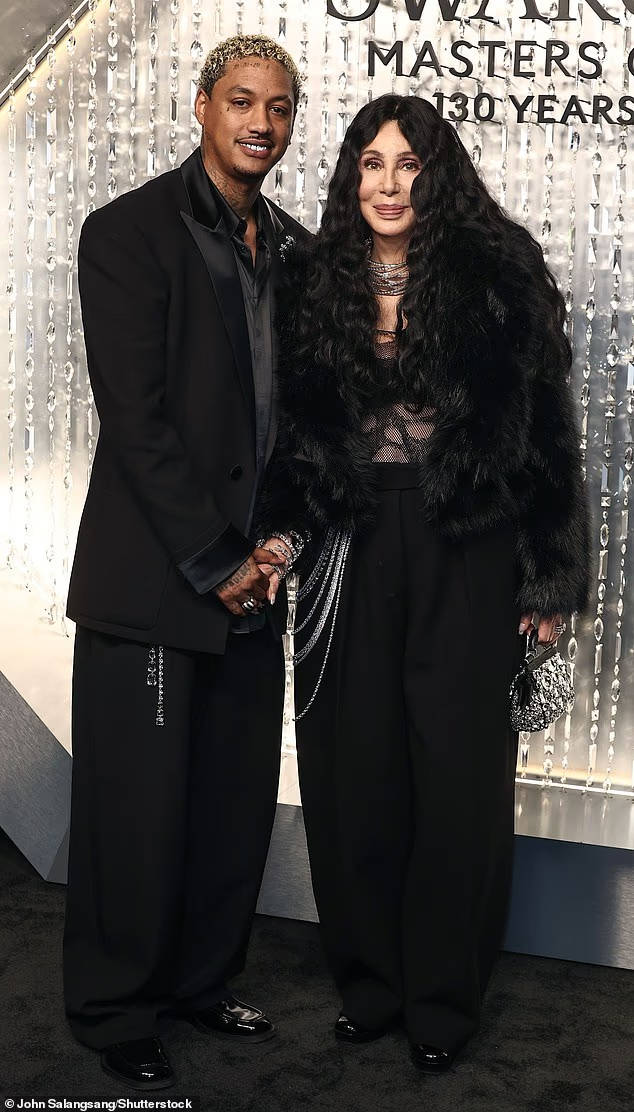
Cher attended the Swarovski Masters of Lighting Opening Celebration in Los Angeles with Alexander Edwards on 28 October. “On the day, Cher donned a black see-through bodysuit paired with a fur crop jacket and wide pants adorned with chain decorations on the sides, exuding her unique charisma. Her signature black wavy hair and glamorous jewelry highlighted her presence as the ‘ageless diva.'” (chosun.com)

Cher was also presented with a Bambi Legende Award in Germany on 13 November.

Cher was introduced around her iconic status and humanity. In her speech Cher said she was proud to be there and felt she had a special relationship with Germany, where people seemed to always been interested in her during her career’s low ebbs. She talked about her inability to save Billy the Elephant from the L.A. Zoo. She kept saying, “I’m just a singer; I can’t do anything.” But then after telling the successful Kavaan elephant story she ended with, “I’m not just a pretty face, am I?”

Movies

Someone reached out to me from Peru about the movie Suspect.

A man named Anthony told me he had recently watched the movie on VHS and “found it very entertaining,  full of suspense and interesting moments. For example, the scene in the library” and yes that scene was very delectable!

Anthony said he searched the internet for reviews and found my Cher Zine review “full of details and very interesting observations.”

He said he was “grateful to be able to read it and that there are unique opinions” and he hoped I could read the email “and feel grateful for filling the world with culture.”

I was indeed very grateful he reached out to me. Suspect is a bit underrated as it includes a very bookish character against Cher-type and I think she does a fine job in it alongside a young Liam Neeson.

More About Me

So my friend in San Francisco and I finished reading Healing The Child Within by Charles L. Whitfield (which Cher recommends in her book Forever Fit) and we started on the comparatively very large workbook.

Oy vey! It has been a shocking experience because when I started reading the book, it felt so dated, so 80s. My friend and I have read so many other self-help books between when this one was published and now. And it seemed very substance-abuse related, which was not my family history, (in my childhood anyway). But then it turns out the childhoods explored encapsulated many more kinds of dysfunction under “also ran” where I could find my little self. The book is full of tables and charts and I could see exactly where my therapy in Los Angeles stalled when I left to move to New Mexico. I never got to core issues! Or letting the feelings go!!

So I’ll be restarting therapy next year when my insurance is sorted out. My friend and I are now deep into documenting our true and public selves. Many surprising revelations for us, I must say.

I’ll be making an unexpected visit to Cleveland next weekend so I wasn’t going to finish putting up my Christmas trees. But then I did it anyway just to cheer myself up.


Forever Fitness of the Heart and Mind

Because I dug out Cher’s book Forever Fit recently for pasta sauce recipes, I decided to sit down last week to reread it. The last time I read it I was 21 years old (right when it came out) and I didn’t know nothin’ about nothin’ so I’m sure a lot of it (ok, all of it) went right over my head.

But I would like to say a few things about it now as it is probably the first really memoir-like thing Cher ever published outside of Sonny & Cher’s reality TV and video moments. And since it was at the end of her big movie spree, it has mostly stories about the 80s and where her head was at in the 80s, which I don’t want to get into yet because Cher hasn’t finished her “official” memoirs.

But I do want to talk about the book in context with all the other celebrity beauty books that came out in the 1980s. It was the golden-era of celebrity beauty self-help books and my St. Louis library shelves, Thornhill, were full of them.

Like the Susan Dey book we discussed last year,  I was really into celebrity guidebooks when I was a teen in the 1980s. I was seeking mentors for adulthood and I poured over the instructions. Took notes even because that’s completely nerdy. I tried out all the products, advice and exercises and loved every minute of it. I think this is why I loved the Cher informercials so much. It’s like a self-help beauty demonstration come to life.

These are the books I mostly remember, Christie Brinkley’s Outdoor Beauty and Fitness Book (which I just reordered for a song on Thrift Books), Revlon’s Art of Beauty, The Raquel Welch Total Beauty and Fitness Program and (I forgot these once iconic, now forgotten) The Beauty Principal and The Body Principal by Victoria Principal.

The whole trend started with Jane Fonda’s Workout Book (which I also had and followed lazily), which was a real phenomenon and started a whole high-impact aerobics craze which unintendedly is now requiring copious amounts of boomers and Gen-Xers to have knee and hip replacement surgeries. These were coffee-table sized books, some paperback, some hardback. Linda Evans had one. There was one by Joan Collins and Cheryl Tiegs. Vogue had a few.

Brinkley even has a new one out called Timeless Beauty. And yes, I’ve today purchased a used copy of that, too. These beauty books were also exercises (punny!) in biography as they always had long preambles and lots of personal stories. Jane Fonda talked about her journey through bulimia for example. Cher talks about her history with diet and exercise too and that sometimes leads into stories about food on movie sets or skin care under television lights.

I purchased Raquel Welch’s book and tried to learn yoga from it. And Cher is right in Forever Fit when she says you need to see video of people doing the poses and exercises (or see them live and in person). Exercise, as Cher says, is not a recipe. To that very point, I found the Welch’s book indecipherable. You couldn’t tell which pictures where poses that flowed into other pictures or how long you were supposed to hold poses. It was so impossible to follow it felt mystical. But she looked great anyway.

I don’t know how well Forever Fit did commercially when it came out in 1991 because it just wasn’t like those other large-sized celebrity beauty books with lots of pictures of Cher applying her own makeup and eating healthy things and especially exercising. That would come later in the 1990s with her two workout videos. It was novel-sized and had very few photos at all, and those are just publicity stills of Cher to start off each chapter.

I read now that reviews were mixed at the time. Some liked the book’s comprehensive approach but Cher was always a target for plastic surgery, which she addresses in the book,  and the ironic charge of inauthenticity, which has followed her all her career but has ultimately proven to be her core superpower and her kryptonite. She has always been unable to be anyone else but herself. So whatever.

More recent reviews call the book “old school” but that its advice stands the test of time….because it was based on science and not fads. For example, the book was already talking about the dangers of high-impact exercising.

But anyway, it’s so much more wordy than the other books were, which, at times, makes it feel like a slog when Robert Hass goes deep into body chemistry. Food science seems like frontier science, constantly evolving. So recent reviewers have noted some of the advice is dated. But the book wants you to understand food science so you won’t get caught up in the diet fads that come and go with eternal and predictable regularity. And for that, I think, the book has earned some lasting respect.

And as I’ve said earlier here, Cher never presents herself as the expert or guru. She always works alongside real experts who have helped her on her own journey.

So in some ways I found the impulse of this book more generous than the other beauty books (if also less fun) and less “be like me.” I had absolutely no way to be like the California sunshine of Christie Brinkley (who does that better?), even less than I had a way of becoming Cher. But I never had the sense Cher would want me to. In fact, the book implied being Cher wasn’t always a bed of roses.

It’s also interesting to me that there are no makeup tips in the book. None. Zero. And Cher has, since press for Burlesque, talked about her love of watching her mother and her mother’s friends put on makeup. In the memoir we find out she’s been doing her own makeup for much of her career and was as obsessed about it as makeup artist and friend Kevyn Aucoin. So that would maybe be something she would be an expert at, but we don’t get such tips from this book.

In any case, the impulse for this post isn’t about the beauty or exercise aspects of the book (which just reading it has gotten me once again off my bookish ass and onto my treadmill) or the biographical snapshots, both aspects that I want to delve into later sometime within a broader context.

What I really want to focus on now is how the book constantly makes connections between the mind and body. Cher constantly brings exercise back to her mental health, her situational and recurring anxiety and depression.

At the very end of the book, Cher starts talking about spirituality and trying to do one spiritual thing every day, how she does this with books, books-on-tape and meditations, all of which she brings with her on tour as part of her post-show, makeup-removing rituals. Talk of this bleeds into self-help and she gives a list of her self-help book recommendations:

  • Each Day a New Beginning: Daily Meditations for Women by Karen Casey (Hazelden Meditations)
  • Mediations for Women Who Do Too Much by by Anne Wilson Schaef (there’s now a journal version and one for men too by Jonathon Lazear with an introduction by Anne Wilson Schaef)
  • Healing the Child Within by Charles Whitfield (which, as Cher says, comes with a workbook)
  • The Road Less Traveled by Scott Peck (he’ll come back in again later)
  • Stranger in a Strange Land, the novel by Robert A. Heinlein (which I read in high school)
  • You Can Heal Your Life by Louise Hay
  • Love is Letting Go of Fear by Gerald G. Jampolsky
  • Codependent No More by Melody Beattie  (This was one book in my little, remaining self-help stack, one of the excellent transforming books recommended by my own L.A. therapist and years later I loaned my underlined copy to a colleague at IAIA in Santa Fe and her boyfriend ripped it apart in a violent rage of anti-self-help-books, she said, and so she couldn’t return it to me; and that was a few weeks before the historic 100-year restraining order of Santa Fe.)

So I decided to try one of these, Healing the Child Within, because Cher says this is one of the best books she’s ever read and because it comes with a workbook which is like luring nerd-crack under the nose of a scholar (Jane Fonda Workout Book had the same effect subliminally unfortunately). And I found both the book and workbook on Thrift Books for around 5 bucks each and talked a friend of mine yesterday, one who I do these kinds of self-help explorations with, into taking the journey with me.

But then….then the self-help paragraphs of Forever Fit metamorphize into Cher talking about beyond books and tapes and about therapy and how she once thought it was “a bunch of crap” and “horseshit.” But at a particularly bad time she reached out to the author Scott Peck (listed above) for a therapist recommendation. She was experiencing a build-up of medical, personal and career issues just “a few months” after winning her Oscar for Moonstruck. (You would imagine that being the most blissful time in a person’s life, endless months of basking in an Oscar win.)

Cher says she didn’t want a woman therapist because she thought they would not be smarter than she was and that you need a therapist who is smarter than you are (even if you have to try a few bad ones out first). She admits this was “unbelievably sexist and stupid” but “that was my experience” and the author Scott Peck ended up recommending someone, a woman, who ended up being just what Cher says she needed, someone who taught her a lot and uncovered things she had been suppressing.

I’ll end with Cher’s own amazing words:

“I was afraid of change for a long time. But as I changed, I found it more comfortable than I anticipated. And so it seemed more intelligent to keep changing. I was always really critical and demanding of myself and other people and got really angry when people didn’t do what I wanted. I learned they can’t always do what I want. The expectation is stupid and childish….I learned to observe without judging. I am now a much nicer person. Everybody comments on that now. I used to go through life completely tough on the outside and never reveal my insides to anyone. I always loved other people but I could also be curt and critical and showing love by criticizing.”

Cher says she felt it was her job to fix everything all the time because ever since she was 6 years old in her family unit, that was her job. “Everybody came to me with their problems.” And she would get overwhelmed and cranky.

I don’t know. I just thought it was really brave to say all that.

Oooh! Shortcuts!

Sonny’s Pollo Bono Recipe

So let me just say to begin that being a Cher fan is incredibly fun. One week I can be writing about doll outfits (I have another doozy of an eBay doll story coming up) or food recipes or beauty and fashion ideas or makeup-head toys or teen magazine advice columns or memoirs or music or movies or TV shows…or creative things fans do like making little wooden Bulto-like wooden carvings of Cher’s outfits. It’s a grab-bag of fun.

And lately, as I’ve been doing the Cher food stuff, (which is quite an amazing mashup of obsessions, to be honest), I’ve been thinking about who could possibly care about this stuff but Cher fans, and maybe even who cares among Cher fans really…about all this minutia. I mean, who is really out there taking this crazy journey with me? Is this just more and more internet self-absorption?

But then I get a letter. And I’m like oh my God. Yesterday I received this email below from someone who is not a Cher fan at all but found something I had posted.

I asked her if I could share her letter on my blog and she said yes. First let me say this story has echoes of Cher’s own story about her sister finding their mom’s beloved cheesecake recipe in a stack of papers after Georgia died. (I made that recipe a few weeks ago and it was a big smash. And, aside from Shoofly Pie, the only other pie I’ve ever made.)

“Hi Cher Scholar,

I stumbled across your website this evening while I was searching for an old recipe my mom used to make frequently while I was growing up. It was titled “Pollo Bono” in my mom’s hand-typed and laminated binder of recipes, which I always thought was a misspelling of “Pollo Buono”. However, searching the phrase “pollo buono” didn’t return any comparable dishes, so I tried a search inquiry using the original spelling.

Lo and behold, the first result was your site! Specifically, the page wherein you compiled some of Sonny Bono’s old recipes, with Pollo Bono being among them: https://www.cherscholar.com/sonny-bono-recipes/

It was just how I remember: lightly breaded chicken breast in an herby sauce, topped with tomato and onion that come to life under the broiler for a fantastic, rustic finish. I’m not sure how my mom had stumbled across the recipe all those years ago. It would have been the late 90s, possibly even earlier, when she added it to her regular recipe rotation. She was never one for magazines or pop culture, but I suppose it’s not unthinkable that at some point, she’d gotten her hands on that February 1990 issue of Woman’s Day Magazine mentioned on the page and found the recipe interesting enough to keep.

I had this dish at least once a month growing up, but the recipe was lost years ago amongst my parent’s divorce, a family fallout, and several moves. I’m now almost 30 and married to a home chef (for whom I thank my lucky stars everyday!) who has kindly agreed to recreate the recipe for me someday soon, though of course he insists on putting his own twist on it. Whether his version will measure up to my nostalgia remains to be seen!

In addition to sharing my fun discovery, I wanted to thank you for maintaining this site and keeping it free to the world. Accessible information archives are a rapidly deteriorating resource in the age of paywalls and internet regulation. Your efforts are commendable and very, very much appreciated!

Sincerely,
Kara from Pittsburgh”

I told her I was so happy this recipe was making its way in the world though and I asked her what other recipes her mom made.

“There were a couple of other Italian dishes in the rotation, like veal parmesan and lasagna, but my mom’s specialty has always been southern comfort cooking. She’d make a great chicken and dumplings dish that I’ve never been able to recreate.

I’m glad to leave the cooking to my husband most days, but I do wish from time to time that I could have those childhood favorites again. I’ve only been able to find a handful of the original recipes online. I’m really glad the Pollo Bono ended up being one of them!”


And speaking of food, I finished my exploration of the recipes in Forever Fit (with the second and last spaghetti sauce recipe) and I made the spicy shrimp fried rice in Cooking for Cher this week.

Things Are Percolating

Things are a bit crazy-making this fall. When I’m overwhelmed with projects, I tend to want to make lists, in this case all the things percolating at Cher Scholar. Everything’s coming along…if only in baby steps.

The Autobiographies

Soon I’ll finish out the 1970s with the two memoirs (Sonny’s and Cher’s). Then I’d like to go back to the food bios found in Forever Fit and Cooking for Cher. And then go back to the childhood, 1960s and 70s stories Cher gave us in The First Time. Rabbit Hole 1.

Food

I’ve been making a few more recipes from the Cher cookbooks:

Rabbit Hole 2. But I’m not going to make every recipe in the Cher cookbooks. I would like to finish out the pescatarian recipes in Cooking for Cher, like the Fiery Pepper Shrimp Fried Rice and the Shrimp Borracho recipes. In that cookbook, there’s also Georgia’s cornbread stuffing I’ll try this Thanksgiving. And I have one more spaghetti sauce recipe to try in Forever Fit.

Dolls

I don’t have much more to add to the Cher doll fashions breakdown (Rabbit Hole 3) except to say that it occurred to me this week that my fleet of Cher dolls have nicer clothes than I do.

Conceptualizing Cher

Rabbit Hole 4: Soon I’ll do a review of Anne Zaleski’s 2025 Cher book. I liked how she categorized Cher stuff. I’ll be organizing my own media studies notes for a long while for my own project. I’ve moved on from books about videos to fan theory to books on movies to camp and now I’m moving on to the books on pop-culture slumming (high vs. lowbrow) and then maybe I’ll organize the music or television stacks next. I like to do small category stacks first (low hanging fruit).

Along this vein, I’ve been watching Captain & Tennille variety shows on DVD, which is both illuminating (variety shows aren’t easy) and disturbing (that Daryl Dragon guy) and this has led to me purchasing Toni Tennille’s memoir from Thriftbooks to find out what was going on with that very un-Sonny & Cher-like musical couple.

And then Ben Stiller’s documentary on his parents Jerry Stiller and Ann Meara is coming out on AppleTV at the end of this month. This will be another fascinating look at the married showbiz couple.

If I had to put these three couples on a continuum concerning how best to navigate a backstage relationship within a married-couple showbiz act, it would be Captain & Tennille on one end and Stiller and Meara on the other, with Sonny & Cher somewhere in between.

Internet Cher Things (All the Things)

The big news from the last week was Cher’s appearance on 30 August 2025 to help her friend Cyndi Lauper finish out her farewell tour at the Hollywood Bowl. Unbeknownst to me, Lauper’s closing song for this tour, “Girls Just Wanna Have Fun,” was paired with a set inspired by one of her favorite artists (and mine), Yayoi Kusama.

And not in a million years would I have been able to even drum up a fantasy of a Cher/Kusama mashup. But there it was. And the news went nuts. A sampling:

Oh and Joni Mitchell was also there (!) and SZA, John Legend, Trombone Shorty and Jake Wesley Rogers.

Clips are going up and being taken down as we speak. Apparently the show is being turned into a TV special so stay tuned on that. Fans who were there say Cher said “I’ll see you soon” which they took to mean a new tour. But it could mean anything.

Anyway, I thought it would be a good time to do a news rollup of articles (old and current) I’ve come across over the last few years that have been stuck languishing in my phone’s browser tabs. I had over 200 tabs open as a kind of to-be-read-later list.  Now that I’ve culled out all the Cher articles and dead links (pages and even whole websites now gone), I’m down to 124.

Sigh. I categorized them.

Movies

Let’s start with this young YouTube film aficionado who does video reviews, in Cher’s case her whole oeuvre. Nora! has watched every Cher movie and talked about the experience, all of which is interesting. I mean just hearing how young Cher fans see Cher movies differently than we did in the theater. Also, Nora has interesting thoughts about even movies we don’t enjoy, like Faithful. Spoiler alert: she liked it. I equate this to my thoughts about the movie Suspect. Sometimes there’s a fan out there who sees something nobody else does.

Nora astutely notices (and why haven’t we?) how Good Times is basically Sonny’s movie with Cher appearing only as a minor character. (To answer her befuddlement about this: it’s because he pretty much wrote the thing.) Nora calls out Chastity for having a “nothing story” and “no real plot,” that it’s just basically “Cher walking around and pontificating” which pretty much sums up that movie. But she gives those films redeeming points for Cher fashion.

Nora comments on what an uphill climb it must have been for a pop icon to become a serious actress because “society doesn’t let women be complex and multi-faceted.” Truth.

She finds a “weird looming element of racism that is never explained” in Silkwood. I completely missed this (and can’t even locate it in memory) and so I will watch it again to see what I can see. She calls out Silkwood’s “extreme de-glamming effort” on Cher. She focuses on “the emotional stuff” in Cher’s performances and quotes the L.A. Times in noting Cher’s ability to reveal depths underneath. This is helpful for me when trying to figure out how to write about Cher in her movies, not being a film critic and all.

It’s interesting to see how a younger person scoffs at the whole Cher, Sarandon, Pfeiffer love-lines plot in The Witches of Eastwick (“how three queens fall for Nicholson”) . As Gen-X kids we did not do this. We remembered Jack Nicholson as a sexy younger man and I guess we just started to suspend belief as he aged. Huh. Likewise, the character played by Dennis Quaid in Suspect annoyed her in ways that were novel to me. His audacity. We focused on the improbable illegality of his behavior, but not his audacity with Cher.

It’s great to hear Nora enthuse about Cher’s “career-defining role” in Moonstruck and the balance she struck between comedy and emotion. She calls Cher’s ability to continue with parts after the age of 40 in the 1980s an “astonishing accomplishment.” She expresses surprise at the good reviews of Mermaids because it “seems like the kind of movie male critics love to hate on.” This I think speaks more to the increasingly misogynist manosphere Nora grew up around as opposed to male critics writing in the early 1990s. Asshole Male wasn’t such an institutionalized thing back then. (As Nora says earlier, “Lord, give me strength.”) She rightly notes the shifts in roles Cher gets after Mermaids, how Cher begins to play her own persona. And Nora is right to call the plot of Tea with Mussolini meandering but as a kind of memoir, maybe that was unavoidable. She ends the video in talking about Cher’s unique sense of agency in show business.

Nora also did some great research on Cher’s press at the time of her movie releases and I tracked down some of the articles she sourced and quotes from:

  1. Let the Oscar Sweepstakes Begin! Our Fearless Forecasters Predict Who Will Will, Say Who Really Should (Washington Post, 9 April 1988) – I’ve always said Cher is not as popular in Los Angeles (her hometown) as she is in New York. I take that knowledge just from having lived in both places and attended multiple Cher concerts in both places at different venues (including the Broadway musical). The difference in enthusiasm is palpable, my favorite NYC overheard quote being “That Cher! I just love her!” L.A. is, ironically, too snobby for Cher. This article explains, for one, how the best movies rarely win Oscars. It’s a great overview of how the Oscars really work behind the scenes. It also articulates why Cher always gets snubbed by L.A. (and double the irony, she didn’t this particular year): “But, again, the overwhelming grass-roots response to “Moonstruck” — and Cher’s own fairly heavy media barrage — has all but eclipsed the early positive feeling for Hunter. Also, with “The Witches of Eastwick,” “Suspect” and “Moonstruck,” this is thought to be Cher’s year — especially since she was snubbed in 1985 (remember the Spider Woman dress?), when she was left off the list for Mask. Speaking of that dress, the only possible fly in the ointment here is that Hollywood is not really crazy about Cher. Yes, they think she has talent (finally). Yes, they respect her drive and determination to break through as an actress. But the sentiment is that she is too independent, too outspoken, too, well, tacky. They’d much rather give the award to Meryl Streep or Glenn Close, because even if they’re playing bums or psychos, those perpetual Oscar-baiters still have class, taste and legitimate acting credentials — all the things that appeal to Oscar’s sense of snobbery. And all things that Cher gloriously lacks.” And all which seems very rock and roll to me but oh wait…she’s usually snubbed there too.
  2. The Cher Conundrum: The Oscar Winner/Pop Diva/Exercise Goddess Talks About Acting, Relationships, Being Fortysomething and Other Serious Stuff” (Los Angeles Times, 3 November 1991) – This is a great article to follow the preceding because it further underscores how Cher is treated in L.A. by reporters who are just not that impressed. This is a particularly tough interview that pushes back on almost everything Cher says particularly about why she isn’t making more movies, and the conclusion of the piece seems to be that it’s due to a perfect storm between parts Cher turned down, difficulty with a few directors (Mask, Suspect and Mermaids), the infomercials (which historically have taken the most heat on this issue), and the fact that Cher just didn’t love the process of making movies. The interview then gets into comments about difficulties Cher was having with her mother (Georgia situations which occasionally used to show up in interviews but surprisingly were all but missing from the memoir last year). The article also misspells the name Sonny. Oy.
  3. “Cher: ‘Women have always been sex objects and always will be’” (The Guardian, 7 November 2013) – I struggled on whether to put this in movies or music because it talks about the Closer to the Truth album and the legacy of “Believe” but also about the movie Burlesque. And it even occurred to me to consider what she was wearing for the interview: sweats or jeans (movie interview) or leather jacket, fishnets, tiny skirt and biker boots (music interview). But that felt reductive. And the comments about Burlesque were what Nora was referring to in her review.
    More movie articles from my phone:
  4. 10 Powerful Movie Quotes That Deserve More Recognition” (Screen Rant, 17 August 2025) – and the quote discussed is “Everything Is Temporary. That Don’t Excuse Nothin’.”
  5. The best singers turned actors of all time” (The Week, date unknown) – The article doesn’t really say why. Just that these people have skills in both areas. And that this is rare.
  6. Cher rejected Eric Roth’s biopic script” (Film Stories, 1 March 2024) – More news than scholarship but hey, it was hanging out in my phone. All I will add is that there are music stars and there are film stars and then there are films about music and film stars.
  7. 7 Things You Didn’t Know About ‘Mask,’ Cher’s 1985 Breakthrough Film” (Remind, The Home of Nostalgia, 8 March 2025) – and yeah there were some things in the article I did not know.
  8. Guardian writers on their ultimate feelgood movies” (The Guardian, 22 July 2025) – In a list that begins with Big Night, Rushmore and Amélie, I assumed Cher’s title would be Moonstruck would be the listed movie and was painfully wrong on that assumption. Here’s the link to the article’s full review of Burlesque by Guy Lodge where he agrees was a “less-than-seminal 2010 musical…a film with precisely zero complexities to unparcel, that exerts a strangely forceful hold on me just the same.” Also of note is the inclusion in this list of The Towering Inferno, which sticks in my mind because in Sonny’s book he talks about taking Raquel Welch to that movie on a date (after they met at a Christmas party hosted by Cher) and that they both agreed to leave early because they thought it was a terrible movie.
  9. While I was putting this together, I found another good one: “Cher movies: 15 greatest films ranked worst to best” (Gold Derby, 17 May 2025) – they get the top four right.

Music

  1. Dark Lady by Cher Dollmation (2022) – very cool dollcreation.
  2. Texas judge blocks Ten Commandments in public schools with epic ruling that quotes Sonny & Cher, Kurt Vonnegut and Billy Graham” (The Independent, 20 August 2025) – Wow.
  3. Top 10 Sonny & Cher Songs” (Classic Rock History, 2020) – top 4 are good. “It’s the Little Things” should be higher. A few factual errors.
  4. Top 10 Cher Songs of All Time” (Classic Rock History, 2025) – Odd list. I don’t even think #10 is Cher’s best Diane Warren Cher song (the subject matter was already handled better by Elvis Costello, for one). “Take Me Home” at the top but no “Gypsies, Tramps & Thieves” or “Bang Bang”? Tsk tsk.
  5. Cher’s 30 Greatest Songs–Ranked!” (The Guardian, 18 October 2018) – a good interesting list that goes through all the years and all the things and puts “Gypsies” up on top.
  6. Cher’s 10 greatest songs ever, ranked” (Smooth Radio, 20 May  2025) – while I was compiling this list I found another song list.
  7. The 150 Greatest Albums Made by Women, Shocking Omissions: The Resilient Reinvention of ‘Gypsys, Tramps & Thieves” (NPR, 20 September 2017) – the album “was written to showcase and cultivate her signature contralto and the title track became her first No. 1 hit on Billboard Hot 100” (as a solo artist). “It even scored her a Grammy nomination for Best Pop Vocal Performance” (losing to Carol King’s Tapestry). The song “presented a darker, more powerful Cher, whose strength lies in her embodiment of the character.” Even Cher’s dislike of the song does not deter this writer (Désiré Moses), who said, “that’s exactly the sentiment that makes Cher, well, Cher.” Right! We’re under no obligation to agree.
  8. It Has Stood the Test of Time: 1971, The Greatest Year in Music” (The Guardian, 22 May 2021) – Cher’s album or song is not in this article but it’s a good one to read after #7 above because it was one of those unforgettable songs of 1971.
  9. In Praise of Cher, the Self-Proclaimed Betty White of Rock and Roll” (Salon, 29 May 2021) – This one is by Annie Zaleski, the same rock journalist who did the write up for Cher’s Rock and Roll Hall of Fame inductee program essay and this year’s picture bio, I Got You Babe, A Celebration of Cher (which I still need to blog about). Great writing as always, “Although Cher is often viewed through the lens of a comeback narrative — among other things, she had to extricate herself from a bad business relationship with her late ex-husband, Sonny Bono, as well as climb back from solo career nadirs — this has softened into her being positioned as a beacon of resiliency.”
  10. The Number Ones: Cher’s ‘Believe’” (Sterogum, 4 July 2022) – “Less than a minute into her improbable comeback smash, Cher shatters. The moment happens when she sings the line ‘I can’t break through.’ On the word “can’t,” Cher’s voice atomizes, breaking into a billion tiny little shards, before coming back together. She sounds like a glitching-out robot, or like a kid singing into a fan. All throughout ‘Believe,’ her first #1 hit in a quarter-century, it keeps happening. Cher’s voice falls to pieces, and then it resolves.”
  11. Cher’s secret pop history: The massive hits pop icon sang backing vocals on” (Gold Radio, 13 August 2025)
  12. Cher Sells Range of Music Assets to Irving Azoff’s Iconic Artists Group” (Music Business Worldwide. 2 August 2023) – “Cher is the fifth-ranked female artist with the most Billboard US Hot 100 charted singles….Cher is one of the world’s best-selling music artists. Launching her career in the 1960s as part of Sonny & Cher, the superstar made unprecedented strides in what had long been a male-dominated industry. Cher has sold more than 100 million records. Her three-year 325-show world Farewell Tour from 2003 to 2005 played to more than three million fans and became the most successful tour ever by any female artist.”
  13. Cher On Making Her First Holiday Record” (Billboard, 6 October 2023)
  14. Cher Talks New Christmas Album” (People, 11 October 2023)
  15. Cher, 77, on her six-decade career: ‘I’m some sort of freak’” (New York Post, 20 October 2023) – NYC loves Cher. “…when it comes to taking on Mariah Carey for Christmas queendom: ‘I’m not gonna take over that spot,’ she said. ‘I’m kind of out of my league there.'”
  16. Cher’s Macy’s Thanksgiving Day Parade Performance Interrupted” (Entertainment Weekly, 23 November 2023)
  17. Cher Scores No. 1 Song on a Billboard Chart in Seventh Decade” (Billboard, 30 November 2023) – This article is in my phone because I sent it to my brother last week after my sister-in-law sent me a Cher drawing from the Canfield Ohio Fair and I asked what the art category was and my brother said “has-beens.”
  18. Cher’s Christmas Album Tops the Charts” (NPR, 4 December 2023)
  19. Cher is Heading to the Metaverse with ‘Christmas’ Roblox Event” (Billboard, 8 December 2023)
  20. 25 Years Ago, Cher Released a Song That Would Change the Sound of Pop Music” (NPR, 19 October 2023)
  21. Should Cher Have Cancelled Her own ‘Offensive’ Song?” (The Telegraph, 5 September 2024)
  22. Rock Hall Inductee Exhibit: From Cher’s glamour to Frampton’s guitar” (Axios Cleveland, 11 October 2024)
  23. Cher facts: Songs, age, films, husbands and children of the Goddess of Pop” (Gold Radio, 23 October 2024)
  24. Miley Cyrus’ Bright, Effervescent Cover of Cher’s “Believe” Is Vocal Nirvana” (NBC, 21 October 2024)
  25. Decades Before Kellyoke, Cher Covered a Dazzling Range of Songs on Her Weekly Show” (Billboard, 30 September 2024)
  26. Cher Returns Half Of Her Career Hits To The Same Billboard Chart” (Forbes, 27 November 2024)
  27. The One Song Cher Couldn’t Live Without” (Far Out, 18 January 2025)
  28. I’m Not a Cher Fan:  why Cher desperately wanted to be like the Eagles” (Far Out, 9 February 2025)
  29. My own Cher interview with Robrt Pela on KJZZ (NPR Phoenix) – of course I kept this in my phone.

Concerts & Stage

  1. Michael Keaton’s disastrous stint as Cher’s opening act: ‘It was death‘” (Far Out, 10 November 2024) – this was interesting.
  2. Cher and share alike: three actors star as the singer in musical that turns back time” (The Guardian, 20 April 2022) – review of the UK musical…still in my phone. There’s an interesting video in the article about the creative team for the show.

Style and Beauty

  1. Cher at Home: The Goddess of Pop’s Domestic Life in 22 Photos” (Architectural Digest, 15 August 2025) – I had this bookmarked twice. The first version of the article was only 15 photos apparently.
  2. Inside Cher’s Stunning Malibu Mansion” (Show Biz Cheat Sheet, 5 January 2022) – “Every day when I wake up and look out my bedroom window I’m never not amazed.”
  3. Sonny & Cher’s former home rentable from Airbnb for allegedly around $600 a night.
  4. Cher’s 31 Most Iconic Looks of the ’70s, From Dazzling Dresses to Bold Bodysuits” (InStyle, 26 June 2025) – There’s a 1960s outfit in the list and at least one from the 1980s. Sigh.
  5. Cher’s 10 Best Looks of All Time, Hand-Picked by Bob Mackie” (Variety, 20 May 2021) – Too bad we didn’t see that unicorn outfit. And interesting he puts in the duct tape TBT-fit in his list considering…
  6. Designer Bob Mackie Didn’t Want Anyone to Know He ‘Had Anything to Do’ With Cher’s Iconic Bodysuit” (US Weekly, 26 January 2025)
  7. Cher and Bob Mackie on Over 60 Years of Iconic Looks” (Harper’s Bazaar, 11 October 2024) –  “For the past six decades, Cher has been living in our collective minds rent-free.”
  8. Turn Back Time Like Cher with Her 5 Beauty Secrets” (Women’s Health, 26 June 2021) – There’s a sign-in wall. I never did see the five secrets.
  9. Cher’s Take on The French Manicure Features a Glitzy Detail” (Marie Claire, 25 October 2023)
  10. 77-Year-Old Cher Has Eaten Like a Blue Zoner for 30 Years. Is That Her Secret?” (VegNews, 26 September 2023)
  11. Bryan Adams photographs Cher, Grimes and Iggy Pop for Pirelli calendar” (The Guardian, 5 August 2021) – Remember that happened??
  12. Cher is Inducted Into the Rock & Roll Hall of Fame in Leather Platforms at the 2024 Rock & Roll Hall Of Fame Induction Ceremony” (Yahoo! Entertainment, 19 October 2024) – There were plenty of seen-in-that-outfit news stories in the last few years, but this is the only one I left in my phone.
  13. Cara Delevingne, Cher and Jodie Turner-Smith Celebrate Burberry Flagship Reopening” (Variety, 23 October 2024)

Food

  1. Cher’s Mom’s Cheesecake Is Impressively Easy” (Parade, 2 December 2023) – but this review links to a non-existent Allrecipes page. Even allrecipe’s own article about it has vanished. But another site has archived it so…. I’ll be blogging about this later after I make it for the Cher food page. Another mention I just found, “The Heartwarming Story Behind Cher’s Favorite Cheesecake Recipe” (Mashed, 26 November 2023)

News & Tabloid 

  1. Cher Mourns Ex Husband Gregg Allman” (Rolling Stone. 27 May 2017) – Yup. still open in my phone.
  2. Queen Elizabeth Death: Cher Appears to Refer to the Queen as a Cow” (All over the press, 9 September 2022) – Well, they are little emojis and hard to see clearly for the elderly. I’m sure there is someone in the colonial world who was calling the Queen a cow; it just wasn’t Cher. Cher’s rebuttal.
  3. Cher Posts Thirsty New Pic of New 30-year-old Boyfriend and…whoa” (Queerty, 24 November 2022)
  4. Cher Relists Iconic Malibu Mansion with a $10 Million Price Cut for $75 Million” (People, 4 April 2023), A.D. version (21 March 2023) – Why does this house keep going on and off the market?
  5. Cher Opens Up About Her New Cherlato Business: ‘It Was A Labor Of Love’ “- Remember Cherlato, the new perfume(s), Sanctuary, Aquasentials? You gotta take advantage of these Cher ventures when they come up because they disappear fast. (I have a few regrets.)
  6. Cher “Only” Averaged $6 Million Per Year Throughout Her Career, But It All Adds Up” (The Things, 24 September 2023) – Only? wtf.
  7. Celebrities Partying in the ’70s: Photos” (Esquire, 10 January 2023) – I’m sorry, any list of 1970s debauchery that excludes a photo of Margaux Hemingway (particularly at Studio 54) just isn’t worth its margarita salt. This exact photo below was indelibly etched into my childhood imagination forever as illustrating precisely what 1970s debauchery was…the drink between the legs, the facial expression…
    Whenever I try to pose debauchery, as unconvincing as it is (and this is one of my favorite Mary Tyler Moore Show quotes that I can relate to: “I might not have been around, but I’ve been nearby“), this is the pose I attempt.
  8. Cher hired men to kidnap troubled son Elijah Blue Allman from NY hotel as he tried to save marriage” (New York Post, 26 September 2023) – Only the family knows about all the things in this story but Cher being vindicated this summer is not so happy news.
  9. Cher’s son Elijah Blue Allman responds to conservatorship filing: ‘I am well, and able’” (NBC Los Angeles, 29 December 2023)
  10. See Photos of Cher with Her Sons Chaz Bono and Elijah Blue Allman Through the Years” (People, 28 December 2023) – Some sites tried to focus on the positive aspects in their capitalizing on that story.
  11. Cher Says She’s Living ‘in the Moment’ with Boyfriend: ‘It’s Never Too Late’ to Find Love” (People, 11 October 2023)
  12. While looking for the link above, I found this one: “Cher Says Younger Boyfriend Alexander ‘A.E.’ Edwards Doesn’t Get ‘Most of My References’” (People, 24 October 2023)
  13. Cher, Who Turns 78 Today, Says She’ll Celebrate By “Putting My Pillow Over My Head and Screaming”” (Marie Claire, 20 May 2024)
  14. Kevin Costner Sits Next to Cher at SNL50 After His Epic Reaction to Her Recent Performance at Radio City Music Hall” (People, 16 February 2025) – Kevin Costner sits next to Cher…and it’s news.

Two takeaways here. One, there are many more news stories out there than any one mere Cher scholar could keep up with.

And two, the categories of this list are a good study itself in demarking the areas of Cher’s cultural influence (in real time surfing the Internet). And the spread of articles across each category is telling in where the most interest seems to rest.

Although I would correct that in saying the articles in the movie section are the most laudatory, so even though that category is small in number the section is still pretty packed with cultural value.

Memoir vs. Memoir Part 2: the 1960s

This is the second blog post where we compare Sonny and Cher’s respective memoirs, And the Beat Goes On and Cher, The Memoir (parts one out now). In Part 1 we looked at how the books were organized and how they each talked about family history and childhood.

Now we’ll look at their lives together in the 1960s. Fair warning, this is going to be looong. Often when I start a blog I think, should this be an official Cher Scholar page or a blog? For instance, this is too long for a blog post but it also doesn’t rise to the level of a permanent page.

Oh crap. It’s even longer now.

Let’s get starting. First, reading these books side-by-side really shows the unusual complexity of this relationship. The second read, I feel Sonny is not as cold and calculating as I remember (although he is often factually wrong and rationalizing). He does some mea-culpas, especially when he’s about to tell a story where he’s going to look bad or sexist. These two disagree on many more “facts” than I thought they would and not over things you’d assume (like fights) but over who enjoyed what and when things even happened, like big important things, like their legal wedding.

I had to remind myself Cher is remembering her life back from the age of 77 in 2024 and Sonny, with the help of a diary, was remembering back from the age of 56 in 1991. Some of the disagreements are solely between them. We’ll never know what the true answer is if there even was one (what they said to each other in private moments). Then there are the disagreements maybe colleagues or family could resolve. And then there are those discrepancies anyone could have easily be researched and verified (like the name on a record label). Those are the most mind-boggling disagreements.

But it’s fascinating to me that for the most part they tell the same stories, they both think the same stories are important and life-defining but maybe they each remember different details about it. Aside from that it is interesting to note which crucial stories each one leaves out of their timelines (Cher doesn’t tell the “Laugh At Me” story and Sonny doesn’t say a word yet about Carol Kaye’s famous bass line).

We have to remember these are two separate people living separate but intertwined lives. Sonny is not perfect (and is often unlikable in Cher’s book and Cher is often unlikable in Sonny’s tale) but neither of them ever rise to the level of a big, bad villain.

The pages  dealing with how Sonny and Cher met up through the end of the 1960s were pages 57 to 178 in Sonny’s paperback book and pages 124-240 in Cher’s hardback book.

The Meet Cute
Sonny describes their “meet cute” with those words, like it was a RomCom. I was shocked by this. I only just learned the term “meet cute” from Substack and here Sonny was using it back in 1991! And then Cher uses the very same term in her memoir. Where the hell have I been?

It was November of 1962 and Sonny says they met at Aldos, “an Italian restaurant.” Cher correctly identifies it as a coffee shop above a radio station. It was Cher, Red and Melissa as a group meeting Sonny.

Sonny describes Cher as “gorgeous” and Cher comments on Sonny’s “amazing smile,” his beautiful hands and that he was wearing a black mohair suit and a mustard shirt with a white collar and cuban boots. Sonny thinks Cher had “character” but was “unreadable.”

They both mention Cher’s comment about Cher admiring Sonny’s wearing “black on black” but in Sonny’s version, Cher says this at the coffee shop and in Cher’s version she tells this to Sonny later when they go dancing.

Cher remembers that they went to the Red Velvet Club right after meeting at the coffeeshop and that Sonny was more interested in Cher’s friend Melissa (who was actually gay they both tell us). But in Sonny’s version they all four went to Club 86 (a lesbian club) the next night and it was Melissa and Cher poking fun of the boys by taking them there.

Their Past Histories
Sonny says Cher had been working at See’s Candy Store. Cher correctly identifies his first pseudonym as Don Christy (the pseudonym he muffed in his own history).

Sonny’s Apartment
“It wasn’t long” (Cher), three weeks (Sonny) before they ran into each other again when Cher spotted Sonny moving in to his apartment at the “sprawling complex” (Sonny) at Franklin and Vine in Los Angles. They both tell a story about looking through the windows of their respective apartments and seeing each other. After hearing about Cher’s living situation woes, Sonny offers to let her move in with him. “No funny business” (according to Sonny) but Cher has Sonny saying, “I don’t find you particularly attractive.” Sonny doesn’t mention this. He insists that front the beginning he felt something for Cher. He says she was gorgeous, “flawless except for a big nose, which I thought gave her character, something perfect-looking women lack,” and that she was statuesque, coquettish, alluring, streetwise, had an “intoxicating aura,” magnetism and “incredible strength” and that he was “already deeply smitten.”(Lots of good adjectives there.)

Sonny talks about Cher’s chronic fears how she needed to have a TV on all night to sleep and how hard it was for him to plug the TV into the bedroom for her because there was no outlet. Cher mentions needing the TV on all night too and that she was full of phobias, one being that she was afraid of silence. Cher says their relationship was like brother and sister/father and daughter at first.

Cher tells the bathing-suit story, that Sonny’s face was “crestfallen” when he saw her shape and then says, “my kind of body wasn’t in style yet.”  “God, you’re skinny,” she remembers him saying. Sonny mentions nothing about this or the other women he was dating while Cher first lived with him.

They both tell the story that Cher lied about her age and said she was 18 and then 17 but was really 16.

Georgia
I think where the memoirs probably differ the most is in their depiction of Cher’s parents, John and Georgia.

I don’t know if Sonny was too hard on Georgia or if Cher glossed over a lot. Cher admits her mother once bought her new clothes and then returned them in a fit of anger and Sonny tells this story as one of the stories about how Georgia was a less than great mom. Sonny describes her as a “pretty party girl” who “measured success by men and cars” and was very competitive with Cher. Cher glossed over their periods of not-talking or Georgia not talking to Cher as things she just can’t remember.

Although allegedly Sonny and Georgia got along off and on (even after the divorce), Sonny does not have much nice to say about Georgia. And his comments are mostly in defense of Cher. It’s possible he was upset with Georgia again when he was writing his memoirs. But you also get the sense that Cher has left a bit of drama out of hers. By her own admission, she could go long periods without speaking to her mother and this was all really vague in her memoir.

Of Georgia Sonny says, “she defined the phrase ‘a real piece of work.’” He admits she was “striking” and “beautiful” and had the attitude of a star.

He pulls no punches: “Motherhood wasn’t high on Georgia’s list of priorities. She liked men, parties, fast cars, and fancy restaurants. She preferred the high life. That she had a daughter, Cher, who turned heads on her own was almost too much for her to handle. There was room for only one beautiful woman in her life—Georgia. That explains the volatility of her and Cher’s relationship. It explains why Cher was so rebellious and anxious to get out of her mom’s house that she dropped out of school after the tenth grade and set out on her own. It was a long time before I heard Cher say anything nice about her mother.”

Wow. Cher doesn’t really take it to the level of volatility.

Another thing completely different is that Sonny says Cher’s biological dad worked for them when they were on the road as road manager. I vaguely remember a story Cher told about her Dad working with them and then trying to sell pictures of himself with Cher and Chastity to the press to support his drug habit and this is how Cher became estranged from him yet again. Sonny says her father died with him and Cher died not talking. Cher says nothing about this. Her comments about John Sarkisian are not terrible but not particularly fatherly either. More bemused and annoyed. She might mention his death and those later-day circumstances in her next memoir, when he dies.

Early Love
Sonny says their relationship was all a tease for the first few months until a kiss on the couch occurred after a conversation about Cher’s lesbian friend, Melissa. Cher doesn’t mention this, but recounts a significant kiss with him after seeing the movie The Balcony. This was after their forced separation by Georgia. They both tell this story of Georgia trying to separate them. Cher says it wasn’t until she was whisked off to Arkansas that Sonny began to have feelings for her.

At first, they slept in twin beds. How Sonny could have been such a ladies man with twin beds, I’ll never understand. But anyway, Cher says she would get scared and was allowed to crawl in bed with Sonny but he would say, “Don’t bother me.” Sonny says he didn’t “make a move” until one night he got into her twin bed.

They both agree this early time was some of their fondest memories of the relationship. Sonny recounts it as “two lost kids found direction in each other” and says somewhat poetically, “I wanted to be the boy who walked the fence to impress the girl. And Cher believed I could do that.”

Cher tells stories of doing art projects with Sonny and acting like kids.

Sonny mentions that their relationship was not very physical or sexual, but he keeps getting Cher pregnant somehow. The both talk about the pain of three early miscarriages which began before they started recording together. Cher admits she “went into herself” after those miscarriages. Sonny says they was hard on him, too, and because they couldn’t talk through it, Cher being so withdrawn. They both wanted to have children together. The first miscarriage was particularly heartbreaking for them and scary. During a later miscarriage, Cher says she was out shopping with her friend Joey when problems started and that she had the miscarriage in their bathroom. Sonny was at a Mohamad Ali fight that night, Cher says, and she spent the next day in the hospital. Cher doesn’t mention a concert date in Minneapolis that Sonny was obligated to perform without her or, according to Sonny, the promoter would sue. Sonny tells the story and how horrible he felt about it. “Shitty” he says. Cher said each miscarriage was worse than the last and she dreaded talking to her friends about them, seeming to support Sonny’s theory that she withdraws when in pain.

They both talk about their non-legally-binding bathroom wedding. Cher says their rings were from a souvenir shop on Olivera Street. Sonny says they were from and Indian souvenir shop at Sunset and Vine.

Sonny describes Cher as often very withdrawn and elusive. He says she would go into a “black hole” for days. But also that she was smart instinctually, just lacked education, poise and confidence. He says her only job had been at the candy store. (He either forgets or doesn’t know about Robinson’s department store.) He says she didn’t become the independent, “who gives a damn” woman until after their divorce, after she continued to work on herself. But then Cher calls Sonny the most private person she’s ever known. “He hid so much of himself.” Cher says that after the very beginning, “he never asked much about me.” She feels he became less and less interested in her as a person and that she started to feel like a shadow. Sonny said Cher was “a tough read”, “impossible to read,” that there was a pattern of her not wanting to talk to him. He says Cher had “the grace, mystery and independence of an ally cat.”

They both agree Cher could dance. Cher says Sonny got jealous of the fact she was a better dancer and didn’t let her go out dancing anymore. Sonny says, “people were always paying compliments to Cher about her dancing.” Sonny admits he was insecure.

Cher remembers every house they lived in, the style and sometimes décor (and sometimes about Sonny’s decorating skills). Sonny mentions a few, but not each one.

Hero Worship
Cher admits she stared to hero worship Sonny but the feeling wasn’t mutual. Sonny says “there was no question that Cher had stars in her eyes, [about Sonny] but for the life of me, I didn’t know what she had in her head.”

Christy Bono
Cher contends that Sonny was a great Dad with Christy and that she visited once in a while and they would all hang out together. Sonny laments often in his book that he was not a good Dad with Christy and that he didn’t give her enough of his time. He says this over and over again.

Specialty Records
They both tell a story or two about Little Richard and the day Sonny brought home the Cadillac. They both mention the crappy Chevy Manza Sonny was driving. Sonny talks about creating the song “Needles and Pins” with Jack Nitzsche and having Jackie DeShannon and The Searchers record it.

Working With Phil Spector
They both have a “working with Phil Spector” section. Cher says he wasn’t “unstable yet” but alternatively moody and funny. “You had to read the room,” Cher says and that if he was mad he would act like he didn’t know you. Sonny confirms this (in his story about the end of their working relationship). Cher says she could give as well as she got with Phil Spector and that this could irritate Sonny (who was the only one of them who was officially employed there). Cher claims Spector told Sonny that she “was funny and showed spirit.” In Sonny’s version, Spector and Cher had “no chemistry” and that Spector was jealous of Sonny’s relationship with Cher.

Sonny starts his Spector session by saying he wanted Spector to produce Cher. “I was convinced that this skinny teenage girl with bad skin, a big nose and an unusually deep voice was star material.” Is he being ironic? No, I think he’s serious. But what happened to “gorgeous”? Sonny spent more time with Spector than Cher did.  Whenever Spector was lonely, it seems he would call Sonny to hang with him in silence. And Sonny alludes to “dark and troubled thoughts,” a “troubled mind,” “odd behavior” and “an explosive temper.”

Sonny says Phil Spector called him his “funk.” Cher says Spector never considered Sonny much of a singer and called “Cher, Sonny, Gracia, Fanita and Darlene” collectively his “funk element.” Who is right here? Maybe Darlene Love could weigh in on this one. I have a feeling I know what she’s gonna say.

Speaking of which, Sonny and Cher both agree that the only person Phil Spector took crap from was Darlene Love, who Sonny says had “the balls of a buffalo.” But only Sonny talks about how racist Phil Spector was to his own wife Ronnie Spector, the reported separate toilets and dinnerware he made her use at home and how he locked her in her bedroom for days. Sonny says in public he lavished her with attention but not in private.

They both tell the same story about leaving for a hamburger one day without Spector’s permission but in Cher’s story Sonny wasn’t with them and was just as angry when they returned. In Sonny’s version, he took the girls and it was Spector who was furious.

Sonny mentions the Wrecking Crew but not by that name (the documentary which coined the term hadn’t come out for decades yet) but Cher calls them that.

They both talk about recording “You’ve Lost that Loving Feeling” (Cher calls it a “once in a lifetime song.” and the time Leon Russell came in drunk and belligerent which was a showstopper at the time because he was normally so quiet and shy.

Early Sonny & Cher
They both agree that Cher was terrified to sing alone. Sonny says she would cry if asked to do a solo and would wilt (his word) when asked to sing. Cher doesn’t dispute this. She says her voice would get locked up from stage fright.

The both tell the story of Sonny finding Sonny’s cheap, broken piano. Cher has him finding it at a pawnshop for $85 and “I still have that ugly thing.” Sonny talks about a $100 pawnshop diamond ring he found for Cher but not a piano at a pawnshop. Sonny says the $50 piano came from a used furniture store. But then Sonny says it was the “85-dollar piano” when he introduces the song “I Got You Babe” on both of their Live albums.

One: “7 years ago they had three things: an $85 dollar piano, a philosophy and each other.”

Two: This is in 1973 and by this time they are separated but not divorced. They are still working on the TV variety show together and are publicly together but they are living in separate wings of The Big House. In this second intro, it’s “ten years ago” and now they had a brass bed Sonny mentions (from a junk store or a drug store). Cher talks about this bed in her memoir.  It was from an A-frame house they rented on Sycamore Trail behind the Hollywood Bowl. The shower leaked and the rug “was kind of hatchet,” Cher says. The bed was from a secondhand store and they thought at first it was an iron bed. But it was just filthy and when they started cleaning it together Sonny said, “Cher, I think this is brass!”

“Excited, we ran out and bought about twenty boxes of steel wool Brillo pads, scrubbing it all night long until it was gleaming. That damn bed was brass and it was beautiful.” Sonny probably invokes it here to remind Cher of the talismanic power of this lucky object  and the excitement of their early romance.

Cher says Phil Spector didn’t think Cher had a commercial voice. She said Sonny liked the movie Cleopatra and decided on their first moniker should be Caesar and Cleo. Sonny agrees with this story. Cher said she cut his hair into that Caesar style. She said Sonny learned from Spector that b-sides should be instrumental numbers with silly titles so as not to detract from the a-side. And that Sonny inserted the “corny dialogue” in their version of “Love Is Strange.” The b-side was “String Fever” by S. Christy. Arranged by Jack Nietzsche. Sonny talks about recording “The Letter” (which Sonny says “bombed…our families didn’t even buy it”) and “Love is Strange” with Harold Battiste arranging. This was late 1963, Sonny says ashe talks about the “bare-bones” record making he learned from Spector. They both talk a bit about Sonny’s friendship with Jack Nietzsche.

Cher talks about their early gigs on the “DJ circuit” at rolling rinks and bowling alleys looking like Dick and Dee Dee or April and Nino. Very clean cut. Sonny is more specific: their first gig was a roller rink; their second was a bowling alley; there was no third gig.

They both agree Sonny wasn’t a genius songwriter but Sonny wrings his hands over this more than Cher does. Sonny goes into his feelings of imposter syndrome, mostly because he was surrounded by geniuses like Jack Nietzsche, Leon Russell, Brian Wilson and Phil Spector. Plus Bob Dylan and the Beatles were everywhere. In Cher’s memoir she talks about how even so, Sonny could make it happen and that was one of his superpowers in a way. Sonny says he had heard once that Cher said his songs “sound like shit until they’re unraveled” and that he often had trouble communicating his songs to Cher and others.

Cher said her early stage fright was torture. They both talk about her locked voice and resistance to walking on stage.

Sonny is definitely smarting from Cher’s later charge in portraying him as a “controlling Svengali.” In Cher’s defense, I actually think that part comes later in their relationship. Sonny feels Cher always portrays herself as the victim. By the way, Cher took great pains not to do this in her memoir. And Sonny talks about all the pressure he was under to launch their careers, although he admits Cher never complained about anything. He could just sense it, she had big goals. They both agree Cher was happy to let Sonny “chart their course.” And Cher looks back and can sympathize with his moods and stress levels during times they were struggling. They both agree they felt like it was “the two of them against the world.”

They both talk about recording “Ringo, I Love You.” (Cher’s first solo but not her first recording as I had always assumed.) They both agree Phil Spector loved the Beatles. At least Cher gets her pseudonym right: Bonnie Jo Mason. Sonny misremember it as Bobbie Joe Mason.” (Yesh, Sonny. Another thing you can look up!) Cher says they recorded it at Gold Star Studio B, “the size of my car.” Cher says she cringes at the early records and how nasal she sounded. She blamed teenage allergies. She talks about an album of covers they made for Liberty Records. “Nothing came of that.” (Where is it??) Sonny doesn’t mention any of this.

Cher talks about how ‘devastated’ they were when the first records went nowhere. How it made Cher stop singing around the house and then Sonny stopped working with Phil Spector. Later she says Sonny felt it “was time to leave” almost as if it was Sonny’s idea. But Sonny actually details his last phone call with Spector and a disagreement they had about the changing music scene that Spector didn’t want to acknowledge and how the Beatles were changing everything, Sonny says, “the Beatles ended Spector’s reign,” how this led to his being immediately frozen  out, if not actually fired.

Cher talks about Sonny’s relationship with DJ Sam Riddle from his promotion days. Sonny is pretty honest about what that “promotion” entailed which was a lot of ways of describing payola.

They both talk about meeting Brian Stone and Charlie Greene, with similar assessments of their characters. In fact, they both start new chapters at this juncture. chapters 7 and 11 respectively. Cher equates them to characters like in the Tony Curtis movie, Sweet Smell of Success. Cher says they re-energized Sonny and were “a match to our fuse.” They both talk about living with them for a while to save money. Sonny talks about Greene and Stone helping them get their Atco contract with Ahmet Ertegun.

Cher talks about her “vocal freeze” during the recording of “Baby Don’t Go” and they both talk about Phil Spector’s financial investment in it.

Sonny & Cher both talk about meeting The Rolling Stones. They both talk about the bus trip to their first Los Angeles concert but Sonny doesn’t mention Cher almost getting pulled out of the bus by a female crazy fan. They both say the Stones wanted to stay with them but that they didn’t have any furniture. (I thought that actually happened and I envisioned Mick Jagger sleeping on their floor. Turns out Sonny imagined that too and that’s why he said no.) In Cher’s version, they all met in a lobby of a hotel where the Stones were staying and they were innocently flirting with her, which Sonny didn’t like. In Sonny’s version, the desire to crash with them came by phone. Sonny contends he never met them until the bus trip concert. But maybe all this happened on the same day.

Cher tells the story of Mo Austin signing them twice by mistake but Sonny doesn’t mention this. Cher talks about the role Bridget and Colleen played in their early style and how they lived in Sonny and Cher’s garage apartment. Sonny doesn’t talk about them at all. Cher admits she dressed up Sonny in outrageous clothes first because he was already dressing experimentally, that she actually wasn’t brave enough at first to wear the looks she persuaded him to try. Sonny doesn’t talk much about clothes.

First Fame
Things started looking up when Cher made “All I Really Want to Do” on Imperial. Sonny says that Imperial wanted just Cher. This is different than all the stories of Sonny masterminding two recording contracts, one for Cher and one for the duo.

Cher talks about how Sonny wrote “I Got You Babe” and how she didn’t love it at first. Sonny remembers that she did like it and claimed she was going to keep that piece of cardboard it was written on forever. (She didn’t.) Sonny claims they both knew it would be a hit. Cher says it was only when they were recording it in the studio, when people were coming around to find out what they were doing, that she knew it was good. It almost sounds like she still isn’t fully convinced.

Cher says it was released as a single. Cher is wrong about this because Ahmet Ertegun fought for “It’s Gonna Rain” to be the a-side against Sonny’s wishes. It was Sonny’s behind the scenes promotion work with Sam Riddle (again) that got “I Got You Babe” played instead.

At this time, Sonny & Cher appeared in the movie Wild on the Beach to sing “It’s Gonna Rain” (giving weight to that being the single) and Cher says Sonny was convinced that this song “would cash in” and that he was also fascinated and absorbed in learning from the movie’s director. Sonny doesn’t mention this movie experience at all.

They have dramatically different London stories. Cher tells a very simple story that Mick Jagger and Jack Good ((of Shindig) both advised them to go to England. She says they hocked their furniture to go. She tells the story about the London Hilton turning them away as soon as they arrived and their being reporters outside wanting to talk to them about it (that’s the suspicious part), but she doesn’t believe this was a set up because the man checking them in didn’t seem that good of an actor. Later she says when they did the song “See See Rider” on her first solo album, they changed a verse to reference the London Hilton experience.

Cher talks about loving her trip and this being one of her favorite times with Sonny, shopping and being suddenly famous. She says Stone and Greene did plant a rumor about there being a Saudi Prince offering Sonny money for Cher (sounds like a Tom Cruise movie plot and also makes me think they would try that hotel trick). She talks about giving her first autograph there in London. In Sonny’s book he says she’s been practicing that autograph and Cher admits in her memoir she had been practicing it since she was about 11 or 12 years old. Chersays the food wasn’t great but everything else was.

Cher says it was when they returned to America, that “I Got You Babe” had become a hit there. It was like they returned as barnacles on the ship of the British Invasion.

Sonny’s chain of events is very different. According to him the song took off “like a rocket” to number 1. He does tell a story about being denied a room in a hotel but he puts that happening in New York City at The Americana Hotel and that there was a verbal altercation between the desk clerk and Stone and Greene, not Sonny. But Cher has a definite memory of Sonny taking a photograph of the registration book. Sonny & Cher had to stay at Ahmet Ertegun’s house, Sonny says. (Later he tells a stories about a few libertine parties at Ertegun’s place where S&C felt out of place, including one Thanksgiving that was where a model threw up all over the turkey). Sonny also does not believe it was a publicity stunt. Sonny doesn’t believe it because he didn’t think Greene and Stone were that smart. “All I can say is, they should have been so clever,” he says. Ok, I believe it then. (Sonny is so convincing. See?)

THEN he says they went to London, “which was the center of everything hip in music,” he reminds us. From Sonny’s telling it that the song was Top 10 there before they went to London and he even remembers pandemonium for them at LAX when they left, that the airport “ground to a halt” due to them. Sonny says the London Hilton also refused them a room, along with any other hotel in town, and so they again stayed at a flat owned by Ahmet Ertegun. Cher remembers them retreating to a kind of divey “pre-war” hotel.

Sonny also has a completely different memory about London’s affect on Cher. He says Cher was “scared of foreign countries” and that it was “a control issue.” (Isn’t Sonny the one with the control issues?) He says Cherhated the entire experience and couldn’t even muster the enthusiasm to go shopping.

He goes on to talk about Cher’s theory that she wouldn’t live past 30, her general hypochondria and fatalism. This struck me as sad because Cher talks about real viral infections like mono that took her down during this period and how kind Sonny always took care of her when she was sick in these early days and how that kind of set up their whole relationship.

In Cher’s story, her first taste of American fame was the hoards of screaming fans (5k) at JFK upon their return. She says they were broke when they left LAX and they came back rich. She notes signing her first autograph there.

These are huge differences, not trivial ones. Where were they when the song finally broke? Cher claims Georganne was on the London trip too. Maybe she can give her two cents on Cher’s mood in England and what happened when. Could one or both of them be conflating different memories. Entirely possible. Memories are famously unreliable.

Anyway, they both agree on how much work they had to do while they were in London: tv shows, interviews, trips to mod clubs. Both mention meeting Rod Stewart, Sandie Shaw and the group the Small Faces (who Cher says the Rolling Stones introduced them to). Cher remembers also meeting Dusty Springfield,  John Lennon and Paul McCartney. But Sonny says they did not meet the Beatles that trip. He says there was a rumor Lennon hit on Cher at a club but the Beatles were all off promoting their new movie Help!.

Sonny says he hired a documentary crew to follow them around to make movies of their songs. He says it cost him 35k but that all the footage was lost somehow and he still grieves about it. Cher doesn’t mention this at all.

Cher calls this time “crazy ass crazy” and “madness” and Sonny calls it a big blur. They both say they were dazzled by fame and were glad they became famous together, to experience it with each other.

Cher does mention Hampshire House Hotel off of Central Park but only that they stayed there after they get back from London. They both tell the story about Cher doing some expensive shopping during that stay. Cher says they finished the album Look at Us at a NYC recording studio. She also mentions a party at Ahmet Ertegun’s but focuses more Ertegun’s his wife than the decadence of the party.

Cher says that around this time Sonny got his nose job due to a deviated septum (from all the fist fights).

Cher says it was the “suit people” who found out they weren’t really married and came up with a press release about a secret Tijuana wedding in October of 1964. It was a lie they both agree. Sonny talks about the “fabricated wedding in Mexico.” He says they weren’t able to wed in 1964 because his divorce to Donna wasn’t finalized yet. Cher talked about postponing the wedding until she was 18.

Sonny says then the label Reprise reissued older songs, like “Baby Don’t Go” which went to #8 US and  #11 UK and then “Just You” which went to #20 US.  Then later it was “But You’re Mine” (#15 US and he doesn’t mention it but it also went to #17 UK), Vault reissued “The Letter” (75), Sonny mentions “The Revolution Kind” going to #70 and “What Now My Love” (misspelled “What Now, My Love”) going to #16 in 1966, He’s correct on those numbers, according to Wikipedia, except for “What Now My Love” which according to Wikipedia went to #14.

Cher talks about this time they had 5 songs in the top 20 at the same time Cher says and that only Elvis and the Beatles had done. This was probably from all the labels they had been on re-releasing old songs to cash in on them.  (I was in the middle of researching this with cher scholar Robrt Pela but we never finished). They both talk about appearing on The Ed Sullivan Show, who Cher says mentioned they had 5 songs in the top 50 (see, here is where it is all confused). And Sullivan muffed her name, called her cheer.

Sonny didn’t like being called a hippie. He is still upset Nancy Sinatra “of all people” called them clowns. (This is ironic, if true, since her biggest hit was with Sonny’s song). They both mention their agents at William Morris wanting them to change their look. They didn’t like being called fakes. Sonny maintains they were who they were.

Which honestly feels like a middle-of-the-road kind of place. They liked looking the way they did but socially did not fit in with the debauchery of the early rock scene. They were outsiders from the beginning, outsiders from even the circle of affected outsiders. This has carried through for Cher even through her induction into the Rock and Roll Hall of Fame.

But people treated them like a freaky fad. Cher talks about this too. They were perceived as a novelty act. And clothes were the thing that could be changed so could they please change it? They were not protest singers, Sonny admits, although he did dip his writing toes in that water. It was a bad fit, he admits. But Sonny says they did identify with the culture of peace, love and idealism, humanity and harmony, They believed Dylan when he said the times were changing. But their act was non-threatening, polite. They were straight arrows (Sonny’s words) and married (ostensibly). Well, on that point they were kind of fake.

Sonny says he was often called a fag for his cloths and hair. “Some idiots tagged us as commies,” he says which tells you a lot about Sonny’s politics. (Like of all things!)

Then Sonny tells the “Laugh at Us” story about Martoni’s Italian restaurant, the “industry watering hole.” where managers, promoters and A&R guys would coagulate. Sonny says he saw Sam Cooke there the night he was murdered. Sonny describes the altercation between Sonny and Cher and some college football players eating at a table nearby “with red, meaty faces and buzz haircuts.” Sonny remembers Cher asked them to “please cut it out” and that they responded with “whatcha gonna do to us, baby?” (Ok, that is pretty bad.) Sonny said he had a poker friend, a mob friend named Tony Ricco, (are we in the song “Copacabana” right now?) went over and said something about brass knuckles and they left but that the end result of it all was the owner asking Sonny and Cher to never to come back because trouble always came with them, which hurt their feelings considerably. Sonny went home and wrote the song went to #10 (US) and #9 (UK). “Cher loved it,” Sonny says but Cher doesn’t even tell the story.

They both agree on Cher’s love of shopping and how much home ownership meant to both them (hardly communist, he has a point). They both mention buying the Encino house and Georgia’s connection to the neighborhood but Sonny read it more as competition between the two of them. Cher never mentions the competition thing but that the house was near where her mom once lived with Gilbert. She said it wasn’t the house of her dreams because it was in the valley and she liked living where the action was. She was still pretty excited about it, she says. She says that after they moved in “Mom and Gee” moved near them, a few blocks away but that Cher only visited their house a few times. It was now when Cher purchased two of everything in fear of future poverty (and she later says how useless two of everything is when you’re broke again). She talks about the Encino neighborhood bike paths that Sonny would explore with his new dirt bike (behavior as seen in the movie Good Times). In fact Sonny admits that Cher’s shopping was all about clothes (Cher tells the story of being insulted on Rodeo Drive and then buying four copies of an outfit in every color….emotional spending) and Sonny’s “vice” was motorcycles and cars. So he was spending money too.

Cher talks about the Sonny & Cher clothes line at Gordon and Mark of California. Sonny doesn’t mention this. She talks about the Dear Cher column in 16 Magazine but she mistakenly attributes it to Teen Beat. Sonny also doesn’t mention this.

They both tell the story about playing for Jackie Kennedy in 1965 in NYC. Someone was throwing a party in her honor and she asked for Sonny & Cher to play. Cher doesn’t talk about how bad their set was, like Sonny did. She only mentions eating dessert with her (they weren’t invited to dinner) and the ladies withdrawing while the men smoked cigars and that this is where she met Diana Vreeland who told her she had a pointed head and that “Richard must see you.” Enter Cher’s relationship with Vogue and Richard Avedon. Sonny doesn’t mention any of the Vogue stuff. Cher says that Jackie told them “I Got You Babe” was one of the family’s favorite songs. The children would sing along. Sonny gave her kids Catholic medals. Jackie said Sonny looked “almost Shakespearean” and after that “he was putty in her hands.”

In Sonny’s version he also remembers the catholic medals he brought for the kids but that they were both very intimidated by the guests there and he interprets this event as “their first fall from the spotlight” because they couldn’t be themselves. Sonny does remember Jackie’s haircut compliment but only that it “seemed complimentary” but mostly just reminded him Sonny and Cher were “just players to her.” Again, they were seen as “an amusing clown act.” Sonny says the sound system destructed and he calls it “an embarrassing fiasco.” Is he conflating this with the later-Princess Margaret performance?

Only Cher tells the story of playing for Princess Margaret in Los Angeles at the Palladium. (The events are like bookends of royalty). According to Cher, this was the fiasco performance, not the Jackie Kennedy one. She says they were shocked to have been invited because “the old guard” thought they were freaks. But they didn’t feel like they could say no. Cher says, “it boggled the imagination how much that wasn’t our audience. The best that could happen is we’d live through it…the whole event was a fiasco. It started late, the princess had laryngitis, Frank Sinatra dropped out…there was no stage , the acoustics were so bad that, coupled with the sound problems, we performed terribly.” Peter Bogdanovich was there and reviewed them by saying they howled like coyotes. “When Princess Margaret asked for the sound to be turned down due to a headache, the engineer then accidentally cut the mic and interfered with what we could hear….it was like a bad dream we couldn’t get out of.”

They both mention the Hollywood Bowl show with the Mamas and the Papas and the Righteous Brothers except that Cher correctly notes the fourth act was Jan & Dean and not Dean Martin. (Sonny. Mr. Cher had a good laugh imagining the concert that included both the Mamas and the Papas and Dean Martin.) Cher says that this show sold out in 24 hours. She tells of her proud mother and uncle attending…sounding not so jealous. In Sonny’s version they did the group show and then latter sold out the bowl in 24 hours by themselves.

Sonny says that around this time The Rolling Stones recorded “Shut Up, Sit Down” a song he had written with Rowdy Jackson. He is very wrong about this. There is no song called “Shut Up, Sit Down” but a song that has that lyric in it on the album Out of Our Heads. The song is called “One More Try” and it was on the U.S. album release, written by Mick Jagger and Keith Richards. The Sonny Bono/Roddy Jackson song on that same album  is called “She Said Yeah.” Sigh. He got the wrong song, the wrong name of the wrong song and his co-writer’s name wrong. And it was look-up-able. (Oh, and search Sonny on this page: https://en.wikipedia.org/wiki/Roddy_Jackson)

Sonny says the summer of 1966 they were everywhere and it was an electrifying time. His family no longer make jokes about his ambitions and he had delivered on his promise to this “scared, confused, skinny girl.” Sonny says when they looked at each other during performances, the love was real and never stronger or deeper. But the second studio album didn’t do as well (#35 US, #15 UK) and Sonny felt he should have been more worried. Sonny talks a lot about the pressure he felt during this time. He, just like Cher, was afraid they would lose everything. Cher would say things like she wanted them to be really big (bigger) and Sonny felt it was never enough. The Kinks and The Who were changing music but he couldn’t change (just like Phil Spector couldn’t change a few years earlier). There were The Doors, psychedelic experimentation and drugs. They were squares, no longer hip, Sonny says. His solo album Inner Views was his attempt to experiment. But Sonny didn’t really want to be rebellious. He says he sometimes hears radio plays of “Pammie’s on a Bummer” but he calls his own song moody and contrived. Cher says she was “crazy about” Led Zeppelin, Hendrix, Cream and Eric Clapton but Sonny was the boss so…

Sonny insists he always believed in Cher’s star power and her having a solo career and never felt any competition with that. He calls her pure magic in front of an audience. “No one had to tell me Cher was hot” but then he says of the imbalance of their talent, “that was the hand I was dealt with and I tried to play it as best I could.”

Cher was easy to write for, Sonny says, when talking about the song “Bang Bang” and he lists the Wrecking Crew members who worked on it but not by that name: Tommy Tedesco, Glen Campbell, Hal Blaine and Leon Russel. He says Cher didn’t like this song but he crows the fact she still plays it live. He says it was Cher’s first million-selling solo single. He says he wrote it while riding down Sunset Blvd in his Astro Martin convertible. Sonny says this time the KHJ LA program director had to be convinced but the song went to #2 (US) and  #3 (UK). Cher doesn’t mention the song in her memoirs, (Eee!! It’s probably the most covered Cher song of all time), but I remembered her referring to it somewhere last year….maybe in the memoirs press. Turns out it was from the French radio interview (the song did well there according to the DJ). Cher says there “it was such a strange song. We loved it. It sounds like it shouldn’t be a relationship song. It was a strange take on love.” “

They both talk about Cher giving Sonny 12 leather-bound journals. Cher says it was at Christmastime and Sonny remembers it as a 33rd birthday present. Cher said it was to help his moods and Sonny credits it for helping him start to think about his life which in turn helped him with his memoirs (he mentions it at the beginning and sprinkles entries from it in his book) and they both agree Sonny took to it, staying up at night to write in it and giving it to Cher to read and write in too. They both agree it was then used to communicate with each other. Cher felt like her opinions would land better in the diary than they would face to face. There’s a note on his 33rd birthday about how he’s never without Cher and that she’s truly a star and his stabilizer, his generator and his reason. Cher says she doesn’t remember this entry but someone showed it to her from “a book he published.” I assume she means his memoir excerpt is not in that book. It could be from when Mary published Sonny’s diary entries in People Magazine after his death. (I have a copy on the way.) Cher said she never would have guessed he felt that way.

First Irrelevancy
Sonny also admits that fame did a number on his head, that he lost sight of his goals, his identity and he started to distrust managers and advisors. Cher talks about how Sonny took on managing their act by the end of the decade and how stressful that was for Sonny.

Making the movie Good Times felt like the beginning of the end to this reader.

Cher says Sonny had poker and clam-eating contests with his friends which included William Fredkin (who Cher says was a documentary film maker at the time) and Francis Ford Coppola (who Cher says was a UCLA student at the time). Sonny says Colonel Parker advised their agent that they should do a film like the Beatles were doing, a cheap movie with an album to support it. Sonny agrees Friedelin was a poker buddy and became the movie’s director.

Sonny says his songwriting wasn’t breaking any new ground and he wanted to make a movie but that Cher was disinterested in the movie idea.

Now here they diverse biggly again around Cher’s love of acting. Both agree she wasn’t enthused about Good Times at first, just as depicted in the movie. Sonny thinks she never was but Cher says she eventually got into it. She just thought her first acting role would be in a serious movie, like the role in the movie Chastity.

Sonny doesn’t think Cher really wanted to be an actress. “She wanted to sing…was always singing,” Sonny says. He says she wasn’t really into her acting classes with Jeff Corey. This could be his rationalization for asking her to quit them. Cher insists in her memoir that she didn’t think she would ever be a viable singer (due to her low register) and that it made her very sad to give up acting classes, but she did it for Sonny. Sonny says “she was ambivalent about the craft and never showed much interest in attending classes.” In reconstructed dialogue with Cher, Sonny tells her half the times she skips class.

Sonny believed her mother was pushing the acting lessons on her. And Georgia, Sonny says, wasn’t happy about her quitting them. And this, Sonny says, ended all three of them into a session with Georgia’s therapist. (This almost sounds like a tug-of-war over control of Cher.) Cher describes loving the classes and feeling like she was doing well in them, getting good feedback from Jeff Corey and we was very excited when she him in a movie. Considering her late 1970s and early-80s devotion to launching an acting career, you kind of believe Cher on this one. But then again, we saw her drifting away from a movie career at the turn of the century in exchange of big concert tours.

In any case, Cher agrees she was wary of those Beatles’ novelty films. “Sonny decided he was a filmmaker now,” Cher says, and hired a screenwriter. Sonny says his name was Nichols Hymes but the title card of the movie and Wikipedia list the name as Nicholas Hyams. But then Sonny fired them and took over the screenwriting with Fredkin they both mention. Cher says one of the issues was Sonny’s calls for urgent, middle of the night script conferences. Sonny’s version is that the writer’s pitch was good but his final script was crazy and surreal.

Cher was frustrated by the “endless” discussions. Cher admitted the movie was funny, albeit stupid and corny and describes her roles as Tarzan’s Jane, a Sherriff’s showgirl and a gumshoe P.I.’s moll. her says the movie was backed initially by Paramount and once Sonny got the funding, which Cher didn’t think he would, she felt “oh shit” I have to do something now. She felt huge because she had gained 15 pounds on birth control but loved meeting and talking to George Sanders. She also liked her experience at Africa USA Wild park. The most difficult part was being murdered with blanks while playing Brigid O’Shaughnessy in the Sam Spade spoof. She ended up walking off the set saying “Screw you, Billy” after they all dismissed her suffering and told her to “man up.” She also said the lion cub almost mauled Sonny in the Jungle skit. She said her mother was really proud of her and Cher’s response was, “I had to laugh” – which is very elliptical. In fact, Cher’s comments about her mom tend to be elliptical. Cher says Paramount pulled out. Sonny confirms this and that he put up the rest of the money needed to finish it. This would come to haunt him later. The gorilla filmmaking started at this point.

Another big discrepancy in the two books is the story of when Cher caught Sonny having sex with his secretary. Cher says it happened during the filming of Chastity and Sonny puts it during the filming of Good Times. Sonny says he hired a typist/secretary to take notes and he was having sex with her one night and Cher walked in. He says Cher gave him the “cold shoulder” after that but eventually came back around (seemingly on her own). Sonny says this was the only time Cher ever caught him cheating but that this was not the only time he did it. He says this was the era of the double standard, he was an Italian sexist but that he’s come to see the error of his ways after two more marriages. We’ll cover Cher’s version of this when we get to the movie Chastity.

Cher just says that the reviews were good and her performance was called “effortless” which Cher wasn’t sure was an insult or compliment and that Sonny was also called “a natural.” She admits it wasn’t a box office success and that Sonny became depressed and that he had “overextended them financially” for the film. Sonny admits they shot at their own pace and went over budge and the studio “pulled the plug.” They were only 2/3 done, Sonny says. Sonny doesn’t talk about the reviews or his experience acting or any of the locations or scenes. He only discusses the writing of it and the money aspects.

When it was released, Sonny says he went around to Chicago theaters and all of them were empty. For the Austin, Texas, premiere there was a parade and press but only nine people actually in the theater. Sonny in the retelling sounds honestly shocked about this and at the same time insists he “honestly never believed the movie was going to be successful” because he knew Sonny & Cher were already “on the wane” and that the film’s premise wasn’t in synch with the times. Here is where Sonny tries to convey that he’s “in the know” about show business even when he fails. This is a pattern in the book. Sonny claims the experience “hardened us” and he admits he blamed Cher for her lack of seriousness about the movie. Distance grew between them and he lashed out, slamming doors and throwing glassware. “Cher would let me have it.”

Cher talks about being on the Carol Burnett show and first meeting Bob Mackie. He designs her first dress for the “You’d Better Sit Down” song (23:29) from this 1967 show. Sonny doesn’t mention Carol Burnett but he later mentions late-decade Laugh In appearances she doesn’t mention.

Stone and Greene get fired. Cher says one day they were just gone, that Sonny didn’t like all the attention they were spending on their new clients Buffalo Springfield and Iron Butterfly. Cher says Sonny told her Stone and Greene stole from them but that she read later Sonny had to buy out their contracts for $250,000. Sonny talks about how there’s always a honeymoon period with managers. (To Cher’s credit, she’s kept hers for longer periods of time.) Sonny says Stone and Greene had become creepy copies of Sonny & Cher, dressing and talking like them, hanging out with their circle and that “we resented it.” Then they found Joe De Carlo who became their new manager and both Sonny and Cher agree he was like a father figure to them. Sonny says he would say things like “kids, don’t worry. I’ll take care of it.”

Music: Sonny said they worked on “Little Man” in London while while they were promoting Good Times in the UK. He used a cap of a coke bottle on the strings to the piano for the gypsy sound. It was a top 10 in the UK but didn’t fare well in the US. Cher doesn’t mention this song or “The Beat Goes On” but Sonny talks about his philosophy of life goes on, about failure, defeat and opportunity, that you always need to keep problem solving. “I was a fighter,” he says and that first came up with the “drums keep ponding rhythm to the brain” line and the la-di-da-di-de fill. He says nothing about the production of the song or how Carol Kaye invented the bass line (which arguably made the song what it was). Radio play got the song to #6 but people didn’t rush out to buy it, Sonny says. The song, like the rest of their later 60s material, was out of kilter with the hip scene.

Tony Curtis House #1: They both talk about the crazy experience of going to the Tony Curtis party (not knowing him personally at the time) at Carrolwood. Sonny says they were invited to the party via one of his poker pals. They both mention either the square footage of the house (Cher) or the number of rooms (Sonny). Sonny says it was the biggest house they’d ever seen. (they both remark on how it felt to pull up to the house) and how the next day Curtis sold them his other house on St. Cloud in Bel Air (only 34 rooms). Cher told Sonny someday they would live in the Big House and Sonny responded, “Ok, bud.” Both say how much they liked Tony Curtis even though he put them through the hard sell when he showed them the St. Cloud House: You wanna be seen as a show biz winner? Imagine kids in the pool! Cher says the St. Cloud house itself was her dream house. They bought it for $250,000 and Sonny says Cher was in heaven. She had arrived. She doesn’t dispute this. Problem was their income was dwindling. They were down to some commercials and backyard parties and the house was expensive to maintain. Royalties were meagre, Sonny says. By 1968 there were no more hits and only a handful of concerts. Sonny started to think some of their happiest days were when they were poor and Cher later would feel this way, too. But that they couldn’t go back.

Sonny says they sold their Encino house furnished and they had no money for new furniture. Cher says all they had was a four-poster canopy bed and a dinning room table and four chairs. Ron Wilson decorated their kitchen for them as a housewarming gift.

The Drug Film: Everyone who was a teen at the time remember this film. The eye-rolling Sonny (and Cher, although she wasn’t in it) anti-drug film. Cher correctly calls the film called Marijuana and she hints at the ridiculousness of Sonny, a man in his 30s, wearing silk pajamas sitting in their opulent home talking to teenagers about drugs. Cher says they showed the movie for years to 12th graders.

Interestingly, both portray the other one as the more adamantly opposed to booze and drugs. Cher says Sonny was anti-drug because he was older, more conservative person. Sonny says Cher was anti-drug because her father a drug addict which had caused havoc in her life. Cher admits she didn’t imbibe because she never saw imbibing really help anyone and she didn’t enjoy it when she tried it; but that she didn’t judge others who did like her mother or uncle (she doesn’t mention Gregg Allman). Cher says the drug film killed their record sales and appearance offers and they went from selling in the millions to the tens of thousands. She admits Sonny was likely on prescription medication at this time, too, painkillers and valium.

Sonny doesn’t even mention anything about the film at all.

Chastity The Movie: Cher says that at a low point, Sonny started writing this movie and that he was influenced by The Graduate and new filmmaking. Sonny says he was bored with music and wanted to be in the movie business. His friend William Fredkin told him to “write a damn movie.” Sonny says the movie was a challenge to write. He calls it a loving interpretation of the enigmatic Cher, an unsolvable paradox. He still believed in her talent. Sonny said in his diary he felt Cher would be one of the “best actresses of our day. I hope I can prove it.”

He wanted it to be like the timeless epics. He wanted to make a statement too, be profound. It was about a quest for identity, a search for the meaning of life. He says it was overwritten but he claims Cher and Fredkin liked it. Cher agreed she liked the original script. But the movie had no studio, director or money and Sonny needed 150-200K. He said he understood that it was unheard of to finance your own movie. But he did it anyway. (It’s hard to know if he did know he shouldn’t put up his own money of if this is just another example of Sonny maintaining that he knows the score all time.) But Ahmet Ertegun “floated them some cash” and arranged for a few other investors. Sonny want to NYC to find investors but couldn’t.

The Salvador Dali Story: Sonny says while he was in NYC looking for investors when the Salvador Dali incident happened. They both tell this story. Cher says it was at the St. Regis Hotel in NYC. They were there with Francis Ford Coppola and Dali’s wife was having a party in their suite. They ran into Sonny & Cher and invited them to their suite party one night and then dinner the next night at a restaurant.

The both talk about the fish vibrator Cher picked up at the suite party. Cher describes it in detail as a plastic fish with a tail that would wiggle when you turned it on. Cher starts to play with it and Cher has Dali say, “It’s lovely when you place it on your clitoris.” Sonny has Dali say, “this is what nuns in Spain use to masterbate.” (You could probably write a thesis paper on just these two responses to that toy). They both agree that the vibrator incident made Sonny and Francis Ford Coppola start laughing uncontrollably.

Sonny says Dali’s crowd assumed Sonny & Cher were kinky and that there were all kinds of things going on at the penthouse suite. But Sonny remembers the dinner happening on the same night. After hanging around the suite without any food arriving, they all decided to go out to dinner. Sonny remembers Helmut Newton being there. Cher remembers Ultra Violet being there and tapping on Cher’s leg with her cane incessantly. In Cher’s story they went to the restaurant and all sat together for some uncomfortable time before the Dali group said they had to be somewhere else and moved to the next table, from then on ignoring them. Sonny says the Dali party immediate sat down at another table and ignored them.

Cher says they worked with a 15 person crew on Chastity and the director was a real person and not Sonny, a director of commercials who didn’t really know what he was doing, Cher calls him a clichéd hack. Sonny doesn’t mention the director at all except to say he was fired during the editing process for taking too long. It was really low budget, Cher providing her own clothes. Cher knew that Sonny had been inspired by her when he wrote it and says, “I could’ve been offended but I wasn’t” The lesbian episode was based on Sonny thinking Cher had been in a relationship with her earlier roommate Melissa. Cher says she hit it off with her British co-star Stephen Whitaker, mostly because he seemed interested in what she had to say and they bonded over a love of acting. It wasn’t sexual at all Cher says. But Sonny was jealous of them and moved scenes around to keep them apart. He cut all the intimacy out of the script, Cher says.

During the making of the movie, Sonny & Cher did the Soul Together, Martin Luther King tribute concert benefit at Madison Square Garden where Cher met Jim Hendrix. Cher says they were at the bottom of the bill. Sonny doesn’t mention the show at all.

It’s here where Cher brings up the dictation secretary Sonny was caught sleeping with “who happened to be young and blonde,” Cher remembers details about this episode, the wrought iron gate she saw them through when she woke up late one night to get a glass of water. Cher insists she had no earlier suspicions. She recounts coming to bed after she caught them, what she said to him and then packing off to her mother’s house the next morning and her mother telling her she’d “been hearing things” about Sonny’s philandering. Cher said she was “overloaded with sadness” and that she did not just “come around” eventually, as Sonny claims, but that Sonny came to Georgia’s house the next day to talk Cher into coming back, eventually blaming her for their not having enough sex.

Around this time Cher says, her mother stopped talking to her and sent her a list of grievances but Cher doesn’t say what those grievances were. You wonder if one of the might have been Cher’s obsession with Sonny, even after he was caught cheating on her. While in Scottsdale filming Chastity, Sonny says they met with a psychic who predicted a good thing would come from the movie and Sonny interprets this to be their new baby. Cher doesn’t mention this.

Sonny said the movie shoot was beleaguered with problems, bad weather, illness, equipment breaking, fights, script problems. Sonny said he watered down the sex scenes, yes, but that it was still “plenty hot.” (It wasn’t). He admits he was worried about Cher and Whitaker because of their looks and pats on the back, “not that I had been faithful to Cher” and that Cher’s double told him an affair was in progress and that “everyone on the set knows.” Cher claims she was friends with her double, a woman named Joanna (see photo at right). Sonny says he had a talk with Cher and the flirting stopped.

Sonny and their new manager, Denis Pregnolato, finished editing the movie and postproduction was expensive, Sonny says, so he needed more money. They went on tour for cash. And while Sonny was editing the movie, Cher was on bed rest. She was pregnant again. No studios were interested. While Denis and Sonny were in NYC to find investors Sonny’s hotel room was burgled. Then the William Morris agents that had once been supportive agents for them walked out of a meeting with Sonny and Denis. Eventually American International Pictures distributed the film.

Sonny’s final assessment: the movie stank. Cher says in the end the film’s R rating meant that the kids it was aimed for couldn’t even see it and it was panned by the critics. They were both too sick to attend the premiere. Sonny agrees with this. He says the movie had one week of good box office before dying. He said the distributor changed the poster to add a buxom body to Cher but it didn’t help.

Cher says the lost their agent but Joe DeCarlo stuck by us. Sonny says he had given up on Joe De Carlo by then (but he doesn’t say why).

Sonny and Politics: Cher says Sonny offered his services to the Robert F. Kennedy campaign. In fact they would have been with RFK the night he was shot but for the shooting schedule for Chastity. Cher also said Sonny had an idea for a bill that George McGovern was interested in. But students accused Sonny of being rich establishment. Sonny says Cher was apathetic about politics. He says he eventually saw the hypocrisy of politics, the phoniness. (Sonny is a mayor as he writes this, not yet a congressman.) He says he sees politics as a lesser state of show business. (I’ve heard that depiction in my own house too from someone who has written for both show business and Washington, D.C., but it’s an ironic way to think in terms of real impact.)

Their Relationship and Marriage: Cher recounts a bad event after going to see The Dirty Dozen movie where Sonny turned on her and started a fight in the car and then disappeared for the night which Cher said became a pattern, a kind of cover for Sonny to put Cher off-balance and then disappear for the night. Sonny doesn’t mention this but does admit he was never faithful. She tells the tennis lesson story where Sonny got jealous and burned all her tennis clothes and that Denis Pregnolato (who was living with them at the time) told Sonny she had been talking to men at the instructor’s party. Sonny doesn’t tell any of these stories.

Sonny instead tells of the pressure he felt from Cher, not that she was ever saying anything. He felt their career supported their marriage and was inseparably linked. He felt pressure to maintain their music career but songwriting had become a task. Sonny says he plotted and planned and that Cher always had faith in him and that he needed her confidence. They both agreed he was tenacious as a superpower. As Sonny stirred the show biz waters, Cher went to bed at 10, Sonny says. Cher says she was always so exhausted by their unrelenting schedule (and now she’s a night owl). Sonny said she shopped and did needlepoint. Cher says she shopped and did needlepoint because that’s all she was allowed to do.

Sonny insists their relationship depended upon success. He says it was unspoken and unstated and that Cher never complained but it was “quite obvious” when she “disappeared inside” The years 1972-4 would prove him wrong about this when Cher would leave him at their most successful peak It wasn’t the lack of success that ended it. Sonny admits their relationship was lopsided, not balanced and not healthy.

Cher says they’d been faking a marriage from the beginning but Sonny decided they needed to be married. Cher recounts this as happening before Chaz was born and they had a quick ceremony in the library. She says it was very unromantic but that she didn’t care. Sonny claims that when he found out Cher was pregnant during the making of Chastity he suggested “we should go legit.” (Why not during all the other pregnancies?). Sonny says they didn’t get married until Chastity was a toddler and that it happened in the den and he says it was not nearly as romantic as when they used to sing together on stage.

So they both agree it was not romantic but they disagree about where and when it happened.

By the end of the the decade, Sonny said his only confidant was Denis Pregnolato and Cher says her only confidant was Joe De Carlo.

Chastity The Person: Both say the other one figured the baby would be a boy, but that they personally didn’t care.

Cher: “Sonny was convinced it was a boy and that’s all he wanted. I didn’t care.”  Cher claims Sonny said, “remember Cher, I want a boy.” Sonny: “Cher was convinced she was having a boy. I didn’t care.”  (This is all complicated by the Chaz Bono story.)

During the pregnancy, Sonny became nicer Cher says. He took her to Cedars of Sinai in “our ridiculous Rolls Royce limo.” Cher talks of all the pictures Sonny took and how she hated it at the time but is now glad he did it, just like he said she would be. Cher says Chaz’s middle name is after Sonny, her Dad. Sonny says Chastity Sun the Sun for the light she brought into our lives. Well, at least they agree about the Chastity part.

Cher says she felt anxiety about being a mother and that her own mother didn’t come to see her in the hospital and that broke her heart. Cher says they weren’t speaking and she has forgotten why. She hemorrhaged the night she came home from the hospital and sonny was MIA. sonny doesn’t mention this. Cher says her mother came to visit three months later and then just criticized her mothering.

Sonny claims Cher would cry if Chastity didn’t smile enough, that maybe the baby didn’t love her (post partum anyone?). Cher only mentions struggling with an early nurse who didn’t think she knew how to do anything and being determined to do mothering the best she could.

Sonny says the baby was everything to them. Cher says it was like Christmas every day.  Sonny talks again about feeling guilty about being a poor dad to Christy.

By this time they were borrowing money from their chauffeur that they needed for their “ridiculous” Rolls Royce limo.

Muscle Shoals: Three weeks later Cher was working again for Vogue. When she returned from the shoot, Sonny told her they were flat broke and owed 270K to the government for unpaid taxes. Sonny says it was 200k. Cher said neither Sonny or her knew anything about taxes. Neither of them had ever been in a job long enough to pay taxes (that’s amazing!) and Sonny never trusted their managers with the money stuff. They couldn’t finish paying for the St. Cloud house and the market was bad for selling it. Cher admits she had a panic attack and withdrew but that Sonny promised her he could turn it around in two years. “Give me two years and we’ll be bigger than ever.” And she believed he could (and he did). Cher says it was his faith this time that pulled her through: “He had a great belief in us.” Sonny doesn’t tell the give-me-two years story in his book but I have a vague memory that he did tell it somewhere in an interview.

Sonny said Ahmet Ertegun still believed in them but that Jerry Wexler only wanted Cher without Sonny for the next record. He said he also lost his role as producer.

For Cher this was the beginning of the next phase. She mentions the This is Tom Jones appearance in London (Sonny does too) and the Jackson Highway album. Sonny was not producing but he was interfering a lot, she said, and claimed he was only there for support and to take photos. But due to all the arguments, Jerry Wexler ended up in the hospital from stress and Cher had to retreat to the cemetery across the street to lay down and talk to all the dead people. She read Sonny’s diary where he said it was the best album she’s ever done. Sonny tells this part too, about this being her best album yet. He calls it a great album.

But they were dropped from Atlantic anyway. That was the end of Ertegun’s great belief I guess. “The album stiffed,” Sonny says.

Sonny says it was Joe De Carlo who suggested nightclubs which they resisted at first because they saw themselves as rock and rollers. But Sonny was depressed and they needed money. They started at the Flamingo Hotel in Las Vegas in 1969 opening for Pat Boone. Cher hated it. They both agree on this. The audience was too close, Sonny says. Cher was back to looking straight at Sonny when they performed. His diary says “her magic grows” but he admits he has to keep her in line now. “I never let her get too far out of line” and he acknowledges how bad that sounds. He was a chauvinist. No argument there. He says Cher hated the travel and not being a star. (This is an interesting claim because she did long, long concert tours later on.) Sonny says they became professional vagabonds on the Fairmont Hotel circuit. They went all over the U.S. and Canada with Chastity and a nanny in tow and it was a great joy. Cher agrees with this. She says they all became closer during this time even though times were hard. And a stage repartee developed. Sonny doesn’t say how it came to be, like Cher does, but he gives an example.

And here we come to the end of 1969.

We have to acknowledge, in Sonny’s defense, he may not have been allowed to the ink and the space to tell as many stories as Cher was allowed. Sonny didn’t receive an icon or a legend’s memoir contract and he may have had to cut out a lot to fit everything into a smaller book. Editors could have been involved. Or maybe he self-edited. But even so, he surely seemed to misremember more than Cher did.

Things I found working on this:

“Home of the Brave” by Bonnie and The Treasures (Sonny says it has Sonny and Cher on backup)

Graham Reed talks about “Pammie’s On a Bummer”

One of the Hollywood Bowl radio promo spots. 93 cents!?

Chastity Movie Radio Interview

The Drug Film (in case you missed it in high school)

Cher Scholar Review of The Memoir

Big Points

I’m not going to rehash the whole new Cher book. It should be read fully to get the feel of the old tales and new revelations. I’m just going to give my overall opinion and point out a few interesting patterns and things.

Apparently there were three ghostwriters and an editor who make weeklong house calls to  Malibu to hash out this thing out over four months. The first one produced a book of facts, the second one got Cher halfway into telling stories she didn’t really want to tell and the last one got her much farther along. Cher says a fourth edit would have been best. To me, this doesn’t sound like a failure of the ghostwriters, just the normal writing process, drafting and drafting, restarting and rejiggering until you get closer and closer until you finally give up and let it be what it is.

The project from the start was a difficult business, how to balance the obscure details fans want and with the big, over-told stories and basic life structure the nonfans need. I wouldn’t want to be the one to do it. Kudos to all the writers who brought this thing into existence, including Cher.

I think they did a fine balance myself. I do know some fans who are frustrated by the watered-down Cher storytelling style or the fact that information is missing. Of course there is a lot of missing information. I have my own list; you’ll see below. But I think those are understandable. Cher gets to decide. And the book ticks all the main boxes for me: it fleshes out her genealogy, covers her music experiences (some more than others), illustrates chosen life stories (much more than I thought we’d get, tbh), what it all felt like. Plus we got a great survey of Cher’s Los Angeles, where she lived and what she loves in L.A. This inspired me to make a map.

And hey, I’ve read all the Cher biographies and this one still felt new to me. It didn’t feel like a rehash of all the previous books. And it remains impressive that Cher had the clout to get a two volume memoir, something only world leaders usually get.

We got way more Sonny stories than I thought we would. As a Sonny & Cher fan this made me very happy. Sonny’s memoir is mostly about Cher and Cher’s volume one is mostly about Sonny. The Sonny story is pretty crucial. We did get much less about Gregg Allman than I thought we would and barely anything about Gene Simmons, and Les Dudek was like a sentence. But we got information on all the boyfriends in-between.

And here’s the thing: the Allman and Simmons eras are very well documented in hundreds of magazines, interview clips and news articles that tracked Cher’s every move during those relationship years and other biographies cover them as well. KISS books alone give copious coverage to the Gene Simmons-Cher relationship (for those third grade St. Louis boys mocking it so much). Allman Brothers Band books likewise give much more coverage of their relationship. And the fact is fewer mainstream readers care about those relationships. Cher’s childhood and genealogy is not covered anywhere and so that information gives us clues into her personality. So if we had to choose between one or the other: childhood should get the ink. And I’ve always maintained that your genealogy works its way up through you in powerful and sometimes unseen ways.

It reminds me of Carol Burnett’s prequel memoir about growing up in Hollywood and living with her grandmother, One More Time (1986). It had nothing about her life in show business, which we didn’t get until her second book came out, Time Together: Laughter and Reflection (2011) . In a sense, Burnett too managed her story over two books.

I feel the same way about the incorrect facts. I do wish there had been some fact-checking for a few things but those are all things we can easily verify elsewhere (which is why fact checking seems like such a no-brainer). For example, as we know very well from last year’s blog posts, Cher’s advice column was not in Tiger Beat. It was in 16 Magazine. Although fans pretend to be aggravated by those finds, I think they are fun to find on some level because it gamifies the book for fans.

And although it was only a sentence, I loved the part where she talked about her fans, that if they don’t like something she tries, they still like her as an artist and person. That’s so important to say because Cher fans are so different and yet so open. And at the end of the day they are fans of Cher and not an accumulation of Cher stuff. I do think some artists would rather just be appreciated for their production. Either they don’t feel much like a person or they don’t want a kind of personal attention or maybe they just want the cash.

But then again, Cher does care an awful lot about the cash, by her own admission. And the reason for that, we can now see, goes back to childhood experiences.

This book reminded me there were a few categories I forgot when I was listing what musical movements Cher was  a part of. I mentioned she was a member of Phil Spector’s Gold Star Studios circle, part of the mid-1960s Southern California Pop scene (with the Mamas and the Papas, the Byrds, the Beach Boys, the Turtles and the Association) and was involved with The Wrecking Crew. But I forgot to mention she was an accidental part of the British Invasion. So weird but true.

And there were two scandals I would have liked to have heard Cher’s perspective on, both taking place during the Gregg Allman era: the Jenny Arness suicide and the Scooter drug trial. It’s hard to know how personal Cher wanted to get but she did give us much more information about the Average White Band/Ken Moss drug party. Cher was also quite candid about her fans (and the rest of America) criticizing her relationship with Gregg Allman and how she felt about it. That coupled with her fan appreciation sentence made me think about all the things fans have been through with Cher.

I made a list.

  • The drug film Sonny made and their sudden subsequent uncoolness.
  • The big style transition from the 60s to the 70s where a bunch of kiddos (enter moi) and old farts jumped on the Sonny & Cher bandwagon to the probable annoyance of existing 1960s fans.
  • Divorcing Sonny.
  • The hookup with Gregg Allman.  (I missed all this because I was in the single digits and didn’t read the news).
  • Dating Gene Simmons and having to endure the whole hiding-in-a- hankey thing but also KISSness in general (and having to hear third grade boys disparage Cher as the Yoko Ono of KISS…and oh the sorrows I have seen!)
  • Black Rose sublimations of Cherness.
  • Epstein-Barr (would we ever see Cher again!?) and the infomercials (I am the oddball fan that loves those probably for the same reason I love Vincent Price on a cooking show).
  • The younger boyfriend  mini-scandals.
  • The occasional verbal missteps that fire up a press but come and go.

Childhood

Although most reviewers wanted to discuss Cher’s experiences with her extraordinary mother, Georgia (and this book was just as much a biography of Georgia as about Cher), I thought Cher did a good job bringing John Sarkisian to life. He had always seemed like a flat villainous character before. I think one of the good things about this book is that it doesn’t try to villainize anybody. Interviews and press liked to draw out the shitty things Sonny did, but in the book people are drawn in their mysterious complexity: Cher’s birth father, her step-father, John Southall, Sonny, and even to a lesser extent Gregg Allman. It’s ironic that she describes Sarkisian as a spoiled youngest son because Cher’s mother was the most unspoiled child as there ever was. How did that even work?

It was also interesting to understand how Cher’s surnames evolved and when they were attached to her and how that affected her identity in odd ways. Pinky Sarkisian is forever etched into my imagination now. It has a lovely internal rhyme.

I appreciate the listing of movie and musical influences, both early and teenage. There were some obscure names in there (obscure now anyway) and it will be interesting to keep thinking about how Cher internalized those influences.

We knew nothing about her step-grandparents before and as it turns out they had a big influence on Cher’s idea of fashion in show business. The button box detail. (There were some great details to bring stories beyond sketches.)

A graphic detail Cher describes a childhood foot injury that she says gives her a “distinctive looping gait “(the Cher strut?) reminded me of the stage foot injury that happened somewhere during the Farewell tour and how much she depends on her feet.

When talking about her family, you got more of a sense of Cher’s feelings about things. This was what I think felt so compelling since she’s usually presenting as such a tough cookie. This especially goes for the very touching relationship between Cher and her sister, Georganne (or Gee). Those moments, in brief snippets, were very moving.

Over and over in this memoir cycle, Cher claimed the usage of “Babe” in “I Got You Babe” went back to her mother’s glam usage of the term. This differs from critics who liked to say Sonny was ripping of Bob Dylan’s 1964 “It Aint Me Babe.”

Cher also brought to life her time studying with Jeff Corey and her first jobs at Robinsons department store and even more detail about working at See’s Candies. And she sorts out all of Georgia’s husbands and lovers for us. That has always seemed sketchy and confusing before. And you can see how disruptive the constant moves become, the patterns that form between Georgia’s upwardly mobile times with her husbands (for the most part) leading to Cher’s glimpses of wealth in Beverly Hills and New York City, in contrast to severe poverty they experienced living in the Valley, where support systems of women took over. You can see these female support systems in Cher’s adult life entourage as well.

Cher’s early viral illnesses also tie into her later struggles with Epstein-Barr Syndrome and Chronic Fatigue.

Cher with Sonny’s parents and daughter, Christy.

Sonny

I believe that for decades Cher has been telling us the truth about Sonny but we just couldn’t hear it. She spells it out as much as possible here. I had no idea the infamous Melissa was gay. That puts quite a spin on Sonny’s ill-fated crush. Cher talks about Sonny’s beautiful hands again. “I just thought this guy was special. Everyone loved Sonny.” She doesn’t recount his childhood as all the other bios do (well enough). She does note that he was kicked out of LA’s Englewood High School for hiring a black band for prom. She sorts through his odd jobs, who his friends were (Sam Cooke, Jack Nitzche), what his music creds were up to that point. I love thinking about Little Richard pretending to hit on Sonny and eliciting an eye roll. Her opinion of their relationships with Phi Spector.

Cher mentions multiple times how Sonny was an avid photographer and took the photo of her standing against the wall at Gold Star Studios. I’m not quite sure which one she means. Which is why it would be good to get a book of Sonny’s photographs someday (maybe sprinkled with some recipes?). Cher says she admired way he “put everyone at ease.”

One of my favorite parts of the book was the listing of locations in Los Angeles, the clubs they went to, the restaurants, the record business hangouts, the houses where they lived. And this part has some of the best, almost unCher-like quips, like her story about how she came to be friends with Sonny and live with him, wrapping it up with  “And that’s how I became the potty-mouthed sidekick to a man 11 years older than me who was in the middle of a divorce. I thought Sonny was the coolest person I’d ever met.”

She doesn’t shy away from discussing all the womens. Sonny would say when women came over, “That’s just Cher. I was just Cher.” And all those women’s attempts to wrestle Sonny into compliance or to wrestle money out of him. Apparently he was dating several women, and not just one who claimed she was  pregnant and wanted abortion money. Cher claims one of these women used the money to get their teeth fixed. Cher also claims Sonny wasn’t really a catch. He had no money and drove a Chevy Monza (in a sentence, how we judge men by their status as indicated by their cars). Cher would sit in the bedroom watching TV or drawing during his escapades. It’s fascinating to think about.

Cher is also pretty honest about her own complicity in slowly losing her autonomy in this relationship, how early illnesses cemented their roles as a woman to be helped and the “macho Sicilian.” Cher says, “I came to feel that he was the kind of guy who’d be there if something bad happened. Before too long, I thought the sun rose and set on his Sicilian ass, even though I knew that I wasn’t his type.” There’s a lot going on in that passage.

“Before too long I began to hero worship my roommate. The feeling wasn’t mutual.”

Cher describes herself as a kid full of phobias and panic attacks and how she evolved from a tag-along to a love interest over time.

And Cher never did expect any high romance. (It was astounding to me how unromantic both of her legal weddings turned out to be.)

Another fascinating character in the book was Uncle Mikey, Georgia’s brother. He was also a very shadowy character in prior books. His highs and lows were fascinating, including the high’s of owning two L.A. nightclubs, The Purple Onion (important to Cher’s story as the first live performance she ever gave) and the Haunted House on Hollywood and Vine, which fans know from the Halloween promotional video where they tour the club and dance. From watching Rifftrax movies, I also recognized the club as the main setting for the movie The Girl in Gold Boots. Cher described it as a “kitschy, goth go-go bar.”

Cher talks about their dogs, Sonny’s aptitude for fatherhood,  (very good, not surprising) and life with both his daughter Christy and also times when Georganne lived or traveled with them. Cher goes more into the Gold Star days than I thought she would. More than even the experiences recording her own albums. Cher doesn’t say much about times spent with Sonny’s family but that she liked his sister Betty. (Fran is the sister who wrote the book about their family’s legal battles, Bono vs. Bono. where family episodes with Cher can be found.)

Cher is faithfully honest about Sonny’s professional attributes (mostly his unwavering belief in Sonny & Cher) and his faults (he started to become controlling pretty early). She admits (similar to many other once  controlled women),  his perceived jealousy and attempts at controlling her “thrilled me because it meant he cared.”

You also come to appreciate how Sonny became Cher’s Dumbo’s feather.

And most of the Sonny section is about how long it took for her to understand that she could support herself both physically, financially and emotionally. She could live without this great love. She could deal with the business of show business herself (with help).

Cher says some of the happiest days of her life were these early years with Sonny when they were living together and working at Gold Star. She details the ups and downs of Sonny & Cher, from the days playing in bowling alleys, roller rinks and later in small nightclubs, who they opened for in the beginning (The Ronettes), who they headlined with (The Beach Boys, The Mamas and the Papas, The Righteous Brothers) and who they fell to the bottom of the bill with after their careers imploded (King Curtis and the Kingpins).

She tells of an early album of covers she did that was scrapped. Oy. All the fans wish we could hear those and other lost tracks. It sounds like “Yes Sir, That’s My Baby” was also a Sonny & Cher, Brian Wilson, Darlene Love, Jack Nietzsche, Jackie De Shannon song under Phil Spector with the moniker of Hale and the Hushabyes,

Without rancor, Cher talks about early players, Coleen and Bridgit, managers Charlie Greene and Brian Stone. Remember they did a tabloid tell-all about Cher in the 1980s that resulted in me sending Cher a fan letter about to Cher telling her how outrageous it was. Cher says those managers were “brilliant liars, committed, charming.” Although she doesn’t believe, for reasons she explains, that the London Hilton episode was pre-planned. she says the managers did spread a rumor that a Saudi Prince had asked if Cher was for sale. How that was supposed to drive record sales, I do not know. (She says the lyrics of Ma Rainey’s “See See Rider” were changed to add a reference to the London Hilton.)

We see the first meeting of Cher and The Rolling Stones. One particularly funny story is about how Mo Ostin accidentally signed Sonny & Cher twice. Cher claims Bob Dylan loved her version of “All I Really Want to Do.” Other accounts say he didn’t like it. The picture of Sonny & Cher with Dylan was taken with Sonny’s camera. Cher explains the difference in stories between later managers Joe DeCarlo and Denis Pregnolato. One helped Cher, one ratted her out. She explains Sonny’s nose job and how his nose was ultimately an illustration of his resilience and strategy.

Cher charts the rise of “this odd little song” that was “I Got You Babe” and how the time in England were more of her happiest days with Sonny, how he told people she was “the missing piece” and they went from being labeled freaks in America to becoming famous overnight in England and returning as a mis-identified part of the British Invasion, with all the hysteria that entailed. Cher says she didn’t know she’d be singing the song for the next fifty years [on and off].

Is it me or is the “Laugh at Me” Martoni’s Restaurant story missing from the book? It seemed such a foundational story about how they were treated by “the establishment.” I wonder why it was omitted. She does talk about the cover up story about the fake Tajuana wedding.

And that she’s known her interior designer Ron Wilson since the Encino house. And he has decorated 19 houses for her over six decades. She’s got her people who are loyal to her, another case in point.

She talked about the unrelenting work: gigs, recording sessions, interviews, TV appearances, no dinners, movies or vacations. Only shopping. But she was torn because all the work meant more time with Sonny. And she says she didn’t like it when TV shows treated them like a novelty act. Cher says she started to become a shadow.

She talks about her relationship with Richard Avadon, the champion of the unusual looking. “We weren’t beautiful in the traditional sense at all.” The squared-off nails pic was from the first session (later they would revisit her nails in another 1970s shoot). She says Avedon and his stylists “made me feel beautiful for the first time in my life.”

Cher talked about her first experience with then-reporter, future Mask director Peter Bogdanovich who reviewed a show they did for Princess Margaret and he said they “howled like coyotes” among other insulting things for his Saturday Evening Post profile.

Cher talks about being an abstainer, like Sonny, but not caring if everybody else imbibed (her mother and uncle did, not to mention Sonny’s prescription usage) so she wasn’t supportive of Sonny’s drug film and she said it hurt their career instantly. “Record sales dropped immediately and offers dwindled.”

Cher admits that “keeping us relevant was a lot of work” and it made Sonny moody. Cher gave him some journals [which Mary Bono sold in 1998 to People Magazine after Sonny’s death] and they often communicated through those pages although she didn’t see, until years later, the moving entry he made on his 33rd birthday.

Enter William Fredkin, who was friends with Sonny, and stories about the movies Sonny & Cher made. This started Sonny down a path of thinking he was a movie maker, getting caught sleeping with his secretary and his jealousy surrounding Stephen Whitaker (no kissing!), Cher’s befuddled co-star in Chastity. She said Harold Battiste read a book on scoring so he could do the movie score for Good Times. Cher also loved the cool jazz version of “I Got You Babe.” [Me too; I played it at my wedding]. Cher seems to have fond memories of making Good Times, which was filmed in their Encino home. She talks about their customized ’64 mustangs (which she looks at every time they come up for auction), how she didn’t believe Sonny would ever get the movie made and once he got the funding she felt like “oh shit.”  She was on the birth control pill and felt chubby during the filming, having gained 15 pounds. She both loved and felt sorry for George Saunders and he was surprised at her classic movie knowledge. She talks about the elephant Margie.  Chastity was a shoestring affair with a 15-person crew. Cher doesn’t name him by name but says the director was a real person who had only done commercials before. They wore their own clothes. Cher admits she could have been offended by the portrait that was inspired by both Cher and her old friend Melissa.

Sonny had many more movie plans, a “Beat Goes On” musical and an animated film. The films were flops, each for different reasons, and this depressed Sonny. The firing of Greene and Stone sounds unpleasant. Cher says she liked Led Zepplin and wanted to change with the times but Sonny was 33 and was determining their direction. She talks about her miscarriages and the funny diagnosis of “an angry uterus.”

Cher took Sonny’s cheating, when she walked in on it, pretty hard. Sonny, like a true narcissist, blamed her for the situation in various conflicting arguments. She said she was “overloaded with sadness” and came to understand her mother had been hearing stories for a while. [But then oddly Georgia often chose Sonny’s side in later years.] Cher lightly goes into conflicts with her mother but it’s vague what the fallings outs were over. Later Cher admits everybody knew about Sonny’s affairs but her.

In the midst of these new relationship issues, Sonny and Cher start moving into the Tony Curtis houses (the St. Cloud house and the Owlwood house or “the big house”) and it’s surprising to know they owned them together at the same time. The Owlwood House on South Carolwood, a famous LA. house has a whole chapter in a book written about it (Michael Gross’s Unreal Estate: Money, Ambition, and the Lust for Land in Los Angeles) and is allegedly one of the biggest money sinkholes in Hollywood due to its gargantuan size (9 bedrooms and Cher said you could “starve to death” trying to find your way to the industrial kitchen). No one seems to hold on to it for very long. So to manage that house and another Bel Air house at the same time is a bit astonishing and shows how much cash flow Sonny & Cher might have had in the early 1970s.

As I said, we get more information about making Phil Spector records than we do Sonny & Cher records unfortunately. The rumor was Sonny’s production process was brutal on Cher, lots of lots of takes. But Cher doesn’t confirm or deny that. Compare this to all the stories we’ve heard around the making of “Believe.” The exception is the story of all the arguments surrounding the making of the Muscle Shoals Jackson Highway album.

SHEFFIELD, AL – MAY 5: Singer and actress Cher takes a break during a session for her album ‘3614 Jackson Highway’ recorded at Muscle Shoals Recording Studios on May 5, 1969 in Sheffield, Alabama. (Photo by Michael Ochs Archives/Getty Images)

One of my favorite eras of Sonny & Cher happens to be the nightclub era. This is because it feels like a metamorphosis. Although it was rough, it was also a rethinking of what Sonny & Cher were. Plus it seemed very cinematic in its own way. For example, the contrasting image of a newly glamourous Sonny and Cher in tux and gown making their way through supper club kitchens and waiting behind swing doors for their  cues, navigating the hecklers, the low turnouts, the band, the bad motels, the delight of a baby and toddler, (“Christmas everyday,” Cher’s words) and Sonny’s storytelling, “Good Princess Garbage Who Loved Garlic,”  truly two people with their backs against the wall. Their relationship coming back together through the hardship of small time showbiz, Cher’s wise acre personality finding its way into the show.

The TV Shows

And that all paid off. I was always under the impression that the Nitty Gritty Hour was sort of a pilot episode for The Sonny & Cher Comedy Hour and not a first attempt that didn’t go anywhere as Cher describes it.

She reminds us that their summer replacement led into the Henry VIII miniseries (which probably helped). She does list the names of her supporting actors: King, Cullen, Langston, Steve Martin, Teri Garr (who she says was “funny enough to have her own show”). Sounds like Ret Turner and Ted Zeigler were her favorites. She says her hair was a problem until Renata came abord and that she always did her own makeup until Mask. Before doing her solo number, she would always ask stage manager to go find Sonny so he could watch her sing from behind camera and she did this even after their divorce. Recently I found a scrapbook photo of just that backstage moment.

She also explained a big mystery to me: what that Bono Award statue was. What the heck was that? It was an Oscar with large nose and mustache. Ahhh. Oy.

I love the weekly schedule run-throughs. Carol Burnett did this in her book, too. What happened Monday, Tuesday, Wednesday, Thursday, Friday, weeks they had to double-up due to concert commitments (50 a year) or recording albums in one week with Snuff Garrett. (Cher admits she doesn’t “like story songs much.” )

Cher talks of being permanently tired but knowing “this is what I was supposed to do” and that it was fun singing “the best song” referring to the Vamp song. Of Sonny & Cher, “that’s all we want to be and that’s what we were.” Besides, she had Sonny in her ear saying “this is our time.”

Little did he know, Cher would take over time itself.

Cher was called at the time one of the top 10 best dressed women in America. Their TV show was in the Top 10. Enter Irwin Spiegel. Sonny starts smoking cigarillos and calling himself El Primo. No one was ever allowed over to “the big house” except on Christmas, Thanksgiving or Chastity’s birthday. (What a waste of all that space!)

It was also interesting to me that Sonny booked them on the Playboy TV show and they accepted gifts from Hugh Hefner (that big lion on the album cover depicting Chastity’s bedroom), but after their separation, Sonny would use her friendship with Hefner to try to say she was an unfit mother in their custody battle. Sheesh, Sonny.

But then Cher meets Paulette in 1972 and this is very crucial to the story. Getting to know Paulette better in the book is very, very important. She’s described as “a breath of fresh air” to Cher. She arrives as the girlfriend of their road manager but eventually becomes Cher’s assistant. She’s worldly in all the ways Cher is not. They swap desires to live each other’s lives. Cher is in a very bad place, not eating, sleeping and by her own admission “needlepointing herself to death.” She has been on the edge, literally, of not one but several balconies. (Oy. Imagine.) She has no control over her life and Sonny is forcing her into a schedule she doesn’t want. She’s watching Paulette and being pulled toward these after-show band hotel-room gatherings Paulette recounts to her. Meanwhile the guitarist has a crush on Cher. It involves a riff and an Etch-a-sketch and it’s where the book slows down remarkably into a veritable suspense story.

So one night in drummer Jeff Porcaro’s room (don’t get me started on the Toto thing, please), Cher breaks ranks and all hell breaks loose. David Brenner is involved, the whole band is involved. Sonny gets dark.

They go on with the show and an episode with The New Seekers, of all people. Cher tells of the Mother Nature skit in that episode in her book. Sonny tells another version of the same story in his. Cher maintains that they were not, in fact, great actors. But that they genuinely enjoyed doing the show and had work chemistry even as they were breaking up. Sonny’s account isn’t identical to this. People who worked on the show wrote about the famous Battling, Bickering Bonos and how Sonny and Cher would go their separate ways immediately after coming off stage.

Which is heartbreaking for all us kid fans who had their imaginations ignited by Sonny & Cher existing that stage ramp with Chastity. What other stage door was so pregnant with meaning as theirs? It’s like we hated to see them leave and had to keep imagining them living life as they disappeared into silhouettes. One of my favorite pictures of them is from a Cher tour book, Sonny & Cher exiting the TV stage with Chastity.

But then as Anthony Kiedis notes in his own memoir, Cher babysat for Sonny’s girlfriend’s kids (Kiedis) during this time. So…it sounds genuinely complicated.

Post Sonny

So the excitement keeps on keeping on after Cher separates romantically from Sonny. For one thing she remarks about “dressing without permission” and I think that’s an important phrase we also heard her use on the book’s speaking tour. Women wearing what they want to wear is one thing, but then braving criticism about it is another. Just the agency to wear WTF you want I think is something we take for granted now. Something men take for granted and something young women also take for granted. Bodily agency is what is being enacted here. And it’s been dismissed (sometimes even by me) as frivolous. It’s not.

Cher also depicts funny post-Sonny moments, like the first time she guffs signing a check with “All my love, Cher.”

We find out that the brother of the guitarist Bill Ham is Cher’s sometimes saxophonist Warren Ham (ex: Black Rose).

And besides lame weddings, the things Cher had to put up with astounded me. Just Bill Ham asking her what movie she wanted to see. David Geffen given her the first valentine’s day gift ever received (she cried). It’s incredible! The 600 cassette tapes she bought because she was finally allowed to explore her own music tastes.

I also found her relationship with Sonny’s girlfriend Connie very interesting. The whole Girls Room thing.

She talks about the affairs with David Paich and mentions the tour with the Toto guys, how she met David Geffen and their early days and all the famous rock stars she got to know through him. And all the movie stars, directors and producers. How Sandy Gallin, Jack Nicholson, Anjelica Hooton and Warren Beaty all kept Cher’s relationship with Geffen a secret as part of Cher’s agreement with Sonny to not be seen in public with another man. Oy vay!

This statement when talking about Geffen thinking she would jump him: “I never made the first move with a guy in my entire life.”

Geffen famously rescued Cher from involuntary servitude with Sonny. That’s all well known. Cher states quite clearly, “Sonny was undoubtedly responsible for making us who we were but…he could never achieved that without my voice.” Cher references having to do this performance after one contract fight.

I did not know Cher had won a Golden Globe for Best TV Actress in 1974. She also won one in 1984 for Best Actress in a Supporting Role (Silkwood) and in 1988 for Best Actress (Moonstruck).

Cher and Joni Mitchell

At Bob Dylan’s famous birthday party she sang “All I Really Want to Do” with him and The Band and, I ididn’t know this, “Mockingbird” with Rick Danko. I wondered how hard it was for Sonny to see Cher’s experience and deep entree into the music business on the arm of David Geffen at that time. She penetrated the in-crowd of the music business in ways he never would. Although even so, the music biz always kept Cher at arm’s length.

She is quite candid about the Average White Band overdose party scandal. “Ken moss told everyone I was being an alarmist.” Wow.

She talks about the struggles with her own solo show after David Geffen stopped helping her get the best musical guests (because he was mad she left him for Gregg Allman which is understandable).  There were the censors who “read sex into everything,” the fact that the show was up against The Wonderful World of Disney.

She was at the Troubadour to see Etta James when she met Gregg Allman. The story is pretty funny. She was there with Geffen, Paulette, and Tatum O’Neal (she references O’Neal a bit dismissively, there’s probably an untold story or two in there). Allman’s friend Chank gave Cher a note that started with, “dear enchanted lady” and ended with his phone number. There’s no mention of a finger sucking in this retelling of their first, disastrous date. The second date entailed dancing and went much better. Cher’s take of the Allman Brothers Band is that they were jealous and undermining of Gregg. She admits it was a mistake to have him come on her show, a “lose lose” proposition for everyone. She says the wedding was “not romantic” and there was no honeymoon and he “was gone the next morning”…which strikes me as a more egregious move than leaving his “dope kit” behind. Cher says it was hard to make these mistakes as “the most famous woman in America.”

Her show then went up against The Six Million Dollar Man during its second season and that show was a phenomenon. (Sonny guest starred on it, to add insult to injury.)

She didn’t see much of Gregg during the reboot of The Sonny & Cher Show, she says. He was kind of miffed about the whole thing, thought he was being made a fool of. I can see his point of view. The birth of Elijah seems very dramatic as it fell in between Allman’s rehabs. I forgot after reading the book the whole complicated story and if Allman was even there for it or not (he was and it sounded very moving; he named Elijah). But it Sonny who was on the road with Cher for many of Elijah’s milestones in hotel hallways (similar to the toddlership of Chas). This explains why during Cher’s Take Me Home tour we saw all those photographs Cher said Sonny took of Elijah.

Cher says it was a surprise to find out The Sonny & Cher Show was cancelled while she was on the road with Sonny. That’s surprising to me too considering the last show seemed so…well final.

Cher said it was her idea to drop her name from Allman and Woman and that her favorite track on it is “Do What You Gotta Do.”

The Gene Simmons section is even shorter than the Allman part (could they have warranted a chapter each?) but Cher tells the story of the $2,800 phone call he made to her from Japan. Simmons was really good with her kids, she says, giving KISS-fan Chasity lots of memorabilia, giving Elijah his first guitar and teaching him how to swim. Life in a bandana was a problem, though, as it turns out. It was hard to have a private life with paparazzi inside every restaurant. It’s very hard to eat pasta with a bandana on.

The rest of the book is about the Black Rose / Take Me Home Tour eras which included the factoid that Michael Keaton was the opening comedian for the Take Me Home shows, Cher’s affair with Les Dudek while working on Black Rose and Cher’s failed attempts to break into acting or even get an acting agent, despite being in the lucky position of having actors, producers and directors as friends. She only got encouragement from Shelly Winters and Francis Ford Coppola (who used to play cards with Sonny at the Encino house). She said Jack Nicholson got her the audition with Mike Nichols for The Fortune and she tells the story about why A Star Is Born didn’t happen.

She lists out the names of her dancers who all died of AIDs while only in their 30s. She also talks about her new assistant (after Paulette left to be with Dickey Betts), how Deb Paull had no experience but was crucial in helping Cher get over her stage freight before the new tour, her first without Sonny, shows where the mic went out, the fire alarm went off and how she broke Sinatra’s attendance record and cab drivers would recommend the show to tourists.

The books literally ends with all the reasons Cher was getting movie role rejections: she was too old, too ethnic, too tall, too typecast as Cher, and had a punchline for a personal life. It’s a great place to end the first book.

The Possible Movie

As I said in a previous post, I think this book contains the synecdoche that represents the whole of Cher’s life, an era that defines the other eras.

The early 1970s journey back from being rock stars and those supper-club indignities feel like a very tactile beginning, their traveling nucleus,  their backs-against-the wall bonding through small tours. A movie could allude to everything that came before. Big concerts and tv shows never film as well. They always come across as flat and kitschy. With live shows, you very literally “had to be there.” These times on the road feel very 1970s, and also very A Star Is Born. (Which, by the way, Sonny and Cher track better to A Star is Born than Cher and Gregg Allman do.) It’s also interesting that when things were bad professionally, Sonny and Cher became good again personally.

Casting is always tricky with both Sonny and Cher. Imitations always collapse in flat cartoonishness. Which is egregious considering Cher is one of the most multi-dimensional people in show biz people. The actors should be cool but not publicly understood as cool. Steve Buscemi is a good example I always give. Before their time people. Under the radar people. Despite being right there. (Which reminds us of Sonny’s idea that being before your time is as bad as being behind your time.) They don’t even need to look like Sonny or Cher. It can be an allegory.

The core action is Cher leaving Sonny. That wasn’t the hard part of the memoir to write for nuthin. It pretty much is the movie. It’s the most dramatic sequence in the book by far. Because the first hard thing you have to do is the hardest hard thing you will ever have to do. This is  Cher’s first quintessential solo battle. It’s where the character discovers her strength.  And nothing afterwards could happen if this didn’t happen. And it was emotionally hard to happen. It was physically hard to happen. It was professionally hard to happen. It was a confluence of a lot of things. And that release of tension would release this very large Cher character into the world.

Meeting Paulette is also important to the story, her worldliness and independence and interactions with the band.

The most dramatic thing is this before and after Cher. Plus it’s about Sonny & Cher, arguably the most charismatic coupling ever. Even Cher will say there will always be Sonny & Cher. Sonny even said something similar on Bob Costas, how a magic seemed to happen when they got together, a frenzy.

At their story’s resolution, the Cher character launches into another life and amazing things the movie can allude to but things most of us  already know.


Memoir Archaeology

A playlist of TV show performances Cher specifically references in the book made by Cher scholar Alex:
https://youtube.com/playlist?list=PL4KcrHavQ0W-ONF7b3T0Yi2Qd2DcEwOK6&si=EvWJ4a9nLpBMSyyy

This LA map of Cher locations I made:
https://www.google.com/maps/d/u/0/edit?mid=1msdsjnHHDIPBDyabT2p31zs-ukvqYoY&ll=34.09008937559771%2C-118.38576864999999&z=10

The Memoir TV Appearances

First of all, I’m sorry but this is going to be long. Very long. I don’t have the energy to break it up into multiple posts. Cher did quite a few appearances on television and podcasts, live interviews and Sirius Radio to promote her new memoir, part 1. Which seems to be paying off because the book has topped the New York Times Best Seller list for something like four to six weeks now. And the interviews are interesting for the different angles they explore on the book and because she, in some cases, elaborates on points from the book or they bring up new stories untold in the book.

In the print interviews, there were typical words that would recur: most commonly grit and gutsy. This reminded me of a Cher Zine article I did for Cher Zine 3 in 2011 called “Synonyms for Strong.” I had been a part of a news group years earlier and it had a questionnaire for new fans and I saved them for data review plus the same survey to some non-fans I knew.  Words used to describe Cher were the most interesting part of the study: words like tenacity (ability to survive, survivor, determined, re-invention, resilience), non-conformity was the next popular word (does what she wants, doesn’t care what people think, is not playing the game, is true to herself), third was her bold attitude (boldness, uninhibited, gutsy, courageous, has guts, has moxie, is straight-forward, spunky, tells it like it is, outspoken, speaks her mind) and finally the term self-confidence (self-esteem, tramp but she loves it). All were strong adjectives.

What I find interesting about the TV and podcast interviews is how most of the interviewers ask Cher when her next album is coming out and not when her next movie is coming out. Maybe this is because she’s been attached to so many movies that never got made, that movies for her are now so rare, or because, although she’s a much more acclaimed actress, it’s the music we want.

Here are some of the highlights of those 15 or so interview appearances (that I saw).

CBS Sunday Morning (17 November 2024)

Cher says she felt like she spent half of her adult life writing the book, that it took three drafts and only the last one was close to being right, a 4th draft would have been better. “Like me.” This is the first interview where she talks about how the first drafts were bad because they were just an encyclopedia of facts you could look up (first draft) or because she didn’t want to say much (second draft). She finally felt she had to “do it or give the money back.” She wanted to tell stories but “didn’t have a burning desire” to do the book. As with most of Cher’s projects, she admits she was lured in by the idea that “it would be fun.” But it was instead a lot of work. Some things, like her relationship with Sonny, were hard to explain. And she agonized about those things. She insists here and in other interviews that their television show was not fake affection, even as they were splitting up. But rather it was the only place Sonny and Cher could find peace,  (or Cher could, at any rate), as their relationship deteriorated due to Sonny’s lack of personal interest in the personal relationship and his increasing interest in the business of show business. The show, from Cher’s point of view, was always fun. Cher felt a sense of relief when they were working and more of a sense of equality there because acting came so much easier to her than to Sonny.

Cher then goes into the childhood chapters, how some of her childhood history she didn’t know for many years (the orphanages, the living with caregivers for extended periods, not living with her mother until she was three). Her first memory was of a Bambi highchair. She says she was more surprised by learning of her early shaking beginnings and how her friend Paulette saw the picture of Cher in the orphanage (Cher’s mom Georgia could show it to Paulette but was never able to show it to Cher). The unknown experienced caused a fear of abandonment she’s had her whole life (admitting she is the person to leave most of her relationships first) and a fear of waking up and not knowing where she is. How ironic, Cher says, that she picked a job where she wakes up in different places most of the time. Cher talks about the hard times living with her mother, how she had to be a grownup from the beginning and yet was also really childish. She calls this her “split personality,” how she can still be savvy and naive at the same time. “I was watching and understanding everything…in a childish way.” She says she saw the fights, the chaos but also the fun and the beauty. She talks about how her love of clothing developed from her mother’s friends, “balls to the walls women” who “the moment they got with a man they got stupid.” (Oy.)  She says of her step-dad, “I loved my Dad. I loved him. They were good for each other in one way and so wrong in another. So in love they were both beautiful he was jealous he was flirtatious he had a drinking problem and violent temper.” She said they had to be on guard and hyper-vigilant because “one drink would be the end of everything.”

Cher talks about meeting Sonny who was wearing a mohair suit, mustard color shirt with a white collar and his Cuban (or Beatle) boots. “He was kind of childish. He got to be real with me. I didn’t expect anything. I didn’t want money. Women his age wanted him to be grownup.” She talks about arts and crafts they would do. “Those ladies didn’t want to do that.” She says Sonny was the first person (other than her mother) who thought Cher could be a singer. She talks about being relegated to the chorus in a Junior High production of The Mikado because she was too high for male parts and too low for girl parts. Cher talks about how she was Sonny’s pal at first, just a kid and how she lied to him a few times about her age. And what she felt for him she never again felt for anyone else. “It wasn’t passionate. I just loved him. He could get away with anything. He was different than anyone else and he made me laugh. We had a dream and we started to try to find this dream. He wanted to be the producer and me to be the artist. I didn’t want that. He had tried to be an artist himself and couldn’t do it.” She admits Sonny might have only been pretending stardom was achievable for them. But that ultimately she believed in his belief. “I’m not sure he knew it. I don’t know with him. His faith made you believe. He would propel me and I would go kicking and screaming.” Harry Smith talks about how well their voices blended and Cher admits “He had the worst voice. Mine wasn’t that much better. I didn’t learn how to sing until 15 years ago.” [Many people during these interviews, including me, contend that Cher’s organic, imperfect voice was just fine, maybe even better.]

Cher talks about how Sonny had to find his way in comedy, how he never learned the script or the songs like she would. He would “crash or fall through it. Then we stared laughing and that was his character.” Smith asks her about the phenom of “The Beat Goes On.” He means “I Got You Babe.” Cher again says, “What belongs to you comes to you.” That leads to talk of the lean times and how Sonny and Cher didn’t know anything about money or taxes. And how you shouldn’t bankroll your own movies. She talks about how the comedic Sonny & Cher schtick began with her banter with the band. “They laughed. Then Sonny laughed. Then the audience laughed. Sonny knew there was something there and we started working on that. It took a long time to get that material. I could kind of be who I was onstage. Not so much off.” Then the TV shows. “Freddie Silverman believed in us….People loved it, loved us” but Cher didn’t know it. She was too busy working. She tells the Sax Fifth Avenue perfume department story where she walked through with the show costume designer, Ret Turner, and “everyone just stopped talking” and Turner said, “This is TV famous.” But then  Sonny started to change, smoking cigars, saying things like “run along.” It took Cher a long time to figure out that Sonny stopped caring about her as a wife. She admits Sonny wasn’t jealous. “He had a million women.” She says she didn’t know. “Of course not.” She tells the story about finding him with another woman when he was working on their movie Chastity. Cher reports that he wasn’t faithful to any of the women he was with. But, just as others have said throughout the years, Cher loved Sonny in spite of everything. They were oddly inseparable. “You couldn’t cut it with a chain saw, our relationship. He couldn’t understand it. I couldn’t understand it. I tried my best to explain it.”

Talk then moves to David Geffen, “the sweetest, most fun. most thoughtful boyfriend she ever had.” It was Geffen who dug out her contracts with Sonny and tried to extract her from them. Cher explains how she convinced Fred Silverman at CBS not to pick up the contract on the show in 1974, thereby ending her obligations to work for nothing. Cher then talks about how over the years she asked Sonny in a variety of ways why he cut her out of the earnings entirely. But he was never able to explain why, other than she would leave him some day. [I wonder if this was his way of saying he needed all the money he could get before his days in show business were over.] They move on to Gregg Allman. “I was madly, madly, madly in love with him. He was so sweet and so gentle and so wonderful and he was a heroin addict. I went through a lot with him but we loved each other.” Cher says that at the end Allman’s best friend told her she were the one. Cher says throughout it all, Allman kept trying. She says if you’re a musician and your boyfriend is a musician, there’s a special essence to the relationship, “a spirit beyond being in love.” Cher admitted she wanted to go back to working professionally with Sonny. But America didn’t go for it. “People didn’t like that we weren’t married and that I was with Gregg. His people hated it and my people hated it.” Cher says her early recording days were “not a good time for female artists,” that she never got to choose her songs and that being a solo artist felt not that much different from being a background singer. “Girls run along. There wasn’t much getting control . It took me a long, long time. Even now I make blunders.” “Doesn’t everybody,” Smith asks. Cher says, “I’ve been in the business too long. I shouldn’t be making any blunders. I’m so trusting. I shouldn’t be.”

The Tonight Show with Jimmy Fallon (18 November 2024) – Interview clipskit

Fallon introduces her by saying, “there’s only one Cher. Icon, legend. (Those pants!) Cher comes out to a standing ovation and asks either innocently or cynically, “Is there a sign that says stand up?” Fallon and Cher do a funny Irish dancing skit. During the interview Fallon talks about his prior ideas for her memoir titles: I Got Scoops Babe, Over-Chering, Breath of Fresh Cher and how he was disappointed with the final result. Cher again talks about parts of her life she wanted to guard, how life is much more complicated than she could explain. Fallon calls Cher “just the coolest. You’re a trailblazer,” how after her failures she reinvented herself. She argues with this. She tells the childhood runaway train story, about how Sonny & Cher couldn’t get traction in the United States because of the way they looked. Of Dia Lupa and the Rock and Roll Hall of Fame performance, “I love her. She’s so nice. We hit it off like crazy.” It is here that I learn that Fallon’s house band, The Roots, were the band at the Rock and Roll Hall of Fame  ceremony. (This makes sense of the comment I didn’t understand that night. More on that later.)

A few days later, on Thanksgiving, Cher again reappears to do a skit with Fallon where they play The Turkettes, turkeys singing Cher songs.


We Can Do Hard Things podcast with Glennon Doyle (19 November 2024)

I had just read Untamed. As the podcast begins, Glennon, Abby (her wife) and her sister Amanda sing “Turn Back Time” together. They say they’re breathless with excitement, called Cher “so warm and wonderful.” They’ll focus on emotionally abusive relationships, Chaz coming out and Tina Turner. “The whole thing is so beautiful” Glennon says and calls Cher a “joyful, beautiful person.” They introduce her as “Cher, the icon.” Glennon said she loved the book, it was “so personal” and tells Cher, “it’s such a gift to learn about you as a person.” Glennon talks about memoir writing and “telling the truth while honoring your people.” Of Cher’s book, she says it was “beautifully done.” They talk about how Cher lost herself a bit with Sonny. But Cher quips that she “was 16 and didn’t have much of a self to lose.” They talk about how forgiving Cher is. And how Sonny struggled early on in the TV show and basically became “ a character who didn’t study his lines.” [In some ways I think Sonny made a better rock star than Cher in that way.] Glennon points out that on the show Cher was “allowed to exist in your Cherness.” Cher said “onstage we were equals. He needed me more than I needed him. Offstage, he was not interested in me being a human at all.” Cher talks about how suicidal thoughts happen when your vision narrows and options seem fewer. The task is to figure out wider options you can’t, at the moment, see. Cher says it never before occurred to her she could leave Sonny. She met him when she was sick and he took care of her and it stayed like that, just gradually worsening into a controlling state. “I never thought to rebel.” But she even forgives herself, “I wasn’t ready until I was ready.” They talk about Chaz being born and how “it lifted me up” and the TV show “lifted me up.” “I wish it hadn’t taken so long.” They talk about advice for women in abusive situations, “If you can’t get out, tell a friend, your mom, get out anyway.”

They then discuss Cher’s current boyfriend, Alexander. Cher says, “it’s very settled. We talk about music, friends, hope, God, desires, Slash, our love of things.” Cher says she’s more willing to argue, “I’m good at conflict, I’ve had it longer and I love him. He thinks he gives more. I think I give more.” Cher talks about the things she learned from her real father “Johnnie” Sarkisian (to differentiate from her step-dad, the man she calls her real father, sister Georganne’s dad, John Southall),  They talk about the last time Cher lost her temper (first answer was with her sister and then she remembers a story about a road manager who shut the door on one of the road crew and how Cher exploded. They talk about her acting career. Cher said she loved Broadway matinees and she compares acting (getting small inside and letting things come out, an internal thing) and singing (let your voice come out). Cher demurs that she’s not an example of courage, “just moving forward, never thought of it as courage.”

The Today Show (19 November 2024)

They introduce Cher as an icon with six decades of songs, anthems all around the world, a TV legend, a movie star, a fashion luminary. Hoda Kotb notes that Cher is always 100% unapologetically herself. Cher says, “It was a journey…when I was 27, I was 16.” At 78, “what are they gonna do to me now?” Cher talks about stories of the orphanage. In different interviews and stories, it seems the political figure changes who rescues Cher back to her mother. It’s a congressman here. She talks about how Sonny dressed so well, the bracelet watch he was wearing when they met and how he had the “most beautiful hands and fingers I’d ever seen.” Cher says “fuck” on TV again during the Eastern Feed after Hoda oddly encourages her to and then frets about it after it happens. She initially says, “we’ll bleep it.” Cher says she stayed friends with Sonny “until before he married Mary I guess.” She talks about how David Geffen and John Sykes helped get her into the Rock and Roll Hall of Fame. She says her greatest achievement is her children and “not giving up.” She says Katharine Hepburn told her “it gets greater later.” And Cher repeats that “what belongs to you comes to you.”

The Howard Stern Show (20 November 2024)

This was a fascinating interview to me. Stern had been really harsh on Cher after her eulogy to Sonny and I never would have imagined she’d appear on his show. But to Stern’s credit, he’s never intimidated by his guests and pushes them beyond initial answers, which always makes for a more quality conversation.

The interview jumps right in asking Cher about her interactions with Joni Mitchell while Mitchell was living with David Geffen during the making of Court and Spark. And this is also the benefit of a Stern interview, he asks about the cool stuff everyone else ignores. Stern says he can relate to Cher’s mother dramas and “the suffering Olympics.” He indicates her mom might have issues and Cher answered that her mother’s childhood was so horrible. He pushes and they spar on ideas. “<om would go dumb with men,” Cher said, “go Republican if he was.”

Stern admits he both “loved and wanted to strangle Sonny” while reading the book. “Sonny Bono should be in Rock and Roll Hall of Fame” and Cher answers “oh yeah.” They talk about the therapist story (sonny getting intel on Cher through her therapist) and Stern calls it out about how often Cher forgives people (we’re seeing it happen in real time). “You’re so kind to people,” your spirit.” Cher talks about how she felt protective of Sonny during their David Letterman appearance (not distant as Sonny relayed in his book). “He was going there in an emotional way” and Cher felt protective.  Stern says he was shocked by her background. When Cher says The Wizard of Oz was a favorite movie, Stern quips, “Sonny was the wizard of Oz”  and admits he understands that Sonny “really was the color in your life.”

In deeper ways, Stern asks questions about the days with Phil Spector, The Wrecking Crew. Cher admits, “I never had a plan in life” when talking about time with the Spector crew. Sonny told her, “You’re getting a college education,” Cher calls Eartha kit “mesmerizing and wanting to be like Elvis. Her fandom of Bob Dylan, but “All I Really Want to Do” being a monotonous song. She claimed Dylan “loved our version” (over The Byrds’), said it was the best one. Sonny really loved it.” Stern reminds Cher she has sold over 140 million albums. They talk about Sonny’s initial push and how Cher was happy for him to make the decisions. Stern acknowledges that Cher “tried not to make him a villain. Geffen is the real hero of the book.” Cher talks about the musicality of her grandfather, her love of Hank Williams, her lack of musical agency in her career and how girls don’t “take that shit” anymore, how she didn’t know “I Got You Babe” would be a hit but she knew “Believe” would be. She says she wishes she had kept the cleaner shirt cardboards Sonny wrote his songs on. Who would think to but a basson and an oboe in a pop song, Cher says. “Sonny Bono should be in the Rock and Roll Hall of Fame,” Stern says again. Cher says, “Well, yeah.” She recounts how Sonny would sing his songs to their arranger Harold Battiste, who was a genius. Later Cher talks about this again, how Sonny would sing his “crazy ideas” to Harold Battiste who would come up with an arrangement. Cher says “Philip did same thing with Jack Nitzsche. “sing down” ideas.

She says that The Rolling stones hated LA. All they met were “suits,” business people. They saw Jack Nitzsche and Sonny and felt they had found their people. They met Sonny & Cher at the Beverly Hilton lobby and began chatting Cher up. Sonny said “That’s my wife.” [But she wasn’t yet.] Cher tells us that Sonny had camera at the London Hilton as they were being told they had no reservation and he took a photo of their names on the register. [Can we get a book of Sonny’s photographs?]

Cher claims S&C had five songs in top 20, something only Elvis and the Beatles had done up to that time. She laments that out of 600 people, there are only 90 women in the Rock and Roll Hall of Fame. She says she is happy to be in there “with all these people I respect.” Stern complains that she should have had a meatier induction speaker than Zendaya (although they like her). Cher defends the Hall of Fame broadcast. “For them it was about TV.” Stern asks her who would have been meaningful to you, Paul McCartney, the Stones? Cher says “Jimi Hendrix – he would have been the one.” She then tells her Madison Square Garden story about meeting him. Stern says, “You love musicians” and then goes into interviewing Gregg Allman whom Stern calls a genius. Like Cher, Stern doesn’t imbibe and they talk about drug usage in rock music. Cher says, “They think its gonna make them happy” and that Allman was wonderful person, sweet and smart and funny. Stern is offended on behalf of Cher for Allman’s nickname for her, Chooch (which he says is slang for vagina). Cher contends Allman “meant it in a loving way. (This is weird, Cher defending Gregg Allman sexism to Howard Stern).

Stern admits the obvious, that every guy fantasied about having sex with Cher and that he personally was embarrassed to watch the Sonny & Cher shows in front of parents. This is something I really like about Howard Stern, how he says what few other men have the guts to say, he has the big balls to be honest even if its potentially embarrassing). Stern compares her solo outfits to a kind of strip show. Cher says Sonny was opposed to skimpy outfits because there were 27 million people watching. She talks about Sonny not letting her play music and after leaving him visiting Tower Records in LA where she bought a bunch of Stevie Wonder records.

“The Beat Goes On” Stern says, “that’s a really good song.” Cher says that song was unusual in that she did her vocal for it first, not like in other duets where they would be standing together. They talk about the Carol Kaye bass line, how she was the only women in The Wrecking Crew and the boys were always trying to fuck with her but she wasn’t having it.

They talk about “Gypsies Tramps and Theives.” “I don’t hate it; I have respect for people who love it. I wasn’t a decent singer until a few years ago. The song was picked out for me. I was told to do it….Nobody cared what I thought.  [I often compare this to other singer’s stories about being asked to sing songs they don’t like and how they had agency to rewrite or rearrange those songs.] They admit “Half Breed” would never be released today. Cher says she doesn’t like her voice on it. Stern says, “I think you sound fabulous” but Cher says she had a hard time sustaining a high note and her tongue would stiffen. She said that produced a “weird sound” and that when she hears the song, “I cringe.” She says the song “I Got You Babe” was manifesting what she and Sonny used to dream about. They talk about the odds of having a hit song, how more talented people do not. Often it entails a special quality. They talk about some of the varied guests on the TV shows: Muhammad Ali, Tina Turner, Kris Kristofferson, Truman Capote, Bob Hope, the Jackson 5,  how she was named one of the10 best dressed women in America. They talk about the road blocks she faced trying to get into acting, how even having the most important friends, “as high as you could go,” didn’t help.

Stern reminds Cher that “Sonny’s show tanked and Cher says, “I didn’t want him to fail. He was hysterical,” funny, that “without Sonny, there would be no Cher.” “Stern asks Cher if she was blasé about the musical career?” Cher says “I am a fabulous girlfriend” as they start talking about Gene Simmons. Stern imagines “guys expect fabulous sex” from Cher and she quickly says, “and they get it.” [Interview highlight, right there.] Of all her boyfriends, Cher says only Val Kilmer left. “I was madly in love with him.” Stern wonders if there is only room for one star? Cher says, “Not true.” They talk about the talent of Gregg Allman, how there were great times and how he was “lovely, interesting and fun and horrible…one of the best singers ever” [I can’t get there]. Stern says her male fans were “outraged he has you. No one should have you.” Cher admits, “They hated us.” Of their duet album Cher says, “he was great. I hated what I did. I was running to catch up with him. I was intimidated.” She says it was not a horrible experience.

Cher says Val Kilmer helped her prep for her movie Mask. Stern says her best ‘fuck you’ was her acting career. Cher talks about how nobody is ever allowed to cross from music to movies and about watching the Silkwood movie trailer in Westwood trailer where the audience stared laughing. Cher says it was “so real” and how her sister stared crying and Cher had to bite her cheek. Then she was nominated for an Oscar. Cher says the nominations are always a surprise. You’re just doing your work, your job. They struggle to remember who won best supporting actress that year and finally come to Linda Hunt.

Cher talks about fighting for Nicholas Cage in Moonstruck. In her mind, he was the only one who could say, “Chrissy, give me the big knife.”[Ok, I see her point now about that.] Cher says if she starts looking at other guys, the relationship is over. “Nobody calls me Cher.” Stern remarks on her nicknames for everybody: Philip, Gregory. She says her sister calls her Stupid, Gene called her Puppy, David called her Sweetheart, Alexander says Baby, Gregory Chooch. [They don’t mention Sonny but he did make shirts and hers was Prima Donna.] He reminds Cher she’s had 17 top 10 hit, #1 hits in 7 decades. She says she  stayed for whole Rock and Roll Hall of Fame program. [Even I had thought he had left.] Stern said he assumed she was the first performer so she could go home and go to bed. Cher said it was a TV show; they know who to put on.” She didn’t force them to let her go first so she could leave.

I was wondering if Stern’s prior comments about Cher would be addressed. The mea culpa came at the end. Cher says she hadn’t wanted to do the interview. She’s rather “eat glass” she thought. She wasn’t going to come on. She said she had heard he had said some mean things about her. Stern says, “I’m sorry. I’m a better man now. I was really fucked up. I’m a pain in the ass.” Then he says he voted for her to be inducted. That he was the speaker for Bon Jovi’s induction. So he apologized and said “I’m contrite.” They talk about Richie Sambora. Stern asks her about musical highlights and she talks about opening for The Beach Boys beach boys, meeting the Beatles, that Bob Dylan blew her away, and she finishes with the John Lennon Harry Nilsson story at the Playboy Mansion.

An Evening With Cher: In Conversation With Harry Smith in New York (20 November 2024)

This was the first of Cher’s traveling “talks” about her book. It was also the only one posted in full online. Cher says she never understands why people stands up when she comes on stage. She and Harry change places. “You’re beautiful” and Cher jokes that it “only took three hours.”  Cher said her Dickinsean, Steinbekian childhood will make a good movie, her skid row mom whose father took her to Hollywood to be the new Shirley Temple. She admits Michael McDonald is her woulda, coulda, shoulda. She says she is a good girlfriend, monogamous, funny sweetish, I’m really good, very supportive. Smith says, “to a fault.“ In reference to a picture of Sonny, Cher says “he hadn’t had his nose job yet.” Cher talks about early living with Sonny, how “girls kept coming over and calling all the time” but that he could be playful with Cher who was just happy to be hanging out with him.

Smith talks about how “All I Wanna Do” turned into a duet. He means “Baby Don’t Go.” Cher admits she doesn’t know her address or phone number. She says, “It’s the house with all the palm trees.” (Seriously, that’s what I used to tell my touristing friends who happened up through Malibu). She talks about how much fun Carol Burnett was, how they were both Tauruses. They kid about her name drops: Richard Avedon (I had such a huge crush on him), Jackie Kennedy. She talks about how Sonny played the roles of father, brother, husband, partner and how there were many girls, how he cheated on those girlfriends with one night stand. She talks about the big breakup that started with Sonny’s signing of a three-year contract in Las Vegas. Cher says she asked Sonny for 50% after the breakup and he refused. Cher talks about the journal she bought Sonny, [some of which are in his own memoir and some Mary Bono sold to a People Magazine months after he died.]

They then take audience questions. The first is about Cher being a gay icon. Cher says they both feel like outsiders. Someone asks if she could go back a decade, when would it be. She says the 1980s were fun but she’s having a great time now. Right after leaving Sonny was both joyous and rough. Someone asks her about her West Side Story performance. She talks about discussing it with Art Fisher who was a genius with chroma key, ahead of his time. She says she was a better singer and actress later, indicating maybe she wishes she had waited to do it later. Another question is which Bob Mackie costume is her favorite. She says the Met Gala dress. What is the biggest misconception the public has about her. She says, “I’m really shy when I’m not working” and that performing is a “way to express myself without having to be vulnerable. I know a lot of actors are shy. It’s one of the reasons we do what we do.” She says singing and dancing is like going to a party at someone else’s house, it’s more fun. Acting is like hosting the party at your own house. The next book will cover her acting career. She says she knew all the studio executives, Jack, Angela, Warren, Mitchell, but couldn’t get a job. When she moved to New York, she lived at 4th and Broadway. She says she doesn’t dress up at home. “I am so ratty at home.  I don’t want to be Cher at home.” Smith pronounces “our undying gratitude for you being you.” Cher quips, “who else would I be?” Smith assures her the book is quite amazing. “Maybe you’ll read it.” Cher jokes, “maybe when I’m old.”

Live with Kelly and Mark (22 November 2024)

It’s Cher Day! Kelly says as she remarks on the buzz and excitement not seen there since the president came. Mark says, “there is more people than I’ve ever seen here.” Cher walks to shake hands with the audience. She’s wearing an oversized gray suit with a hanging chain. Kelly says the book “moved me in ways I can’t express. It was so expansive” Kelly says she can tell Cher doesn’t enjoy talking about herself. Cher says, ”people get mad, upset, sad” and say, “what’s the matter with you, Bitch.” Cher calls bullshit on her reputation for reinvention. “It’s not giving up. I want to keep going.” Kelly jokes about wanting Sonny & Cher to be her birth parents. (were my fantasy parents, too) and about Chastity: “That bitch is living my life.” (I didn’t think that but I wanted to be older than Chaz for some reason and was crestfallen to learn I was four months younger). Kelly says the variety shows set an example for working mothers. They talk about how Sonny was very strict. It took me a long time, Cher says. “A house had to fall on my sister. I don’t have a temper. By the time I was done I was done. I still liked…loved him. We had so much fun with each other.” Kelly defends “Dark Lady.”


Cher in Conversation with Darlene Love in New Jersey (22 November 2024)

Cher in Conversation with Stephen Fry in London (25 November 2024) –

These were available online for only a short time while I was in Oakland and I couldn’t get a chance to watch them before they were taken down. Boo.

The Graham Norton Show (30 November 2024)

Cher says she tripped up the stairs in her pants on the way out. We start with Josh Brolin’s story about how backstage Cher confused him with his father, James Brolin who was in her movie Burlesque for a minute. Cher says “I had so much fun that day.” Brolin complains that his dad is like 130 years old. Cher says, “So am I.”  Kiera Knightly is also on and she plays “Believe” on her teeth. Cher amazes at how she hits the notes. Later Cher will tell Knightly that she looks good in her new show and Knightly says “thank you, Cher” with a thrilled look on her face. Cher is surprised Graham read the book. Cher tells women and girls not to give up. They talk about how S&C were huge music stars and Cher says the London Hilton story was not a publicity stunt to her knowledge. [Some bios have said that it was.]  Cher says her first interview were in England. She says she is bad she is with numbers. “Someone has to add up my Gin score.” [Funny that because I just had a family reunion in Joshua Tree and could also not add up my scores. I am not dyslexic. I am just numbers dumb (as my family reminded me a million times in the last few weeks but there are many different types of intelligences: visual, musical, mathematical, logical, emotional) and Mr. Cher Scholar’s cousin kept adding up my scores before I could every attempt to do it during a dice game.] Cher keeps saying “there was no dyslexia in those days” and what she means is the diagnosis.  You can tell Cher likes Josh. He tells good Goonies stories. Goonies is the only reason I like Josh Brolin (oh and Flirting with Disaster). This episode is less a four person conversation than last year’s couch with Julia Roberts and Tom Hanks. Cher tells about her first career nadir, when her “records started dive bombing” and Sonny & Cher went from performing in arenas (first she says stadiums at first….not that big) to just four people in a bar. “Now I’m an icon and legend” she jokes sardonically. They talk about how S&C had no fan boundaries in the 1960s (Sonny told stories himself about inviting fans into the house and Cher talks about this in the book), Fans would dress like Cher and storm the stage and try to rip their clothes off. There was a Cow Palace fangirl, Cher says, who tried to pull off Sonny’s moccasins, one which had his wallet in it. “They wanted a part of you.” Josh talks about reading Cher’s book (or hearing about it) and compares his childhood to hers, both the fun and craziness of living with his mom and the chaos and Cher’s mom. He talks about his memoirs. Cher interjects with “You’re more interesting than I thought.” (Cher’s has been saying a version of this a lot in this round of interviews: Howard Stern, Jimmy Kimmel). “You could be my boyfriend.” This makes the crowd laugh. Josh freezes and says “Let me take that in” and looks at Graham and says “I don’t remember your question and I don’t care.”  Josh talks about his drug history and Cher talks about her Benzedrine story. Josh says he discovered he needed the chaos the drugs created. Cher answered that “I’ve created chaos without drugs.” Josh talks about responding well to women like Cher and his step-mother Barbra Streisand, people who say it as it is.

Cher talks about her final album and praying she can still hit all the notes. Jalen Ngonda sings a song and comes over to the couch afterwards, telling each couch person in turn “nice to meet you” and then when he gets to Cher he changes it to “I love you so much.” I really liked this guy when I explored his debut album after the show. Ngonda talks about discovering old 60s and 70s music at age 11, artists like the Temptations, Motown, Sonny & Cher, The Beach Boys, The Doors and Chicago. I’m sorry but Sonny & Cher doesn’t usually make that list. He talks about Smokey Robinson. Cher says “I love Smokey” and Ngonda says “I love you! I got your 45s at home.”

Cher says something else at the end and Graham says “Cher says the darndest things!” Cher is not always amused by Graham Norton.

Cher in Conversation with Jacqueline Stewart in Los Angeles (2 December 2024)

I attended this conversation. and I’ve also been to many book readings. I can assure you, none (not even David Sedaris) have had a merch table. This was held at the Saban Theater. I bought a tote and a magnet. There was also a program with a good write up saying “Cher’s remarkable career is unique and unparalleled….with her trademark honesty and humor, Cher: The Memoir traces how this diamond in the rough succeeded with no plan and little confidence to become the trailblazing superstar the world has been unable to ignore for more than half a century.” Sara Gilbert sat a few rows in front of us with her son. There were cowboy hats on gay men. And one ironic fur vest. This was also the first book talk I’ve been to with a intro tour video. It felt out of place but my bookish friends didn’t think so. Stewart calls Cher “one of my favorite people; you look incredible.” Stewart mentions the book’s level of detail. Cher talks about the first book she ever read, still one of her favorites, The Saracen Blade, a novel by Frank Yerby that Sonny recommended to her. They talk about early music that inspired her, Hank Williams, Disney’s Cinderella song “A Dream is a Wish Your Heart Makes.” They talk about her mom’s premonitions, how Cher’s voice didn’t blend and she didn’t even know about blending. Cher compares her contralto range to  Bruce Springsteen and Paul McCartney. She says performing with Tina Turn was like a “death wish.” Because Stewart is a talking head on Turner Classic Movies, it wasn’t surprising when she said, “Let’s talk movies.” Cher talks about her struggles to get auditions and the irony of her packed shows at Caesars Palace, how she was not happy. “Singing on stage I loved,” she admits, but movie people wouldn’t give her the time of day.  She tried to speak to Francis Ford Coppola about a movie project twenty years ago [this is probably her dream to remake The Enchanted Cottage], and he “just answered me now.” “Altman is a bear’s ass,” Cher says and Sudie Bond was a great actor. “I did two movies with her. She thought I was gonna mug her in the elevator.” [How did Sudie Bond not know know who the most photographed woman in 1970s America was?]. Cher recalls that ” Sandy Dennis said it was the worst audition she had ever seen. Karen Black didn’t like me very much. I almost hit her once. She was such a bitch.” Feeling guilty Cher insists that she shouldn’t “take cheap shots.” She says she told Robert Altman he ruined Popeye. Cher says she was really good at matinees, which were full of little old ladies. Cher says working with Meryl Streep was one of the highlights of her life. Of Mama Mia: “I’m a hired hand in that one.” [So true.] Cher reminds us she is a fan of classic movies and would watch them with her mother. Who were the performers she looked up to? James Dean. Elvis. She often couldn’t relate to the women. Stewart says she’s been told “the dress shouldn’t wear you” and how this applies to Cher. Cher talks about having rubber bands around her shoes and her mother making her wear them to school as a task of humility. Cher talks about her “future body,” how she didn’t fit with the classic beauty ideals but how she “turned my back on it, made own clothes, wasn’t gonna get any place in the regular way, wasn’t a regular girl.” They talk about the respect Cher has now in black and brown communities and in gay culture. Cher says she still feels like an outsider. About the gay community she says, “they never left me. Even when I was down and out. There’s a special place in my heart. So many times I was over. I couldn’t get arrested.” The talk about the Greta Garbo and Marlene Dietrich boldness compared to Cher. How her dress is often a statement of “women’s empowerment.” Cher says, “I wear what I want to wear. I don’t ask permission.” She also advises, “If you have a dream, follow it. You only have this one life. My nine lives are over.” Sara Gilbert’s son keeps standing up and holding the book over his head. Very excited. They talk about areas of Los Angeles, Cher’s hometown, the prejudice she has against The Valley. “I was poor there.” They talk about her industrious mother and Cher’s yearning to go out into the world. “I wanted wheels. I am a work in progress.” They talk about Sonny. Cher says there will always be Sonny & Cher. Stewart talks about Cher’s gracious, forgiving heart. Cher says, “If you get bitter it’s not gonna hurt him.” They talk about David Geffen. If not for David Geffen I’d be sleeping on the highway. Cher talks about him having the phone receiver to his head all the time and their first date where Geffen was afraid Cher would attack him. Cher says she is the “least likely to jump on a man in the universe.” [She might have to fight me on that one; it’s just not polite.]

They then take audience questions (and here I realize we never were given any opportunity to ask questions so who’s questions are they? One question is about Cher’s famous I am a Rich Man quote. Cher says, “don’t pay attention to expectations. You have to become who you are.” Another question is about her recording history and unreleased albums. Cher says she has no idea. “I didn’t even read the book.” She talks about a new album she’s making, half with her boyfriend Alexander Edwards, half with her “Believe” producer Mark Taylor. She touts Edwards as the VP of Def Jam records and how his songs are “so fresh.” She said she had a good time with the Christmas album and that this was the first time she’s asked people to sing on an album. She says she loves Kelly Clarkson and that for the Christmas album, “I don’t wanna sing all that old shit. Can you imagine me singing “Frosty the Snowman?” [Well, yes, I could. You sang “O Holy Night” quite memorably.] Cher tells us “thank you for coming. You were a great audience.” She points out some friends she knows in the crowd and says she looks forward to seeing them backstage.

The Kelly Clarkson Show (3 December 2024)

Clarkson introduces Cher by mentioning her 17 top 10 hot 100 hits. Again Cher gets a standing ovation. Cher gives Kelly one-of-a-kind gloves made for her for Kelly’s celebrity guest wall. Kelly says the real gift was Cher coming. Kelly talks about her guest stint adding vocals to Cher’s 2023 Christmas song “DJ Play a Christmas Song.” Clarkson says, “I love that you let me sing that song with you.” Cher says she wanted it louder like as a duet. Kelly said she took the job to be like a backup singer. Cher says they will redo it. They talk about Cher’s mother living in the Bowery of every city. That her mom had talent but “I just went farther.” Again Cher mentions that there are 600 men in the Rock and Roll Hall of Fame to 90 women. She said she had fun being inducted and have previously wondered, “what do I have to do?” She says she’s drinking Coke Zero. They mention her most active social media account:Instagram@cher. They talk about her being an employee of Sonny’s and when the split up contractually she couldn’t work. She tells the story of Sonny cheating on Suzie Cohelo and talking to Sonny about it in Paris with Sonny in the bathtub. Cher is asked to list her top five live events:

  • 5 is the 1967 Carol Burnett Show performance singing with Sonny where they met both Burnett and Bob Mackie.
  • 4 is the 1968 Madison Square Garden charity benefit concert for Martin Luther King where she met Jimi Hendrix
  • 3 is David Geffen’s birthday party when she sang with Bob Dylan and Don Henley.
  • 2 is her performance on The Ed Sullivan Show in 1965 with Sonny.
  • 1 is the Take Me Home Tour 1979 because it was the first musical project she did on her own.

They talk about how Las Vegas has changed and how she was ahead of her time with residencies there. She said Sonny once told her it’s as bad to be too early as is to be too late.

Cher in Conversation with Joel Selvin in San Francisco (4 December 2024)

Desert Island Discs (British) (aired 15 December 2024)

This was another great interview because it focused on music and thereby produced questions other interviewers don’t ask and answers Cher normally doesn’t give. (Question 1)  What are the misconceptions? Cher, “That what I wear is frivolous.” She’s says she’s not one thing. She’s shy when she’s not working. She says she used to not like her records. But she’s gotten used to them. “I’m all things, the persona you see and the self you don’t see.” She says she’s been on the road most of her adult life. As for the R&R HoF, she is proud to be in there with people she respects. For each question, she picks a song. For this question it’s “Whiter Shade of Pale” by Procol Harem. “I like the sound. I don’t care what they say. It’s the feeling. Sonny was too middle of the road. He would want to understand the lyrics. I just thought it was genius.” (Question 2) They talk about characteristics of mom, tough, funny, smart. “We fought lots. I never talked back. The way to get her was to stop talking. Give yes or no answers.” She talks about her birth father, Johnnie Sarkisian, who met Georgia during the war and was a good dancer. She says she has his half smile, his lack of temper. Cher says she did like him although he was a mess. “He was who he was, cute, charming, kind. For this segments, she pick “Love Me Tender” by Elvis. Elvis, Cher says, was the “beginning of me knowing what I was gonna do.” She tells the story of seeing Elvis when she was 11 years old. Her mom loved music. Her grandfather and uncle played guitar. They all sang together. She loved Elvis’ gold suit, the drama of his entrance.

(Question 3) They talk about Georgia’s six marriages and how her mom’s girlfriends were her real family. She talks about some of her step-dads: Joe Collins, John Southall, the most crucial dad figure in their lives. She talks about the poverty, eating on the same pot of beans, shoes with no soles. Cher says she’s gone barefoot her whole life, sister that she and her mom have the same voice, that her mom said things in a funny way and had a ridiculous laugh. Cher picks for this segment, “A Dream Is a Wish Your Heart Makes,” a song she first heard when she was 4 or 5 years old, before sister was born. (Question 4) Cher talks about being a terrible student, how she only learned by listening, but that she was great at sports and pretty popular. She talks about organizing the Garland and Rooney like performance of the musical Oklahoma. How did it go over? Cher says she just “let it go” and “felt like I had a bad flop.” She choose the song “Evil” by Stevie Wonder but says she could have picked 10 other songs of his. She likes the special lyrics of this one, the concept and believes Wonder is a genius like Beethoven. She says it “felt like liberation to me, the first music [post Sonny] that I got. We became friends.” (Question 5) They talk about her first impressions of Sonny, so electrifying although he was not handsome. He was “unbelievably dressed” and had beautiful fingers, was “really charming.” They talk about her time working with Phil Spector, who Cher says was “21 and a genius. She picks the Spector classic, “You’ve Lost that Lovin Feeling” by the Righteous Brothers. She remembers Brian Wilson, Sonny, Darlene at the session doing backups, Billy (Bill Medley) getting ready to do vocal. According to Cher, “We all stopped. The whole world stopped. We knew this was gonna be one of the great songs.”

(Question 6) Cher tells the “I Got You Babe” story. Cher says “I didn’t think much of this song” when Sonny sang it to her in the middle of the night. But then admits in the studio “it sounded really good.” She wonders how Sonny, “how does he even know the oboe and bassoon?” She said the song had a fresh sound. “I don’t think it’s the greatest record I’ve ever heard” but that “it captured a moment.” She says it knocked “Help” off the top of the charts. Cher says they had sold or hocked everything they had had to get to England. There she was asked for her first autograph. Cher says Sonny was a traditional Sicilian in terms of relationships, that Sonny’s “Dad that way with his mom,” the patriarch. “He didn’t want me going anywhere or to have friends…he didn’t want any escape routes.” Cher says she became used to Sonny taking care of her but then it started to bother her when Sonny lost interest in her as a person. She was also “disappointed and angry, past furious” when she discovered he had taken her half of their earnings. ” I couldn’t work without his permission. I was forced into the contract. I wasn’t home eating bon bons [when they made all that money]. I was there at Motel 6.” But she reminds us again that “without Sonny, there would be no Cher.” And then, here is the kicker. That she would pick this song for the Sonny segment. It seems to almost pain her, too, to say it out loud: “Ugh. ‘I Can’t Make You Love Me‘ by Bonnie Raitt. I love her. She’s a great musician. She’s got a great voice, plays slide like a demon. It’s one of the best love songs I’ve ever heard.” [I got a little verklempt at this part of the interview. This is probably as emotionally raw as Cher has ever been when ruminating on Sonny.]

(Question 7) They talk about Cher’s incredible iconic outfits and her fashion history, the recent exabit of some of them at London’s V&A Museum, the numerous scandals they occasioned. Was that intentional? Cher demurs, “I wasn’t sophisticated enough to know what we were doing” and Bob Mackie was so young. She says they were recycling old Carol Burnett gowns in the beginning. “She had some great gowns too. CBS was always bitching about the costs.” They discuss The Dress, a.k.a. The Naked Dress, The Met Gala dress. Cher says she had to be naked sunbathing to wear it and they had to spray water on it to attach it to her skin so that when she wore it, you couldn’t see the fabric, only the sequins and the mirage was that she was naked just wearing sequins and feathers. They talk about Cher being under the microscope for decades and a part of “unrealistic beauty standards” Cher insists she “plays by my own rules.” That there is definitely a standard to keep up which is not expected of men. But she says, “men in Hollywood are vain” but that they can be “straggly and old. Helen Mirren ages really well, Judy Dench” That leads to a discussion of the “[Franco]  Zeffirelli ladies” from the movie Tea With Mussolini, “ I just wanted to listen. Joan Plowright took her clothes off and jumped into the water.” Cher says she was “sweating vapors” during her scene with Maggie Smith. How did Maggie Smith respond? She said, “Don’t be ridiculous.” They talk about the Silkwood preview and everyone laughing, And like everything, Cher isn’t bitter about that audience response. She calls it “visceral; you can’t argue with it.” But it made her sad. She plays “Minute by Minute” by The Doobie Brothers for this segment. “I had such a crush on him [Michael McDonald]. I should have told him.”

(Question 8) They talk about Cher’s two sons, Elijah and Chaz, Elijah’s heroin addiction, Chaz’s transition. Cher says, “you do your best, be supportive, keep trying. Elijah is so bright, so smart. It hasn’t served him well. He’s above all of us.” [This does seem the crux of the problem. Intelligence doesn’t always engender wisdom.] “Greggory, he tried hard. They’ve got demons. It is what it is.” Cher talks about how freighted she was during Chaz’s transition from female to male. “Chaz is great, a great person.” She says she’s close to both of them. They talk about Cher turning 79 soon and how she’s still relevant. “I like creating stuff” but that the next album will “probably be my last album.” She says the voice runs out. There will come a time when she can’t hit the high notes. “I’ve got great songs. I really want to try my best.” They then talk of sending Cher to the deserted island. How would she manage? Cher admits she doesn’t have any practical skills. Just tenacity. She talks about her deserted island song by saying Sam Cooke and Sonny were good friends. Her song is “A Change Is Gonna Come” which is her all time favorite song. She says there are “people whose voice comes from some other place.  The book would be The Saracen Blade [mentioned above] because it “opened a whole new world, a whole new thing,” starting her on a path of reading. Her luxury item would be an eyelash curler because her mom once said every woman would need one on a deserted island.

L’INTÉGRALE with Éric Jean-Jean (French) (19 December 2024)

Mr. Cher Scholar assisted with the translation and transcription of the questions and French commentary.  One question I had for Mr. Cher Scholar was how do the French consider Cher?. Do they know her? What adjectives do they use? Mr. CS said Jean-Jean, (a name he found funny, from one John-John to another), did not spend any time explaining to the French who Cher is. It was assumed that the French know who she is and her career markers and products.

Jean-Jean states she has sold over 100 million albums, is an “actrice” who has won several Golden Globes, an Oscar and a best actress at the Cannes Film Festival. She has had an incredibly rich career, he says, “une carriere incroyablement riche, trop riche pour un volume.” too rich for one volume. “She called us from the California hotel where she is staying.” (This as Jean-Jean explains later was due to the first Los Angeles fire, the Franklin Fire that came right up to her house in December of 2024.)

They play a piece of “Strong Enough” and Jean-Jean says the book goes up to  about 1980. When are we going to read the second part? Cher says she missed three deadlines on the first book and she hasn’t started part two yet.

Jean-Jean talks about Cher seeing Ray Charles sing “Georgia” on TV. What was going on in her head at that moment? Cher says she was, “on my floor, lets crossed, peanut butter and jelly sandwich” and that it was a “watershed program every day as teenager.” She’s talking about American Bandstand.

Jean-Jean explains that her surname is Sarkisian (it was) which is Armenian. He talks about how her mother worked as a waitress but had a career as a singer and actress in a few films. Was this a complicated childhood for you, Cher? Cher answers, “You think? I love my mom. We fought like cats and dogs. She talks about her birth father’s lack of a temper, her mom’s voice, how her sister has it too, but “me a little bit more.” They play “I’m Your Yesterday,” the duet Cher once did with her mother and Cher tells the story about trying to lip sync it for television but couldn’t tell which parts were her. [I can tell. They are very similar but Cher’s voice is more smokey and syrup and her mother’s is more crystal and champagne.]

Jean-Jean says “your mother married several times. You moved a lot with each new father. How was that for you? Cher says her mom didn’t stay very long. Men come and go. She just remembers the extraordinary beautiful women. Jean_jean says her mother’s childhood was marked by poverty and violence and their heritage is Cherokee, “anglaise, irlandaise, française” and your father, Armenian. That gives you what type of character? Cher says as a child she was “not thinking life is horrible. This is your life going through it.” It was both fun and sad. Her mom’s history was very bad. “Mine was better than hers. I’m an American. That makes me a real mess.” She talks about her trip to Armenia which she says was amazing, a medical supply trip. She says she arrived after the wall fell in 1990. She talks about the picture of her sitting on the toppled statue of Lenin and how “everyone I met was so amazing, gracious. I have Armenian eyes.” She talks about her Armenia relatives, her father her Aunt Roxie.  Jean-Jean notes that Cher went back to Armenia in 1993 to discover her heritage. Jean-Jean says “Did you feel Armenian, like you found your Armenian roots or are you definitely an American? Cher says she is definitely an American woman. But she can be many things. She did feel at home there. “They were so happy to see me. ” She says America is built upon people from other countries.” In Armenia, “everybody looked like me. People don’t go to Armenia like Azerbaijan. They have gas. America never bothered to help Armenia. They have no natural gas. They don’t have anything.”

Mr. C.S. was unsure what Jean-Jean was saying at this point “except arguably the most beautiful woman in the world” or “nobody could argue that they might have the most beautiful women in the world.”

Jean-Jean asks Cher to tell us about how her mother took her to see Elvis Presley when she was 11 in Los Angeles at the Pan Pacific. They talk about Elvis in concert, her seeing him on Ed Sullivan, his gold suit, how she wanted to be like him. Jean-Jean says “you say that your mother was so beautiful that night, the most beautiful woman in the world. Cher says [and I think to differentiate her mother from herself, because she doesn’t consider herself so self-evidently beautiful without a lot of makeup] “those days women could just wear lipstick, mascara, rouge. You had to be beautiful with those three things.” This reminds me of her Desert island comment about the eyelash curler. If you’re that beautiful, that’s all you’d need.

Jean-Jean continues talking about Elvis on stage, his eyes and his hair that matched Cher and how she wanted to be like him. He asks, singer actor or star? Cher talks her grandfather, mother, uncle guitar, how they all sang together and she thought everyone did that, about seeing Dumbo and Cinderella. She says she had no Plan B. She’s not much of a planner anyway. She says due to her dyslexia, she had no academic future. She tells the story about failing the math test. They play “Walking in Memphis,” which Jean-Jean introduces as coming from the It’s a Man’s World album of 1995, originally done by Marc Cohen and the song is about Elvis and that this is the first “choque” of Cher, which neither Mr. C.S. or I knew what that meant. Choque means “shock.”

Jean-Jean notes that Cher was “16 ans” when she left home and worked as a “magasin de bonbons” (at See’s Candy Store) when she met Sonny Bono. Was it in New York or Los Angeles? And what did you feel at that moment? Cher says she met Sonny at Aldos Café, a coffeeshop that was under a radio station in Los Angeles. She says people were all calling to him when he walked in, “Sonny! Sonny! It’s Son! I thought he was special.” She said it was an experience just seeing him. “He didn’t like me at all” but they ended up as pals. Hanging out as friends. He was promotion man with singles and would meet DJs to try to get songs played. “He was very good at it. He had a good personality. Everyone liked him. He was affable.”

Jean-Jean explains that Sonny began working with Phil Spector in the famous Gold Star Studio (I’m amazed the French know all of these details of American music) and you accompanied him. And one day Phil Spector asked you to replace Darlene Love of the Ronettes (this is a mistake, Love wasn’t one of the Ronettes but that is a fine point since all the groups cross-pollinated as needed…however Love mostly sang lead vocals with the Crystals, Bob B. Soxx and the Blue Jeans, and as a solo artist under Spector’s productions.) How did this story happen? Cher said she had no place to go. Sonny offered that she could stay at his apt, “but I’m not attracted to you.” He heard her singing while making the beds one day and started promoting her to Spector after that. She says the experience, “was fabulous” because it was going from The Valley to a studio with the most famous music people. She talks about the songs she recorded there. They play Darlene Love’s song “Winter Wonderland” which Jean-Jean explains is from Spector’s Christmas album of 1963 and he calls this Cher’s debut as a singer.

Jean-Jean asks Cher to recount why she didn’t realize she had a very special voice. Cher says her voice wasn’t good for background  because she was too loud. “I didn’t blend well in the beginning,” [I would argue she still rarely doesn’t.] “I never thought of being a real singer and get paid for it.” Jean-Jean asks her to remember the first solo song she did as Bonnie Jo (Mason). How it’s about being a fan of Ringo Starr? Cher says the DJs wouldn’t play it. They thought it was a man singing a love song to another man at a time when that was illegal. They play “Ringo I love You.”

Jean-Jean wants to know if Phil Spector was already crazy when Cher worked with him in the mid-1960s. Cher says “not in the beginning. He wasn’t crazy. Very eccentric.” She says they had fun together. “His parents were first cousins. He had a great sense of humor.” Cher says everyone in the studio was in their early 20s (except Sonny who was 27). “Everyone was quite young. In my mind everyone was old because I was 16 .

Jean-Jean says Sonny & Cher first found success with “I Got You Babe.” Can you tell me how that song came about? Cher tells the IGUB story. Says their piano at that time was in the living room and they had no furniture. Jean-Jean asks “And when did you realize this was a good song?” ? And Cher says while they were in the studio doing it, everyone came in and was curious about the song and the words. My mom called everyone babe. Jean-Jean plays “I Got You Babe.”

Jean-Jean notes that “you say in the book that Sonny became difficult. You cay Sonny could be hard on you. What happened at that time? Drugs like Phil Spector? [Oh, that’s funny.] Cher doesn’t say anything about drugs [aside from prescription drugs, Sonny didn’t abuse any] but she says “Sonny would take care of everything. I didn’t know about the business world. I was happy to just sing.” Cher says they became famous and that was amazing, But then their careers “went into the toilet.” T

Jean-Jean reminds us that Cher’s book covers the decades of the 1950s, 60s and 70s primarily. You say Sonny was strange. He hired a detective to follow you when you were alone (and Mr. C.S. isn’t sure what is said here but possibly something about Sonny’s two-timing Cher. Cher says she became used to it. That at 16 she don’t think to ask why he was doing what he was doing. “He was fun. I didn’t notice. I was flattered. It’s hard to explain. When I started to grow up, had my own thoughts, he wasn’t going for that.”

Jean-Jean says Sonny also wrote several songs like “Bang Bang” on the second solo Cher album, The Sonny Side of Cher in 1966, a song that had a lot of success in France [I can’t find the French charts. I wish I could as this is my favorite question of the interview]. How did this song come about? Cher says “it was such a strange song. We loved it. It sounds like it shouldn’t be a relationship song. It was a strange take on love.”

Jean-Jean asks her about the French singer Sheila’s version (1966) and the Italian-French singer Dalida’s version (1966). And he plays the original song. [Going to search for those songs lead me down a rabbit hole that resulted in this page, a repository of “Bang Bang” covers.]

Here Jean-Jean seems to be talking about a kind of album from CBS. How did that happen? Mr. Cher Scholar and I think he’s talking about the album encapsulating the nightclub shows, Sonny & Cher Live. He says we’re going to listen to an excerpt of that “mythic show” and we think he means the CBS show. So all of that is getting confused together, more so when he plays “Can’t Take My Eyes off Of You” from their appearance on the Playboy Club show, not the Comedy Hour. This song was not on any album or segment of their CBS show. (the TV shows were not big in Europe so they’re not as familiar with it.)

Cher explains how they lost all our money, started at the bottom again in horrible nightclubs, “People didn’t like us. We dressed like our style before” in some “unpleasant places.” Eventually they changed to a tuxedo and gown but “people didn’t like our music.”

Jean-Jean astutely talks about all the artist of Lauren Canyon, the Beach Boys, Mamas and Papas, Jefferson Airplane (technically true I see from a Google search but I always associate them with the San Francisco psychedelic sound, not the Southern California sound). What was that like at the time? Cher says, “you don’t think about famous people when they’re your friends. ” You’re not in awe of them. You think,  “that’s a great song or Michelle looks great tonight. They’re just your friends.” Jean-Jean continues that she also met at the time Jimi Hendrix and Salvador Dali. Cher says this is just show biz (baby!) and you run into people.

Jean-Jean notes that in 1975 Sonny and Cher divorced. How did you feel at the end of this marriage? Cher says, “He drove me crazy but we were always friends. “My wife could say that” quips Jean-Jean. on stage, Cher says working with Sonny could be so much fun, the best time. “I don’t think two people could get along so well playing around and singing. He liked playing around and I liked playing around.”

Jean-Jean says, now they’re going to play the cut “The Beat Goes On” from the 1967 In Case You’re In Love album (I love that he notes the albums), a song written by Sonny Bono and he asks the audience, have you ever heard any song like it?  After your separation that was a new stage for you, in 1980s you stared doing films. Did you like this new career as a comedian?

Cher says she wanted to be funny and sing since was five. She starts to tell the Mick-Jagger-You-Should-Go-To England story but then corrects it to the Francis-Ford-Coppola-You-Should-Go-to-New-York story (they’re very similar stories as it turns out).

Jean-Jean recounts that Robert Altman gave her the role as a fan of James Dean in a Broadway play. Jean-Jean then recounts Cher’s “remarkable career” in films like Silkwood, Mask, Les Sorcieres D’Eastwick, how she won best actress in 1987 over Meryl Streep and Glen Close (for Moonstruck, which in France was called Éclair de Lune) and then he incorrectly says she played Morticcia in The Adams Family (this was Anjelica Houston, and is a big gaffe) and then goes on to discuss Mermaids which was strangely called in France Les 2 Sirènes. Why two? There were three women in the story.

They then play “The Shoop Shoop Song,” (pronounced choop choop) from 1990. What should we know about that song? Cher explain the movie being the story of the mother of an eccentric family. Cher says it was the story of my sister and my life and my mom, two daughters, one is kind of crazy, a mom trying to make it. She describes the scene where they are setting table with the radio on, singing and dancing. [The movie is not literally their story. It was a novel by Patty Dann and also her MFA thesis from Columbia…but in any case, I  think I now understand this movie.]

We’re coming to the end of the hour Jean-Jean says. He wants to ask about the story of “Believe,” the last song he’ll play from the 1998 album of the same name. He comments on its enormous success, historically the first to use a “novelle technologie,” the vocoder (incorrect, it was a pitch machine later named AutoTune). Can you tell us more? Cher says the verse was never very good. She says the pitch machine was able to you on the note and they played with it.  Let’s listen to Believe, Jean-Jean says. It’s the only song played in full.

Jean-Jean notes that autotune has been used heavily by rappers. My last question, “Do you believe in life after love? [Oy] Cher says, “Yes there is life after love. It’s a strange concept. There is no life without love, you couldn’t live without love. Love is always coming to you.”

Thank you so much Cher.

Jimmy Kimmel Live (7 January 2025)

This marks the 400 TV appearance I have tracked. Wow.

Cher first tells Jimmy Kimmel “you got balls, dude” for what he said about Trump in his opening monologue. I rewatched the show recently in Cleveland with my parents to see what he had said in the monologue. (My mom is a big Jimmy Kimmel fan because he keeps mentioning his staff and labor issues). The monologue seemed pretty typical of his usual monologues so maybe Cher just hadn’t heard one of them before.

Kimmel says, “I take that as a great compliment from you. You do have balls in the spiritual sense. And there’s a lot of that in here (the book).”

Kimmel notes that her book has spent six weeks on the New York Times bestseller list and that it’s very exciting to have her on the show. Kimmel says “maybe it’s annoying to you when people are interested in your life” but that he was honestly interested. For Christmas, does she cook? Cher said she had 26 people for dinner, six she didn’t know (friends of relatives and friends). She says she decorated and there were lots of cute kids there including Slash, the son of her boyfriend, Alexander. Kimmel quips, “I’m gonna try to sneak in there next year.” Cher says she is in possession of Sonny’s popular red sauce recipe that was his mother’s recipe and that she makes it occasionally for Christmas. “Olive oil, garlic and onions and I’m on my way….Son made it great and he handed it down to me.” She hasn’t taught it to others, however. “It is with me. I’m taking it to my grave….which could be any moment.”

Everyone groans and Cher says, “When you’re old, you know?”

Kimmel again notes her book was #1 for six weeks in a row [maybe just four]. “That’s a lot of weeks.” Is Cher surprised. Cher says she didn’t want to “squish it together” in only one volume. With the first one she wanted to see how it was, did she do a good job, would people be interested. She notes the book goes back from her great-grandparents up through the television years. Kimmel asks if there will be three volumes? “Will this interview be part of the next book?”

In a Man Show moment, Kimmel wants to talk about Cher’s losing virginity to guy in Toluca Lake. Do you think we could find the spot? Cher says she doesn’t even remember the guy. “I have people I’ve mentioned and I’m wondering what do they think, like one guy who was very instrumental in helping me to leave Sonny and I wonder how does he feel about it. He was a really good person.” This excites Kimmel and he want to dig him out. Cher thinks he’s in Texas. Kimmel calls out, “Open the fucking book. Guillermo. Go through it real quick. Get him on phone?” No, Cher says.

They talk about Sonny and how she felt equal only when she was working on their show. “I loved it. We loved it. We worked so well together. It kept us closer longer than I really wanted.”

Kimmel trots out the 16 Magazine Sonny & Cher advice column. He decides to ask her a question from it to see if she would respond in the same way. The question is not one of the columns I had found last year, by the way.

[Do show writers scan the internet for interview ideas? This reminds me of the time David Letterman referred to the Cher Historians among us. Are these just coincidences?]

Anyway…this elicited a very annoyed Cher stare.

Here is the question Kimmel reads:

Dear Cher, I have a problem. I hope you can help me. I’m 13 years old. I like a boy who is in my class and he seems to like me but sometimes he teases me. He hits me gently on the face and calls me names just to be fresh. I’m also four inches taller than he is and please tell me how I can get him to be my steady. Unhappy, Ridgefield, NJ

Kimmel asks Cher how she would respond to Unhappy now? Cher says, “Kick him to the curb.” The audience likes this and she smiles. Kimmel then reads the response from the 1960s Cher.

Cher says, “Oh God.”

Dear Unhappy, As I’ve said here many times before, if a boy teases you it’s a sure sign he digs you. Just be good natured about it and give him a nice friendly smile now and again. Sooner or later, he’ll come around. As for being four inches taller (Cher interjects, “nah”) well most girls are taller than boys nowadays. I’m talker than Sonny and he couldn’t care less. In fact, he digs me in boots with medium high heels. Hang in there. Keep trying and you won’t be unhappy for long.

We should hear Kimmel’s response now as opposed to the response he would have given on The Man Show.

Cher shakes her head. “Come on girls. We know that’s not true.”

In that time, they’ve found out the guitarist’s name. It’s Bill. Cher says, “I know.” She’s not willing to share his last name. “Because of him, not me.”

The next book should come out in November but Cher admits she hasn’t started the new book but that she finished this one late too but still hit the deadline. “We’ll see,” Kimmel says skeptically. “November of what year?” Cher says, “I’m a little tardy. I think I’ll be better this time.”

Kimmel says he feels like she can help her and starts to ask rapid fire, random questions. Does she drive a car? Cher says she hasn’t driven in a while but just bought a car and will drive soon. What does her drivers license say? She says it doesn’t show her last name. She had to go to court and get special dispensation to prove she is known by one name. “It’s not easy,” she says. Guillermo pipes in that he wants to do it.

Has she ever been to Costco. Cher says, “I think once.” Kimmel says, “You’d know if you had. May I please take you to Costco sometime. I’d love to take you to Costco.” Cher says a flirty little “okay.” Has she ever played a video game? Yes, she has. Which one and when? “None of your business. A month ago.” Has she ever been on jury duty? Cher says she tried as research for the movie Suspect where she played a lawyer (“doesn’t count,” Kimmel says) but the judge thought she would be too distracting. Who is the most intimidating person you’ve ever met (present company excluded? That gets the Cher stare.

Cher lists Obama, Tina Turner, Ray Charles. If you could turn back time (Cher interjects, “this is so dumb”) what year would you go back to. Cher picks 60. Was it her best year? No, 40 was her best year. She stared to work in film and started to get respect. Why not 40, then? Cher laughs and says 60 seemed like a good number. “When you’re 78, 60 sounds great.”

Kimmel shows a picture of Cher and Jimmy Carter (the one under the street sign) and says they look like they’re having an intimate conversation. Did she know him well? Cher tells the story of The Allman Brothers giving Carter some of his earliest campaign money and how she had dinner with the Carters on their first night in the White House. She starts but doesn’t finish a story about President Carter calling her once for a favor. This turns into the story about why Cher didn’t get along with Johnny Carson, who had her thrown out of a party. And then time is up and Kimmel starts to wrap up.

Cher says, “You’re a lot nicer and funnier than I thought you would be.”

The Jimmy Carter story reminds me that my friend Mikaela recently sent me an excerpt of Amy Carter talking about Cher at the White House and how this was one of her most memorable moments of that time.


If you’ve made it this far, apologies for the likely many typos. I would proof this yet another time but we have to move on to other things, my own review of the memoir, the Hall of Fame week, the new commercial and other upcoming things. So. Much. Stuff.

Sonny and Leisure Music: The Importance of Music to Conceptual Mental Synthesis

Cher not only listens to music at home now, but she now records music there too.

I just did a blog post about how my Cher and poetry blogs tie together. This is another blog topic I didn’t quite know which blog to post on. It’s related to Cher but also about the creative process and mental synthesis.

Last night I finally got to the point in Cher’s new memoir where she mentions that Sonny didn’t allow her to listen to music in the house. She says “He wouldn’t even let me listen to music” (196). It’s at the half way point. I knew it was coming. I’ve seen all the interviews. But I wanted to read it for myself before I made it my first post about this book.

First, let me say it’s hard for me not to think about the book as a writer as much as a Cher fan, having thought a lot about the best way to tell the Cher story to a wide audience.

Fans might want a lot of things, but non-fans have a lower tolerance for too much detail or Wikipedia facts as Cher calls them.

And it’s important to remember what the book is trying to do and who the intended audience is. I believe the intention is to reveal insights about the main character to the population at large.

And to that rubric I think, like Mary Poppins, the book is pretty much perfect. I’ll go into it all more later, but it’s hitting all the notes. Some of the factual errors are maybe driving some scholars a bit crazy, but I think the reviews have been pretty unanimously the best of her career. Which isn’t surprising really, that her life story would be giving her the best reviews. Cher is really bigger as a character than any media she travels on.

And I really wanted to blog about recent events in date order: the Spotify playlist, the Victoria’s Secret show, the Rock and Roll Hall of Fame, the Memoir but I think now we’ll have to do it backwards. The memoir is just so big and seemingly impactful. Every media publication known to man is looking for an angle story on Cher right now. House & Garden is even weighing in.

At 78, Cher is as hot as she ever was. Which is just incredible when you remember all those lean years of fandom.

So why is it taking me so long to finish this damn book? For one, I’m reading pretty slow and taking notes. Scholars are nerds, after all. I’m also reading other books although I’ve done some drastic paring down to accommodate the Cher book. But I also have book club books on deadlines and the new Murakami book I’ve been dying to read. I’m exactly halfway through that one as well.

So Mr. Cher Scholar says I read more than anyone he’s ever met. Which I don’t think is true, really. Book reviewers, for example, spend a lot more of their day reading than I do. I read maybe an hour in the morning and 1-3 hours at night. I mean I also watch some TV every day or so too.

But I think what he might have been driving at was that I read a lot of books at the same time. Sometimes like ten books at a time, I’m embarrassed to say. I picked up this habit in college when I was taking multiple classes and sometimes a miracle would happen when something I was reading in one class sparked off something I was reading in another class and that’s how I came to write a whole essay on one paragraph of William Faulkner’s Light in August as seen through the lens of a Plato theory about pre-knowledge. Maybe my scheme wasn’t entirely accurate in hindsight but it was a good mental exercise and I felt pretty brilliant about it at the time.

Yesterday I had cause to look up what this type of thinking might be called as it relates to music. I’m not good at thinking about music and I think this is why musical mashups appeal to me. How does someone hear one song and then another song and then think they could find an avenue to meld the two together into a collage. It’s a way of thinking I have no access to. Sometimes it works and sometimes it doesn’t but it’s that spark of the idea and then the sewing together that intrigues me, these conceptual combinations we use for everything from inventing new food recipes to creating basic metaphors. How to show like to like and different to like, how to bring disparate things together somehow into a new thing.

Here’s an example of what I’m talking about in joke format.

This comic I saw today is a mashup of Door Dash culture and the myth of babies being delivered by stork. Unless you have a lot of unrelated material floating around in your head, you probably can’t make these connections.

I would even guess the bulk of jokes are created by bringing two unrelated ideas together.

Which brings us back to music and Cher.

I read a lot more than some people maybe, but it is nothing, nothing, nothing compared to the amount of music I listen to every day. Like 6-8 hours of music (a day). I listen to music at work, while I’m cooking, while I’m cleaning, while I’m driving, while I’m decorating for the holidays (which I am not doing this Cher-treeless year).

It seems to me a kind of torture to insist that someone you live with not to listen to music in their own house. Cher is talking about the days before earphones were common. Maybe superstars like Sonny and Cher already had headphones. I keep trying to figure out what Sonny was worried about: was it undue influence working on Cher, his musical prodigy? Was he worried about subconscious plagiarism seeping into his own songwriting? Or was he just annoyed by her musical choices?

None of that matters though because listening to music is a human need in my opinion. I can’t imaging living without it. I wouldn’t do it.

Atul Gawande talks about decline of living standards in his book Being Mortal and what animal sense you could possibly lose that would make your life not as worth living. I definitely think not being able to eat solid food would be on my list. But what about loss of hearing? Loss of sight? I don’t do well with audio books and podcasts because I keep drifting off in my imagination and can’t find my way back to the spot I fell out.

Would I rather give up books or music? Ugh. Unpleasant decisions. I just can’t get there.

But back to my earlier point about mashups: Music is a way of thinking. Very different from reading. But those two things talk to each other, just like anything else: knitting, plotting against ground squirrels, surrendering to ground squirrels and building them a hutch.

I don’t really want to give up anything because they all feed together like hungry squirrels.

Not being allowed to listen to music. Inconceivable! In some ways, Sonny was a genius at being outrageous.

Dear Sonny & Cher from 16 Magazine, Part 5

What a picture this week! Cher is wearing some future-Cher-signature hoop earrings. She was literally before her own time, not just everybody else’s time. This is also classic 60s-Cher with the thick eyeliner and the neutral lips, the thick bangs. She looks slightly miffed, like kids are writing to her via 16 Magazine and they are not telling her how old they were. (Can you believe it?)

This also marks the last solo effort of this column. From now on, Sonny will weigh in on questions, too. Maybe his new movie-mogul schedule has freed up. Who knows. The bottom line is Cher only got through three of them by herself.


If your young life is full of problems, there’s no need for you to suffer alone. In fact, there’s no need for you to suffer at all. Cher wants to help you—right here in the pages of 16!

Dear Cher, Do you think it is wrong for a girl to try and make herself look like another girl? For instance, I think you are beautiful and I model my hair, clothes and looks after you. Who would I try to look like? I flip for John Lennon. Worried, Niagara Falls, Ont.

Cher’s Response:

Dear Worried, Since you didn’t say how old you are, it is hard to give you advice. You 16-ers must remember to state your age when you writer to me—as that does make a difference. If you are 14 or younger, I think it is quite a good thing to choose another girl whom you admire to model yourself after. However, as you get older, you should start discovering yourself. You should—sooner or later—get your own style. That’s like letting the real you emerge. Everybody starts by copying, but in the end they must come to themselves. I agree with you that John Lennon is quite flippy.

Cher Scholar’s Response:

From Canada. She’s getting international letters now! I think this is a very good response, except for the scoldy you-16-ers part…and the part about John Lennon being flippy. I don’t agree with them on that one and the comment itself seems aside from the question. Just a non-sequitur. Maybe it was a hey, girl-to-girl thing, look at that hottie John Lennon. Wink-wink, nudge-nudge.

Truth be told, I don’t find any of the Beatles “flippy” or handsome and I know this will piss off millions of Boomer ladies by saying that. I have always struggled with the mandatory exercise of “picking my Beatle” and I have defaulted to Paul just because he and his wife Linda sided with the animals and Linda had a line of TV-dinners taste-tested in St. Louis. The dinners didn’t ever “go” but it was back when there were no vegetarian TV dinners in grocery stores and, incidentally, they were very tasty and so I also have her cookbook. You could argue I’m more of a Linda McCartney fan. But I do like the Beatles themselves. It’s more of a problem of picking a cute one. (And Cher Scholar’s gonna drop some catty bits here).  I contend that there is a fatal flaw in each of the Beatle faces. I had these thoughts watching the excellent Get Back documentary. For Ringo, yes, unfortunately it is the nose. For Paul, it’s those droopy eyes that most Boomer girls did indeed flip for. George Harrison has the most classically handsome face, but I can’t get past those teeth. For John Lennon, the eyes, nose and teeth are fine. It’s his mouth.

That all is needlessly (and maybe inappropriately) said because quantifying beauty is very subjective and cultural. For example. I love Cher’s older crooked teeth. I don’t like George Harrison’s crooked teeth. Probably sentimentality plays into our evaluations more than we like to admit. I have no sentimental attachment to the Beatles so I can nit-pick away. Maybe if I was an older person, I would have joined my peers and “flipped.” As it was, I was born later and flipped (and floundered) for people in my 1980s-teen-era instead. (However, I did not pick a Duran Duran member either. Sigh. Okay, maybe it’s me.)

And how are all these I-want-to-look-like-you Cher questions coming through the slush pile anyway? Is that the bulk of the mail coming in? Are they choosing only questions that discuss Cher beauty or Cher hair? Which is an interesting marketing strategy to pick only those questions that made Cher look good (but look at me being all conspiracy theory right now).

I am fascinated by these changing age borderlines in the 16 Magazine responses. Like was some teen-psychologist being consulted? Age 14 seems like the fulcrum of many changes in one’s life. Boys getting more sensible with girls, girls coming into their “real you-ness.” The real Eunice, as it were. How can I get to my real Eunice?

I actually love the idea that you begin to discover your own look by copying others and then making small tweaks away from that copy, so many tweaks that eventually you won’t recognize the source. I would love to hear (or read) about Cher’s childhood models, what and from whom she copied to finally define her Cherness, her Eunice. And I think this practice applies to probably everything we do as creative people or thinkers. We model other things until we understand the thing fair enough to try out tweaks for ourselves. There’s some great quote out there about artists who become great because they fail at trying to be someone else.

I was 15 or 16 when the Cher movie Mask came out. But since I was a slow kid, let’s just say I had the maturity of a 14-year old and that’s being generous. Watching the movie in the theaters I remember thinking Cher looked so great and that of all the eras of Cher, this look seemed somewhat copy-able for a girl from Missouri. You know, a sprinkle of hillbilly in there? Her 1960s-hippy chic look: eh. The glamourous TV star look: not do-able. Biker chick: possibly. Looking back it seems folly but I did try it out. And the form it took was to copy her character’s white undershirts and ribbon/shoestring necklaces. The shirts didn’t work immediately. But I did wear those shoestring necklaces all through my Sophomore year until I decided, you know, I’m not really a choker-necklace person.

Dear Cher, I have very dark, coarse hair on my forearms and on my face. Do you have any suggestion as to how I could get rid of this unwanted hair? Hairy, Ft. Collins, Col. 

Cher’s Response:

Dear Hairy, YOU FORGOT TO GIVE YOUR AGE!! If you are under 16, I advise you to try to ignore this excess hair for the time being. It may just be a passing thing and soon gradually begin to disappear. But if you are over 16, it is probably going to be a permanent problem, and you should speak to your family doctor about recommending a good electrolysist. There are people who scientifically remove hairs permanently—one at a time. Do not use “hair removing” creams and plasters on your body or face, as it is very dangerous.

Cher Scholar’s Response:

First of all, THE YELLING!! Maybe 16 Magazine needs a form kids can fill out to send in with their letter. That would eliminate all the forgetting to tell Cher what age you are. I now feel compelled by these stern reprimands to give my age when I have a question for anyone. “I’m 55!” That’s got to be the boundary of some kind of life cycle change, right? Wait a minute. Maybe Cher should start an AARP advice column right now! “Dear Cher, I’m 55 and not yet having hot flashes like all my friends? Am I a freak of nature. I feel so left out. What should I do?”

And I notice the age boundary has moved to 16 in this case. I hope there’s a chart somewhere of all these teen thresholds. Or is 16 just the age when girls can start going through draconian beauty practices? Boys can get drafted into the military at 18; girls can start electrolysis at 16?

There is some intense social pressure to be hairless, oddly. As a race, human animals are turning into hairless cats. I personally like hair on people, cats and dogs. And I know some very beautiful girls with hairy arms. In the third grade, a girl named Laura moved to our neighborhood from somewhere in the south. She sat next to me and we became friends for a year. All the boys went nuts. She was very pretty and had a southern accent. And hairy arms. The boys did not care. She was the most popular girl that year.

It’s interesting that this response differentiates between removing hair scientifically as opposed to what? Magically? I think they mean these snake-oil type remedies. You know, the whole skin care industry basically. I have a love-hate relationship with skin care products and I wrote about this extensively in Cher Zine 3, “Cher and Your Skin (The Infomercials).”

Hair removal has come along way (err, scientifically) since the 1960s. Just look at this Wikipedia page with its hilarious drawings of human hair and old-tyme ads for hair removal. There is now sugaring, threading, drugs, laser, IPL, diode epilation.

One thing is for certain, people care an awful lot about their hair. It’s a very serious business. Do I have too much? Not enough? One good thing about hair is that you can play with it.

Dear Cher, My father is in the Army and we lived in Europe for five years until about five months ago.  Before I left, all of my friends told me they would write to me. I have written to them all and given them my new address, and not a single one has responded. What is wrong with me—or with them? Now that I have gone, have they forgotten me? Depressed, Ft. Ord. Calif.

Cher’s Response:

Dear Depressed, Nothing is wrong with you or them—except that you are all human beings acting in a very human way. You remembered to write and [were] anxious to hear from them. In fact, it was probably easier for you to spend a lot of time writing to your old friends, rather than make new ones. They, however, still have each other, and are not lonely—though I am sure they miss you and speak of you often (and also feel guilty about not writing). But you should also remember that writing a letter is hard for your former friends, as they are all caught up in the busy life they share. That doesn’t mean they think ill of you. Don’t be such a pessimist. Go out and get some new buddies and start all over. When you remember the past, think only of the good things and—if you feel so inclined—if you feel so inclined—just drop your old friends a happy little picture postcard from time to time,. You’ll make out all right—you’ll see.

Cher Scholar’s Response:

Europeans!

I was a big nerd and also in French class so I had a lot of international pen pans in high school. The two pals who petered out first were the boy from Germany and the boy from France. I really don’t think this is because they were Europeans. I think this is because (can we all agree?) they were boys. My best pen pals were from New Mexico (Maureen I had as a pen pal the longest, through my twenties, and yet have never met her, even though I lived in the small city of Santa Fe for three years where she was from and probably still living), the French-Canadian (who wrote to me in French and I returned letters to her in English) and the girl from the Philippines (who wrote to me until the Marcos were deposed and then I never heard from her again). So it’s situational is what I’m saying.

I guess I’m pretty hot-headed because I didn’t spend much time making additional attempts after one went unanswered. So for this question I went to one of my bffs, Julie, to get advice. She has a remarkable reputation among our group for doing something we call “never forcing a falling out.” You know, sometimes you get fed up with a friend and you “force a falling out.” You instigate trouble to cull that friend from your herd. This may be a catty girl thing to do but we would often find Julie in a situation where “forcing a falling out” would seem beneficial and we would recommend she do it and she would never do it. Admirable really. So I told her this scenario and she texted me back: “I wouldn’t send more than two unanswered letters unless this was a really long-time relationship, then maybe three or four. And I would probably try calling if it was a long-term relationship before accepting being ghosted.” We then discussed the word ghosting and me using it here in this anachronistic scenario and we decided it was a very useful term. Because ghosting was happening long before “ghosted” was a word. To be clear, ghosting is not nice. To force a falling out is, although still dysfunctional, somewhat nicer. At least the victim has closure.

I do like the idea of converting to postcards as a way to touch base without the pressure of a response. “Remember me? I’m in America now doing obnoxious American things! Thbbbbffttt!” Then again, I can see where that wouldn’t help things much.

There’s probably not much hope in this sort of situation and I see Cher now giving me the stern Cher-stare and saying, “Cher Scholar, don’t be such a pessimist!”

Dear Cher, I have fat thighs. I am not tall, so it really shows on me. I am 14 years old. [Thank God she said how old she was!] What should I do? Out Of Shape, Bossier City, La.

Cher’s Response:

Be glad you are 14—for that means that some of this weight is still “baby fat” and it will slowly disappear in the next couple of years. However, I think you should practice rolling around on the floor. [Is this code for sex?] What you do is recline on the floor propped up by your arms with your elbows straight. Point your toes and stiffen your leg muscles. Now slowing roll over to the right as far as you can. Hold it for a moment, and then slowly roll all the way back to your left. Repeat this 25 times a day, and within two weeks your measurements will be on the way down.

Cher Scholar’s Response:

Roll around on the floor?? There’s not a better, more “scientific” name for this exercise? Ok, I’m gonna try it. Hold on a minute…

Okay I don’t think I did this right because it seemed more of a workout for my arms than my thighs, which were also chubby as kid. I have a distinct memory of being in my Wonder Woman swimsuit down at our neighborhood pool where Lillian, Diana and I would yell “Laugh at Me,” (after Sonny’s solo opus, no kidding and no idea why), and then jumping into the pool and grabbing at each other underwater and then Lillian coming up to tell me she found my legs chubby. And I wasn’t mad about it but I do remember being a bit irritated, thinking “Oh great, now I have to worry about my legs.”

Those chubby legs turned into tween-anorexic skinny legs (you saw that coming) and then I had a decade in my late-teens and twenties with normal legs and now we’re back to elderly chubby legs again.

I just did a google search that made me feel a bit fat- shamey: “best workout for fat thighs.” I got the usual suspects: lunges, squats, dead lifts with weights and jumping jacks (which are hard on your knees…just ask Jane Fonda).

Cher obviously couldn’t have thrown this out in the mid-1960s but there will come a time in the 1990s when Cher would turn into somewhat of a fitness guru. So we have quite a suite of workouts, guides and encouragements to suggest now.

Cher’s VHS A New Attitude, a step workout, was released in 1991. Body Confidence was released in 1992 with weight band exercises and a hot dance. When these came out, I just watched them while eating ice cream. I was thin then and the devil may care. Years ago I actually bought a step and tried the workouts. They were good and hard. The most distracting thing about them is the fact Cher is really overdressed in them. And that is kind of a turn off somehow. She does honestly struggle through her own workouts sometimes and that is refreshing. But to show up dressed for singing “Turn Back Time” is not motivating for those of us who do not have Turn-Back-Time-fits or care to.

In 1991, Cher also came out with a nutrition and fitness book, co-authored by nutritionist Robert Haas (who wrote Eat to Win), not to be confused with the poet Robert Hass (who wrote “The Nineteenth Century as a Song“).

Cher also did a series of commercials for Jack LaLanne gyms from 1984 to 1989. You can get some inspiration for your fat thighs here by listening to some memorable Cher epigrams about sweating:


Read more Dear Sonny & Cher from 16 Magazine

« Older posts

© 2026 I Found Some Blog

Theme by Anders NorenUp ↑