a division of the Chersonian Institute

Category: Music (Page 1 of 37)

Dax Shepard and Other Bric-a-Brac

So I’m a little behind. I had a thing. Or two. It was not a pleasant turn-over from 2025 to 2026. Trying to catchup is my therapy right now.

Armchair Expert

I want to start with the Dax Shepard controversy. While I was in Cleveland one morning in January, my sister-in-law asked me if I had heard what Cher said about Dax Shepard. And I answered Who is Dax Shepard? And then I looked him up and I remembered his face right away. I did not know he was the husband of Kristen Bell.

Dax Shepard is an actor who also has a podcast called Armchair Expert with Dax Shepard (and Monica Padman is the co-host). Four weeks ago they interviewed Cher. On the podcast Cher, now infamously, called Kristen Bell “definitely the better half” and said then said, “the truth is, I trust her. So you must have something that I don’t see.”

Cue the hysteria.

It came at the end of a very good interview, I have to say, one that asked some novel questions and went deeper into Cher’s recent memoir than most of the interviews in 2024. And kudos to Dax Shepard (and Monica Padman) for circling back with follow-up questions like a real conversation. I mean he read the book. And had feelings about it!! One of their good questions was trying to nail down with Cher whether Sonny was so restrictive with her for love or for money. No one before had the large stones to ask her that before. And Cher was tactful in the interview except for the question about Kristen Bell, who is one of her friends from the tumultuous filming of the flawed movie Burlesque.

And I think this contrived-seeming scandal detracts from the quality of the interview itself.

I say contrived because Dax Shepard himself brought up the fact that Cher had mentioned prior to this interview that she didn’t believe Shepard was a  good enough mate for Kristin Bell. So Shepard knew the answer before he asked the question and was never at any point offended about it. In fact he said mock-seriously that he even agreed with Cher’s assessment adding that no one was good enough for her. He challenged Cher to list someone she did think was good enough for her. Kristen Bell herself interjects at this point to instruct Cher that Shepard is being self-deprecating.

Is it, of course, a pure example of Cher pulling no punches. It’s also ironic because Cher, more than anyone else I can think of, has been in this position of defending her heart over and over again. Remember Sonny (a relationship that was impossible to explain to people) and Gregg Allman (“nobody understood it”) and all the younger boyfriends. She predictably sees things in men her family, fans and co-workers do not see. And that’s as it should be. We can’t all like the same people. Love is irrelevant to translation and transference. (“Love don’t make things nice” and all that.)

That Cher would put anyone on the defensive about their heart is very interesting.

But it all made me look more closely at Dax Shepard; and he struck me as charming. I woke up early one morning thinking about this whole thing and Shepard’s way of downgrading his stock, (as Bell advised Cher he was doing). At one point, he joked about what a terrible father he was. Bell kept trying to explain him to Cher, his sense of humor.

And all that seems to indicate he might be exhibiting what they call  gray rocking. Not a likely thing for an entertainer to do (they usually try to make themselves bigger) but not unheard of either. Folks today are calling it “reverse catfishing.” Back in the day we just called it self-deprecation. It is, in a nutshell, to undermine or undersell your value…on purpose.

Sometimes people seem like they’re underselling but they’re not. This is to set up an expectation they can come back and defend. Like the bad lover who says, “I’m no good, baby!” Oprah then quotes Maya Angelou to say, “They tell you who they are.” You just didn’t believe it. It’s the bad ones who often do this. The good ones sometimes do not tell you who they are and for a reason.

And that reason could be gray rocking (or reverse catfishing or whatever). It’s often initially a defense mechanism to deflect against unwanted attention from various situations or people, like narcissists, for example, or manipulators or too much affection coming at you that you can’t return or just waiting to see who’s willing to look a little closer (in order to weed out the unserious or unobservant or to confuse the constantly self-promoting).

There’s an Easter Egg effect about it (like those secret doors in video games or DVD home screens that lead to a secret entrance to a fabulous room).

And it can become, like in Dax Shepard’s case, a comedic trick.

I mean I guess. I don’t know Dax Shepard. Seeing him in person with all his real room vibes is a lot different than watching a podcast on YouTube. But he strikes me as a strategic underseller.

It’s a thing. There’s a club. Don’t ask me how I know.

The Cher Zines

The Cher Zines (1, 2 and 3) are back up for sale for digital download only on Etsy.

Cher Weddings

Cher and Alexander Edwards suffered wedding rumors at the end of last year and even some local network news shows picked it up. These never cease, boyfriend to boyfriend.

The Grammys

Cher was awarded a lifetime achievement award at this year’s Grammys along with Carlos Santana, Chaka Khan, Fela Kuti, Paul Simon and Whitney Houston. These were presented at an earlier ceremony on Saturday, 31 January 2026. Cher did not attend but her friend Loree Rodkin did and posted most of the Cher reel on Facebook.

Cher did show up at the Grammys main broadcast on Sunday, 1 February 2026, to give her acceptance speech and present the award for Record of the Year.

I haven’t seen the full show so I’m not sure about the context of her appearance. Was she the only lifetime achievement winner allowed this televised acceptance moment? Was it conditional to her presenting? She wasn’t billed as a presenter ahead of time so that kind of limits the value of her presenting (if that was the condition).

Entertainment Tonight posted her acceptance speech as a short on Facebook.

Apparently there was confusion and Cher said she was going to walk off. As she was walking off the host called her back to present the Record of the Year award.


But then she has trouble reading it probably due to dyslexia and who knows, maybe having the wrong eye-wear in (or out).

She announced Luther Vandross (because his name was on the card) as the winning song. Samples of his 1982 song If This World Were Mine” were part of the true winning song “Luther” by Kendrick Lamar and SZA. Cher corrected the mistake but…cue the hysteria.

See Entertainment Tonight’s YouTube title for the segment:

According to A.I. “the mix-up highlighted the deep connection between the late R&B legend and the winning track.”

See? Even A.I. is cutting Cher some f**king slack!

And A.I. wasn’t the only one, as the Entertainment Weekly roundup shows. SZA defends Cher to Entertainment Tonight later when they asked her if she knew what was happening. She said, “a legend was speaking. That’s what I understood.”

I find it very heartwarming how supportive the black community is even after Cher flubs.

More SZA defending Cher from:

Helen Mirren

Helen Mirren recently won the Cecil B. Demille award at the Golden Globes and in her acceptance speech she provided a list of “women that inspire me” which included Monica Vitii, Ana Manani, Jane Fonda, Bette Davis, Judy Garland and a list of women who can be recognized by just one name: Madonna, Barbra (Streisand I think), Cher, Sarah Jessica (Parker), Meryl (Streep), Kate  (Hepburn I presume), Cate (Blanchett probably) and her “ultimate Goddess” Viola (Davis).

That was nice.

Defining Cher

As I was reading Annie Zaleski’s 2025 Cher book I tracked down some of her sources for quotes I didn’t recognize. That led me to this Elle article from back in 2018, an interview with Cher about her new Broadway musical.

It had some good quotes and conceptualizations by Abbie Aquirre on Cher.

“Have you ever stopped to think about Cher? You are aware of her, of course, the way you are aware of the sun, with its blinding light, its rising and setting. But have you ever considered the totality of Cher—not just the celestial body herself, and not just the epic arc she has traveled, but the sheer range of stellar explosions she has undergone?”

She goes through all the Cher variants: the ones from Sonny & Cher Cher (pop star Cher and then TV star—the Cher, pulling in “30 million viewers” a week), along side the 1960s and 70s solo career Cher.

“Many more Chers followed,” she said, including Disco Cher, Roller-Skating Cher, Punk Cher and Rock ‘n’ Roll Cher. Then Best-Actress Cher working with the likes of Meryl Streep, Jack Nicholson and Nicolas Cage [not to mention the directors]. Then there was Battleship-Thong Cher, fashion icon Cher and much later Autotune Cher.

And this is what I mean when I describe Cher’s performance width as being vaudevillian versus a career of particular depth in one area. (Both are good, it’s just that vaudevillian types are more rare these days since the death of the variety show.)

When Aguirre talks about her feelings interviewing Cher she has an almost existential crisis, “Wait, Cher is also an actual human.” She describes Cher’s strong presence that is also “quiet, still calm, even delicate…open and listening, and thus exposed. If in her work she is an output, in person she is on input. Powerful but not overpowering.”

She says, “Nicolas Cage gets at this quality when I ask him to describe her acting talent. ‘Cher is a person with a huge heart, and that really comes through not only in her music but as a screen performer. She has an extraordinary blend of strength and vulnerability on-camera,’ he says.”

She quotes young Broadway Cher actress, Micaela Diamond, to say about Cher, “To be so vulnerable and yet have the most power in the room, that’s a really hard place to stand in.”

Aguirre decides Cher is “both otherworldly and relatable.”

She quotes Meryl Streep admiring Cher’s “deep, velvet, mature [singing] voice” and to say that Cher’s crooked teeth “made her even more perfect.”

Meryl Streep is one of the few great actresses to defend Cher’s television work: “She made everybody else on TV look like they were trying too hard, pushing. She was so immediate, free, and she was canny about landing the jokes. Skilled, but it was invisible.”

Aguirre covers the trials of Sonny and confirms what Cher says: “Cher walked away with nothing.” And explains how it was worse than nothing.

I wonder if that’s why Cher wore shredded pants at the Grammys Sunday night, to symbolize her eras of poverty. (I kid.) But honestly, I bet the cost of her outfit could pay for my roof that is being replaced right now over my head as we speak.

Yes, literally (and figuratively) my roof is falling down, but at least Cher is still giving me some bits of diversion.

Alive From New York…It’s Saturday Night

For those of you who know me personally, you’ve already heard the news that my mother passed away at the beginning of the year after a long, depressing battle with COPD.

I had been waiting for the new year to write about Cher’s heavily-anticipated 20 December appearance on Saturday Night Live and now somehow those two things have converged.

The episode was a ratings boost for the SNL, whether you believe this was due to Ariana Grande hosting, musical guest Cher or the emotional departure of Bowen Yang, or a combination of all three. Arianna Grande did a great job. She was funny and mastered many different characters. I don’t watch the show very often, but overall it seemed like a good Christmas episode.

Cher only appeared in one extra skit, the Delta Lounge skit, and then Kenan Thomson did a spoof of “Believe” as a corrupt black Santa Claus.

I watched the show live at my brother’s house in Cleveland. My brother, sister-in-law and niece Eliza were there and one of her local friends came over to watch. It was very interesting to see the show with young women. My sister-in-law asked Eliza’s friend if she even knew who Cher was. My family is convinced Cher is a flash-in-the-pan and no statistics or living legend inductions will convince them otherwise.  Alternatively, they could be just trolling me. My family has done that in the past.

But my niece Eliza’s friend did in fact know who Cher was and was decidedly on team Cher because she thought Arianna Grande was too thin and a bad influence for young women because of it. We talked about this at length after the show and looked up pictures of Arianna Grande from years ago. My niece is a huge Arianna Grande fan going back to her early televisions shows so I could relate to what she must have been feeling, having to defend her fandom. This was what Cher fans were doing back in the mid-1970s.

A lot of discussion circled around Cher’s lip-syncing. I am usually pretty good at noting when a Cher song is too close to the album version (“DJ Play a Christmas Song” was an example of this) or when the song may have been re-recorded for the show but Cher makes mistakes in the sing-a-long (“Run Rudolph Run” matched this rubric). But my brother, an occasional live singer himself, found a new tell. He noted one time in the performance when Cher pulled the microphone away from her mouth and the vocal didn’t change to reflect this.

There was plenty of controversy about the lip-sync performances online, too. And what more can I say anyway about Cher and lip-synching or plastic surgery or autotune. Did she or didn’t she? The questions are full of schadenfreude.

I do not need to hear the opinions of other fans and non-fans about Cher controversies. For a lifetime, my own family has needled me with them. They have a particular way of asking about something with an agenda lurking in the shadows of their questions. Like over the years when the Kansas City Chiefs football team loses spectacularly. “How does John feel about the Chiefs losing?” As sports fans themselves, they don’t even need to ask the question. They just like to hear the grieving.

My ambivalence is fully on record (about football, lip-syncing, plastic surgery and autotune). I tend to like live singing, especially on a show that makes so much of its liveness. Even if the singing is not so great. But I won’t exactly rent my garments about all the American Bandstand or Solid Gold episodes of Cher lip-syncing.  Cher has sung live on hundreds of television shows in her lifetime and if she lip-syncs on every show from now until the end of her life, it won’t change the ratio all that much. But then again, the people who remember the days of Cher singing live on television are a dying cohort. And with A.I., the past is quickly becoming a fiction.

So…blah, blah, blah.

During my December visit to Cleveland, (a rush visit because my mother was suddenly declining), I learned a bit of the kids’ new slang: parasocial. For the young whipper-snappers this means a one-sided relationship with famous people who are not in any way socially related to you. I am very comforted by this new jargon because it reminds me of when my friend Christopher visited me when I lived near an Amish community in Pennsylvania. We were driving by some Amish playing volleyball and he said something like, “Imagine living your whole life not knowing who Janet Jackson is!” And I replied, “but instead, they know who their neighbors are.”

I get it, but then I’m Cher Scholar. So obviously I’m a conflicted pop-culture consumer.

So when I watched SNL again with my parents that Sunday afternoon, which was also the last moment of television I watched with my mother ever, I wasn’t surprised that she wanted to cover and recover the issue of Cher’s lip-syncing. My mother never did approve of my Cher obsession. And it’s not because she didn’t watch all of the The Sonny & Cher Comedy Hour episodes because my parents faithfully did. She just wanted me to grow out of it. Whether this was because she resented my alternate-universe fantasy of glam-parents or because she was simply annoyed by the frivolity of a celebrity obsession, I do not know.

But when she got wind that Cher might not have sung “live” on Saturday Night Live, she kept asking me about it all afternoon.

Now this was also because she was failing. Mostly alert up to the end, the lack of oxygen and build-up of CO2 in her blood was causing her to forget some things and get confused. She might have just been trying to remember if I had said Cher did or didn’t sing live.

Or maybe she was needling me about it. Like if it was the last thing she did… she would remind me of Cher lip-syncing on Saturday Night Live.

My mother and I had our problems over the 57 years. We were very different people. And those differences often chafed. Even if we had been more similar, the mother-daughter relationship is a strange brew even in the best of relationships. But we had both come a long way over the last few years. My December visit with her was very emotional. We knew the end was coming. And for the last year or so,  whenever I said goodbye to her I would say, “I love you” and she would say, “I love you too…more than you know.”

And I would always be reminded that this was one of my favorite Cher songs. Similarly, after she died I came across an article about Moonstruck quoting Loretta’s recounting of her emotions after watching the opera La Bohème:

“That was so awful. Beautiful. Sad. She died.”

And the end was indeed awful, in all the ways.

My parents didn’t laugh at any of SNL skits or seem to register seeing the show (or Cher) at all. (And they watched SNL every week.) But then again they don’t seem to watch television anymore the way the rest of us do. They can never seem to consistently remember what they have just seen even a few minutes later. It’s like they’re in their own world of dreams while the television is on.

Two Saturdays later, my mother would be gone.

These last five years have been harrowing for the family, not least of all for my mother. We’ve been up and down on a neverending roller coaster since she contracted COVID back in November of 2019. She miraculously survived that and then things were looking up. Then things were not looking good again and it was a reeling see-saw month to month. We couldn’t seem to keep a direction in sight for longer than a few weeks, good or bad. It was an endless and laborious and heartbreaking switching back and forth. It wore us all down. It wore her down terribly. She was getting better. She was getting worse. There was hope. There was no hope. She was giving up. She was fighting on. Deciding how to be in that world was hard enough but somehow manageable. It was the constant switchbacks. Years of switchbacks.


No, I do not obsess over lip-syncing or plastic surgery or autotune. But what I have always obsessed about is the truth. Let us all acknowledge that which is true. Just be honest about it. Like Zack Bagans’ Haunted Museum in Las Vegas, Nevada. Just cop to your amazing, next-level haunted house and drop the whole museum thing. Just own whatever it is you are doing.

I get fatigued. Especially lately around so many who can’t seem to do that. I’ve also been run down by those who can’t seem to keep track of the things I’ve said. Because after this whole thing, I have no energy left to keep repeating myself. So when for the third time during watching Saturday Night Live when my mother asked me “Did Cher sing?” I responded with a combination of frustration, futility and (in hindsight) maybe even some unintentional kindness.

In the face of her suffocating death and confusion and fear and all the insurmountable loneliness to come and the sad state of world affairs today with all the lies and obfuscations (from even those who happen to love us so), what does it even matter what truth is anymore?

So when my mother asked me for the third time “Did Cher sing? I just said, “Yeah mom, she sang.”

End of 2025 Catchup

I checked Cher’s merch page and unfortunately there is not yet a Cher snow globe available. But wouldn’t that be swell?

Music

Since I’ve been working on my own Cher rabbit holes (with books and dolls), I’ve been delayed in posting the latest Cher news. And there has been quite a lot of it, the biggest of which maybe happened yesterday.

I had no idea when I woke up Sunday morning that I’d be greeted with news of new music that very day. Cher completely surprised us with a  new  Christmas single!

Some fans, me included, worried that after months of really aggressively fake Cher news on Facebook, that this too was fake news. In fact, I spent the better part of Sunday morning lying in bed trying to find confirmation on this story. I didn’t even think to go to straight to Cher’s YouTubes. Eventually I just had to rely on the reliable sources of Cher Universe and Cher Brazil. They get the scoops, those young whippersnappers.

I spoke with another Cher scholar and we wondered is this was actually a 2025 recording? There has been no context around this release (interviews, advanced press) and so it’s hard to know. Or is this an outtake of the 2023 Christmas album? Will it be resold and repackaged into the old album to tease fans into buying it once again? The song is heavy on auto-tune, which feels like Cher’s continued middle-finger into the face of auto-tunes detractors, but its also not new.

On the other hand, the lyrics speak to the from-ennui-to-anguish her fans may be dealing with in 2025 in a sort of general way that covers all of our possible scenarios.

I always appreciate the Cher-as-Mother-Figure songs. Her Cheer-Up-Kid gestures always get me. This could be because Sonny & Cher were my fantasy parents. But songs like “Chiquitita” and “Stop Crying Your Heart Out” I find very comforting. This is another song in that category. It’s been quite another rough year from this end (ending with a roof leak among other dramas), rougher probably because it’s also been rough for all my friends too.

Sometimes I feel like I’m losing my resistance and elasticity. (Don’t tell my non-Cher mother. She’s got enough to worry about.) But songs like this are very appreciated from Cher’s own brand of public surrogate motherhood.

This is also a good time to visit the Cher Scholar Christmas Page.

The new song also explains why Cher will be on Saturday Night Live on Saturday December 20, their year-end Christmas show. She’s a musical guest alongside Arianna Grande, but hopefully she’ll also appear in some of the skits. Would a duet be too much?

Let’s touch base next year on how all that turns out.

A Grammy Salute to Cyndi Lauper aired on CBS on 5 October. It was a great special all around with some fabulous and unexpected duets. Cher came out for the finale of “Girls Just Wanna Have Fun” in a visual tribute to Yayoi Kusama which I love, love, loved!

Last week, Cher also received another victory against Mary Bono but this time at the federal level. Bono plans to appeal all the way to the top! (Just wow. Will the Supreme Court eventually take on this case someday? Let’s hope not.)

Cher Books

CBS Mornings (which has confusingly rebranded since I last looked from the previous title of CBS This Morning) had Cher on the show in November to talk about the paperback version of her Memoir just out. There is an appended story at the end of the paperback version, (to get us to all buy that again) about Sonny and Cher at Martoni’s Restaurant, a very funny one but not the “Laugh In” story that was left out of the hardback version, which is significant I think. Did that even happen at all?

Cher’s Memoir part two was postponed earlier this year until spring of  2026 and now reports are saying it’s furtherly postponed until fall of 2026, which will be two years after part one came out. (That’s the way it is and you’ll like it!)

Anyway, 2025 was sort of an embarrassment of riches on the Cher book front. In another post (this week) I’ll talk about Annie Zaleski’s picture bio and Natalie Hammond’s style guide.

But this week, the children’s book on Cher (from the Little Golden Book people) came out, written by Candice Ransom and  illustrated by Laura Catrinella. It’s so brief, it didn’t have the chance to print any egregious errors. Which is nice.

Some of the best drawings include:

And then there’s this picture. I’m sure many Cher fans will fight me on this one but that is definitely me in the lower left-hand corner of this picture. That’s even my facial expression at Cher concerts!

Outings 

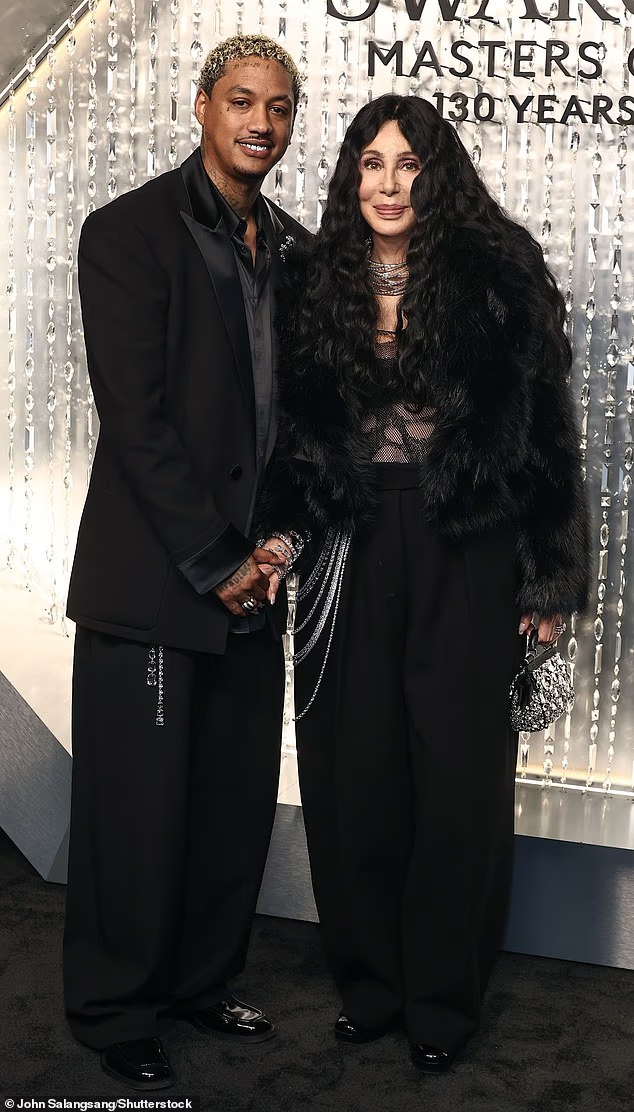
Cher attended the Swarovski Masters of Lighting Opening Celebration in Los Angeles with Alexander Edwards on 28 October. “On the day, Cher donned a black see-through bodysuit paired with a fur crop jacket and wide pants adorned with chain decorations on the sides, exuding her unique charisma. Her signature black wavy hair and glamorous jewelry highlighted her presence as the ‘ageless diva.'” (chosun.com)

Cher was also presented with a Bambi Legende Award in Germany on 13 November.

Cher was introduced around her iconic status and humanity. In her speech Cher said she was proud to be there and felt she had a special relationship with Germany, where people seemed to always been interested in her during her career’s low ebbs. She talked about her inability to save Billy the Elephant from the L.A. Zoo. She kept saying, “I’m just a singer; I can’t do anything.” But then after telling the successful Kavaan elephant story she ended with, “I’m not just a pretty face, am I?”

Movies

Someone reached out to me from Peru about the movie Suspect.

A man named Anthony told me he had recently watched the movie on VHS and “found it very entertaining,  full of suspense and interesting moments. For example, the scene in the library” and yes that scene was very delectable!

Anthony said he searched the internet for reviews and found my Cher Zine review “full of details and very interesting observations.”

He said he was “grateful to be able to read it and that there are unique opinions” and he hoped I could read the email “and feel grateful for filling the world with culture.”

I was indeed very grateful he reached out to me. Suspect is a bit underrated as it includes a very bookish character against Cher-type and I think she does a fine job in it alongside a young Liam Neeson.

More About Me

So my friend in San Francisco and I finished reading Healing The Child Within by Charles L. Whitfield (which Cher recommends in her book Forever Fit) and we started on the comparatively very large workbook.

Oy vey! It has been a shocking experience because when I started reading the book, it felt so dated, so 80s. My friend and I have read so many other self-help books between when this one was published and now. And it seemed very substance-abuse related, which was not my family history, (in my childhood anyway). But then it turns out the childhoods explored encapsulated many more kinds of dysfunction under “also ran” where I could find my little self. The book is full of tables and charts and I could see exactly where my therapy in Los Angeles stalled when I left to move to New Mexico. I never got to core issues! Or letting the feelings go!!

So I’ll be restarting therapy next year when my insurance is sorted out. My friend and I are now deep into documenting our true and public selves. Many surprising revelations for us, I must say.

I’ll be making an unexpected visit to Cleveland next weekend so I wasn’t going to finish putting up my Christmas trees. But then I did it anyway just to cheer myself up.


Memoir vs. Memoir Part 3: the 1970s

I just need to say this again: if you had told me when I was six or seven or eight years old that one day I’d be reading Sonny’s memoir alongside Cher’s memoir, each discussing their days as Sonny & Cher, I would have fainted across my Raggedy Ann bedspread. It was inconceivable to me that such an amazing thing would happen someday in this world. That’s how much I loved Sonny & Cher.

I now think either Cher eventually read Sonny’s book or one of her ghostwriters did because their opinions, even minor ones, seem so point-to-point.  And why would they not read everything, just for research. I guess it could be an amazing coincidence, like Sonny’s image of Sonny and Cher connected to the same umbilical cord.

Anyway I’ll try not to replicate Cher’s book here because you should go out and buy it. The paperback is out now with an additional story. But let’s continue…

If you want to go back:

The Nightclubs

So Sonny admits it was Joe DeCarlo’s idea to try out nightclubs. This is big. Cher and the world usually give that idea to Sonny. Sonny calls the period a “bumpy road personally.” Cher says they actually got back on track as a family during this period. And Cher calls it Supper Theater. The Supper Club circuit. Places like the Flamingo in Las Vegas and the circuit of hotel and casino dinner theaters.

Cher remembers she was “relieved to be working” and they traveled with Chas in a wicker crib and their nanny Heidi, “the sweetest woman in the world.” Chastity’s first two years were on the road and her first milestones all in motels and hotels. Cher says Chas was our early entertainment and “such a gift.” The band and hotel staff held her all the time and her “feet never touched the ground. Cher says, “she was the sole focus of our long road back to who we once were. “ Even though they had no money or house and had hotplate meals, the three of them hung out together and “no matter the circumstances, Sonny could always make me laugh.” Cher is unequivocable: “struggling again helped revitalize our relationship…being poor narrowed our focus—how to best spend our time, made us feel three of us against the world.” (This is the “backs against the wall” era.) Cher says Sonny was a big kid, very creative, and she could happily watch him play with Chas for hours.

“Our world consisted of the three of us.” This sounds very happy but Sonny portrays it all unhappy and remembered only the struggle.

He says, they “struggled to find chemistry off stage” and he says he took some of the act’s barbs personally. He does start to worry he is being too bossy and that he lives too much in fantasy land. He admits he was “obsessed” with Cher’s “steamy love scene” with Steve Whitaker in the Chastity movie. He worried that his jealousy meant they didn’t “get it on film.”

Later in the book Sonny will claim that Cher’s unhappiness came out of left field. But here he acknowledges their fights over the busy schedule he arranged and he admits they “worked their asses off” in the summer of 1970 and that may have “cost us our relationship.” He mentions making the Dick Van Dyke TV special (he doesn’t mention its name, The First Nine Months Are the Hardest) and how it was hard to be on the road again and playing two shows a night. “We were up and down on planes…packing and unpacking…walking through smelly kitchens late at night…not connecting well.” He says Cher saw it as “a treadmill going nowhere.” He also says, “our enthusiasm for life was too low to pick up” and “you feel miserable.”

Cher does say ”every night was like a war” but she’s talking about with the audience.

Only Cher mentions the Love American Style appearance in January of 1971. Cher talks about how kind Sonny was during her panic attacks and his “odd” experiments like having her sing Puccini’s “Un bel dì, vedremo” from Madame Butterfly.

Cher explains how the new act developed from drunks in crowds and how she started talking to the band and making them laugh. She didn’t get the side eye from Sonny because it was working and at least they were entertaining each other. Cher calls it “always hit or miss” and that very “slowly we developed a [20 minute] act people would line up to see.” She notes it was “not our singing. “They wanted to hear our jokes.” Cher talks about her heritage of wiseassery. But that “never in a gazillion years did I imagine that I’d become a standup comedian.” Cher explains the type of jokes they told: about Sonny’s mother, his height, his singing, his hopes of becoming a sex symbol, her nose, her body type. Cher says it was accidental and “We got excited again.” They both tell some of the jokes they did.  Cher says, “Timing was everything” and she could “make Sonny laugh so much he couldn’t sputter out his lines.”

Sonny’s version: “We gradually developed a humorous and fairly sophisticated repartee.”

Cher again says their stage personas were the opposite of their off-stage relationship. Cher tells a story of trying to confide unhappiness in Sonny and his explosion and threat to divorce her.

Cher does talk about the discomfort of it, how that “felt horrible.” They would be in motels across the street from venues and casinos. Train whistles would keep them up at night. Bad plumbing. Mildew on the walls. Paper thin walls. Sonny would make them hot-plate pasta for the family and the band because they couldn’t afford restaurants. Cher admits sometimes “I wanted to curl up and die.”  Cher says they’d take the service elevator and then navigate their way through the busy kitchen trying not to slip on any grease or wok into a waiter flying past carrying five plates and standing by the swinging doors and trying to keep out of the way, listening for their cue. Then walk out smiling.

She says her sister was  traveling with them, too.

Sonny admits that although they were feuding, they were also other’s best friends. He says there are talks of a TV show but nothing came of it. Cher talks about the Century Plaza comedian night and working on The Nitty Gritty Hour special, which she says felt formulaic and nothing came of it.

Sonny’s August 26 1970 diary entry admitted Cher was complaining that he was pushing too hard. He says that during weeks in New Orleans they barely spoke unless they were fighting. (Later he will say he had no idea she felt this way.)

Cher says, “I felt permanently tired.”

Sonny says they would dress up to play to 12 people, where they used to play for tens of thousands. He says they were “not concerned with putting on a good show” but “how can I get out of this situation?”

Cher says it’s a “thousand times harder to come back than become, almost impossible.” And she concurs that they were used to 30 thousand screaming fans and were lucky now if they had more than 100. One of the midnight shows at the Elmwood there was only 4 people. Some “real dives.” They were used to kids who “knew every word of our songs” and now played “to people who didn’t know us,” people who were coming for dinner and drinks, not to see a show.

At this time Sonny said he felt Cher’s “admiration for him was zip” and that he was worried about the survival of Sonny & Cher but she was only worried about her own survival.  It’s in the middle of this, (not at the massive tax debt episode where Cher puts it) that Sonny says he asked Cher for 3 years (not 2) to get them back on top.

They both agreed they communicated better in Sonny’s diary.

He shares his September 11 diary entry (paperback, 1812) which has similar verbiage to the one Cher mentions in her memoir (hardback, 207) , the one that talks about Cher being “my stability, my generator. I need you to believe in me Cher” and Cher responds: “I am you. That’s scary to me. Even if you left me, you couldn’t rid your body of me. I can’t believe I’m saying this out loud.” Maybe these are two different entries they’re talking about. They don’t read the same in each book. This also wasn’t one of the ones Mary Bono republished in People Magazine.

But in hindsight Cher felt she did believe in Sonny because “Sonny believed in us…he kept pushing,” getting them TV appearances and shows.

Sonny says they were “popping” and “generating heat” and selling out shows and “drawing” in Las Vegas, where they shared a bill with David Brenner and Frankie Avalon. They didn’t even have a hit record, Sonny marvels. He says the true benchmark of their worth was “how hotels received us.”

Both end chapters before they start to talk about their new TV show, The Sonny & Cher Comedy Hour.

The First TV Show & Records

Sonny says TV executive Fred Silverman, a “genius programmer at CBS Television” saw them at the Waldorf Astoria.

Cher says it was around 2 years to the day that Fred Silverman saw their performance at The Royal Box Supper Club in the Americana hotel. Cher says by this time their act was “razor sharp.” Then they were sub-hosts on the Merv Griffin Show.

Sonny says, “Silverman arranged for us to serve as guests on the Merv Griffin show and they went over big. Silverman sent a congratulatory letter.”

Cher says Silverman wanted younger viewers. He sent producers Bearde and Bly to the Fairmont Hotel where they saw some raw talent and all hit it off. On their way back to LA on the plane, they sketched out the show. I remember Bearde and Bly saying the same thing on some Cher documentary, maybe Behind the Music.

In the meantime, Sonny says, a friend from his record promo days, Johnny Musso, signed Cher to Kapp Records and Sonny says, “he was taking a risk.” Musso “didn’t want me to produce.” This is the second time Sonny is asked not to be producer. “He wanted to use Snuff Garrett. I was bored by the studio and Snuff was a friend back to Liberty Records.”

Because of the TV schedule, Cher says, they had one week to finish this first record. Cher “loved Snuffy” because he was funny and great at his job, a “get it done” kind of guy. Sonny was busy with other things, Cher says, like arranging the tours.

Silverman arranged for a replacement series of 7 shows, Sonny says, and their ratings were good.

Cher calls it a summer of 6 shows and their show led into the miniseries about six wives of Henry VIII, every night a different wife. Fact check: there were 6.

Then in September the single “Gypsies, Tramps & Thieves” was released and 7 weeks later it hit #1. Sonny counts every chart position and he gets them right. Cher tends to get them wrong. Cher talks about the cover, the accent on her name, how it was her first top ten solo (“Bang Bang” went to #2 and “You’d Better Sit Down Kids” to #9). The album went gold and the song was nominated for a Grammy. She was working so hard she doesn’t remember how it felt. She only remembers being on the road, country fairgrounds and “huge crowds for us” but also being exhausted.

Sonny is frustrated with this. “Cher was sleeping” he says disparagingly at ever milestone of good fortune. He feels he is the only one enjoying it. Then he fires Joe DeCarlo because he’s taking 20% (the combined 10% each that 1960s managers Stone and Greene were getting). Besides, he has his road manager Denis Prognolato who he says was doing all the work anyway.

Remember Denis was the spy in tennis-lesson-gate, friend to Sonny. Not so much to Cher.

Cher says around this time Sonny changed. He hires lawyer Irwin Spiegel and is always in meetings with him smoking cigars.

The album Sonny & Cher Live comes out and goes to #35.

The “All I Ever Need Is You” single goes to #7 and the album to #14. The single “When You Say Love” goes to #32. This is all Sonny recounting.

But we could have used more of Sonny’s view about his own songs here, just like with “I Got You Babe” and “The Beat Goes On.”  He had three songs on All I Ever Need Is You. He says nothing about “A Cowboys’ Work is Never Done” except that it was a top 10 song in April of 1972 (#8).

Things are going good, Sonny says. The Comedy Hour got a greenlight. Their Vegas shows are sold out with “traffic backed up nightly.” But he feels deflated when Cher says she “wished they were really big, like the Rolling Stones or Dylan.” They are selling seats for $500. He says he feels invalidated and Cher is always the victim. (Which is neck-breaking projection in one paragraph). He thinks Cher is tired of S&C and hates sharing the spotlight. Cast and crew of the variety show, including Bob Mackie, the producers, the first hairdresser, just don’t back this up. There is the famous story about how Sonny would say “jump” and Cher would say “how high,” plus the fact that he said himself Cher had anxiety and hated performing without him, and in the 1970s would prefer to perform through him.

Sonny sees they are drifting apart. He wants you to know he sees and yet he also reserves the right to be completely taken by surprise later.  He feels they are still connected, intwined, “still drew life from the same umbilical chord and to think of severing ties seemed suicidal.” (Which shows he was thinking about it.)

Cher agrees and says they had a strange relationship as husband and wife, best friends, parents, partners and strangers.

Sonny says they went “from hasbeens to hot stuff “ and that he reinvested most of “our salary” into show, which had a 35k weekly budget. Which he said was “peanuts in prime time.” How’d they afford The Big House then? Because they were broke at the start of this decade. Sonny talks about their nose jobs and Cher’s breast reshaping and the infected scars that resulted.

The both agree they loved their televisions show. Sonny says, “the show was a blast to do. Even on our bad days we had fun.” He says Cher had her dream gowns of Bob Mackie.

In Cher’s version she had to fight for Bob Mackie. Ret Turner was already assigned to the show. She got Mackie to intervene and persevere. Cher became friends with both men. Cher says the small budget gave the show a family dynamic in the beginning.

Her first favorite dress was the red one with the open stomach, but that she loved the beautiful beaded shimmery gowns, which later came to cost 5k per dress. Cher says she was a size 6 at 108 pounds and her body type had come into vogue. (We could argue she helped it get there with her TV show.) Cher talks about John Wilson, the set, their coordinated outfits, how they both walked on stage with interlocking fingers, and her feeling “this is what I’m supposed to do.”

Cher has much more room to talk about the details of the show, what they did on which days, who the guest stars were, the role of Chastity, the innuendos and the lack of censorship, about the audience feedback. She said she could look back at the script Sonny wrote (“virtually by himself”) for Good Times and suddenly see it was “way ahead of its time.”  She talks about the first taping, the issues with her skin and hair.

Cher said Silverman was like a father figure. She talked about the difference between their written lines and their improvisations, how Sonny didn’t memorize anything and relied on cue cards, whereas she would memorize the scripts “on first sight.” She said she “let him flounder,” go along and then get him with a one-liner. She said the show was set up for Sonny to be the straight man. And they encouraged him to be silly. “He knew I had his back,” Cher says. She felt they were more equals on the show. “Sonny learned his own style of comedy and was hilarious. People loved him.” Cher says when they went to work, they got along. “I don’t remember a single show when we were angry with each other.”

Sonny says they had “top-notch writers” but he doesn’t mention any names of the cast or crew. He says Cher still had stage freight and worked to the cameras and through characters. But it gelled, was “hip and kooky.” Sonny talks about his “Fair Cher” poems and Cher’s impeccable timing” but he says now Cher is “impossible to read.”

Cher says they had a great crew and the producers did a great job. She says the reviews improved and they were renewed for 13 more shows. Critics said they were “endearingly mismatched” and they liked the screw ups and ad libs and the married-people affection like Sonny brushing hair from Cher’s face. Cher talks about director Art Fisher’s pioneering chroma key/blue screen, her iconic Vamp and Laundromat skits. She mentions Ted Zeigler, Freeman King, Peter Cullen, Murray Langston and Steve Martin “who went out tour with us after shows.” She talks about singing the old songs. She says she needed Sonny for those solos and couldn’t have done them without him. (This doesn’t sound like a woman who had been trying to distance herself from him.)

Cher says they were a Monday night institution and a top 10 hit with millions of viewers at a time. Market research found  Sonny loveable and Cher beautiful with her array of clothes. Cher then talks about recovering on weekends with Chas. After a show wrap, she would “go home, go look at the baby, wash face, brush teeth, watch TV, go to sleep.”

She remembers their days at their house at Oxnard Beach which were “some of our happiest days.”

Sonny agrees that at that time they felt like “a cozy family unit.”

Cher talks about being TV famous and how work was a safe zone, that they never fought on the set. [Charo tells a story of overhearing fights on the set and there were those Battling Bonos rumors.]

The Big House

Architectural Digest reported in 2019 the house was on sale for $115 million. More history (considering the short time they lived there, all tenants considered, it’s interesting that the house is still referred to as the Sonny & Cher house/estate) and updates through the years.

They were living in the 34-room mansion known as the St. Cloud house and it was 8 weeks into season 1 of their show and Tony Curtis, ever the opportunist Sonny says, sold them another house known as The Big House, now known as Owlwood or sometimes Carolwood Estate. Curtis said to Sonny, “You’re stars. You should reside in heaven!” The house was $750,000. Both houses seemed like a trophy, Sonny says, and that the Big House was 54 rooms and 30,000 sq ft. [Wikipedia says the house is 12,000 sq ft.]

Sonny says the purchase was a grave mistake and there were lots of misfortunes associated with the house and it was too big for a tiny family. He said the house had cold, bad vibes and was only good for hiding troubles. You wonder then why he later wanted to fight for it. He says Cher furnished it in three days.

Cher says “I don’t think anyone ever sat in the living room.”

Cher admits she broke down in tears asking Sonny if they could buy it. Cher says she rarely cried or asked for anything.” She says, Sonny wanted the house too because it was “a gargantuan symbol of our comeback,” their “castle on the hill” and that it would change things. Cher admits she had the house decorated with antiques from Europe. She says, “it was stunning” and she lists the outdoor buildings and describes Chas’ bedroom, although notes that Chas preferred the tack house to her bedroom (famously depicted on Sonny & Cher’s last duet album). The kitchen was her least favorite, Cher said and that the paneled library was her favorite space and one of the smallest. Cher correctly notes the 12, 200 sq ft of the house with 9 bedrooms, 10 baths. Sonny never wanted to throw parties, she said, except for Thanksgiving, Christmas and Chas’ birthday.  Sonny stopped her friends like Joey from coming over.

Busyness & Las Vegas

Cher says Sonny was “turning into one of ‘the suits.'” He wasn’t happy being an entertainer but wanted to be a mogul. She missed the old pasta-making Sonny with Chas on his hip. Now he just spent hours in meeting with lawyers. Cher talks about “The Benevolent Army of El Primo,” the jackets, all which was kind of a joke but kind of not a joke. Cher feels herself disconnecting, shutting down in fights. The CBS family “kept me going” she says but she longed to have own opinions and make friends. She felt closed in. They had no dinners out, no concerts, no movies. Their relationship was all work. Outside of that she had shopping and Chas.

Sonny feels Cher is ungrateful. Cher says Sonny was on a mission never to be poor again.

Sonny acknowledges it was a hectic calendar. “If there was a break in the TV show, I booked out of town concerts…That’s where the big money was.” He said they made 50-60k on a good night. They made 4 million that way, he says and that “Cher’s complaints were a broken record.” [But during the breakup story below, he will act dumbfounded.]

Cher’s defense: “Work was hard on me” and she said she had a more demanding TV show schedule than Sonny did. Sonny also wanted them to be recording new [solo and duet] music and doing shows on the road. “We have to make the most of this second chance…this is our time,” Cher remembers Sonny saying.  Everything became “a big blur,” all the TV work, fittings, photoshoots, interviews, tours, recordings, being a mom. She said they did 50 shows that year and Sonny arranged it so they would have to tape 2 shows a week sometimes, film two shows in 3 days show so they could spend 9 days on the road. It saved the producers money but Cher felt she had no time to catch a breath and it was double work for everyone on the show. She said they did that about once a month. She quotes producer George Schlatter as saying, “If Sonny & Cher were driving into Hollywood from the valley, Sonny would take a gig on Mulholland to break up the trip.”

Sonny says he was “building our savings” and he understood that “she hated the grind” and how she never could play in Vegas without getting sick, which Sonny took as “an excuse to cut the run short.” Sonny loved Vegas. “We were huge there…broke house records.” Sonny loved the “Disneyland for adults” aspect, what he called “the dark artificiality” of it. He admits Cher hated “everything about it” and that she hid in hotel room with room service and the TV. He pictured her as reclusive as Hugh Hefner, which is a tragic misreading of a person desperate to go out and have some fun for a change, just not in anyway like the way Sonny wanted to have fun.

Sonny went to see Elvis with Denis. He’d never seen Elvis but they often played Vegas at the same time. Sonny was fascinated by his power over an audience. It’s interesting to compare how Sonny and Cher each describe seeing Elvis perform. They are both mesmerized by it.

Elvis invited Sonny and Denis backstage “I’d never seen anyone like Elvis,” whom Sonny said had the charisma to transform a mediocre show. Sonny said Elvis “didn’t give a shit” and like Cher he would probably rather trade handshakes for money than perform. Sonny doesn’t mention this but like Elvis, Cher would also become a mesmerizing and hypnotic personality.

Sonny is actually great at explaining Elvis in his book, though. He said Elvis told him he liked the S&Cs version of “What Now My Love [Sonny mis punctuates the title] and that he listened to it before recording his own version (which sounds more like the original French version to me).

Sonny said he and Cher had a private plane and would be mobbed at airports, and that they had packed shows. But that Cher was “absorbed in needlepoint” on plains and in dressing rooms and always looking bored and disinterested.

Cher says she needlepointed herself half to death from the stress.

Sonny says romance became a commodity. Both agree they were suppressing their relationship troubles.

Cher felt alienated, not allowed to have friends over or “fraternize with the band.” By this time her sister was busy working as an actress. Cher tells about the Tupperware story and this is one of the final straws.

The Breakup Story

Sonny begins his breakup chapter with two diary entries that look back on the implosion, his November 4, 1972, entry where “Everything has exploded. Chastity doesn’t know mom and dad are on the ropes.” He says he’s been so worried about their careers, he’s never worried about their relationship.  [Sonny, even your own diary begs to differ].

Then a few days later on November 11, “Cher wants to run like a racehorse but she can’t find a track. I used to be the jokey. She shoved the saddle up my ass.”

[This is a terrible analogy because it kind of proves Cher’s point. She’s not a horse. WTH.] He says Cher was “admittedly miserable.” He talks about the worst time in his life, when he was married to Donna and lost his job before Christmas and then his car broke down.

They both take time to tell this story.

Sonny introduces the day by talking about Cher being antsy and unhappy (for no reason he can understand).

Cher introduces her version by talking about her breakup catalyst, not Bill Hamm (Sonny never obscures his name), but her soon-to-be best friend, Paulette, who was a 21-year-old worldly Armenian, sophisticated and dating their road manager, Jerry Ridgeway. They’ve been best friends for over 50 years now, Cher says. And Cher was initially allowed this friend because for some reason “Sonny never saw her as a threat.” [And he never acknowledges Paulette’s role in their breakup in his own memoirs.] Cher enjoyed listening to Paulette’s life stories. They each wanted the other’s life. By that time Cher says she wasn’t eating or sleeping. (In Forever Fit Cher Cher says she was suicidal and down to 94 pounds, only eating a few bites of egg a day.) Cher says she feels the TV show changed Sonny completely but that she still loved him. “He didn’t notice me anymore” because he was trying to be a mogul. This is a consistent Cher story in interviews (from at least Believe-era on). Cher felt she couldn’t trust him anymore and she was needlepointing herself “to death.” She is candid that she had no desire to have more kids with Sonny although she admitted he was a great dad and that he and Chaz had a special relationship that “didn’t include me.” Chas was El Primo, Jr.

Cher says that they had back-to-back shows in Reno and Las Vegas. At the Sahara they had two shows a night in the Congo Room. She was feeling trapped. Paulette was starting to help her as a gofer and a dresser. After shows, Paulette would hang out with the band smoking pot, drinking beer, playing guitars. Cher was envious of her stories.

Cher says she was exhausted and asked Sonny for a vacation to Europe and he rolled his eyes. He called her selfish. Cher says she was crazy with loneliness and had been sitting on the balcony rails of hotel rooms ready to jump “five or six times” (!!!) But “one morning everything changed.” Between shows that day she figured she could just leave Sonny. Paulette was oblivious to Cher’s condition and told her about Bill Hamm’s crush on her. There’s a story with the Etch-a-Sketch and the song “Superstar.”

Sonny says It was a Saturday night. “Cher and I were breaking attendance records while ignoring our personal differences.” Between shows, Sonny remembers that he, Cher, Denis and our guitarist Bill Hamm went over to the Hilton to see Tina Turner. They then went back to Flamingo and did their late show and received three standing ovations. David Brenner was their opening act and jokes about “the dough we were making” and “our opulent suite.”

Cher says it was The Righteous Brothers that the band wanted to see at the Hilton Hotel and that Cher went with Paulette and Ridgeway. Not Sonny. Everyone acted like she was crazy for doing something without Sonny. She sat next to Bill and he put his hand on her knee. (I can’t wait for this movie.)

In Cher’s version, she returned from the Righteous Brothers and had to ignore Sonny’s fury. She left for her dressing room, ignoring him. After the show she told Paulette she wanted to hang out with the band and they hung out in Jeff Porcaro’s room. None of this is in Sonny’s book. Cher said the band was “nervous as hell.” Bill and Cher left to go look for cigarettes. They ran into David Brenner. Cher says David and Brenner were close and Brenner was nervous about seeing Cher out and about without Sonny, too. Bill asks Cher how she can live this way. Some kissing happens. They go back into the room. Sonny calls pissed. Cher says she’s just hanging with the guys. “You could have heard a pin drop in the room,” Cher says. Cher says she told Sonny on the phone that she was bringing Bill up to their room.

Sonny says they were exhausted after the second show and there was strained conversation at the elevator. On the road, Sonny says, they had a truce to engage in “shallow chitchat” because they were “forced to share close quarters.” (How does he not see a train wreck coming?) Anyway, Sonny says he is looking forward to sleep. [This must be one of the nights he wasn’t out with other women.] Cher shot me a pained look. “Bill Hamm is coming up,” Sonny remembers Cher saying. He figured they were working on songs together. [How was that allowed? Working on music without Sonny?] When they get to the hotel room, Sonny has Cher saying, “I’m in love with Bill Hamm. I want you to leave.”

Says says he wanted to talk about it. “Let’s talk, okay.” Sonny says he “never suspected” was “shocked” and felt “flat-footed.” He admits he thought of killing Bill Hamm or hitting him. Sonny says when Bill came in to the room, he was oblivious but soon figured it out. (Sonny is always more sympathetic to Cher’s boyfriends and husbands than he was to Cher somehow.) He said Cher had a “fearless nerve.”

Cher says the nerve was all Bill Hamm’s who must have had “balls the size of something huge.” (That’s how much everyone was afraid of Sonny.) Cher doesn’t have Sonny asking to talk about anything. She has him in a chair staring her down and she remembers shocking herself by saying she wants to sleep with Bill in their room. She says she didn’t mean it but it seemed like an expeditious was to escape The Sonny. Cher says Sonny returned silence (not a plea for dialogue) and that he asked her “how long to you think you’ll need?” Cher said two hours and not another word was spoken and Sonny left the room.

According to Sonny, he fantasized about breaking whiskey bottles over their heads or perhaps destroying the suite (which would have been a real rock star move for him). But he just left, felling defeated, like a “zombie.”

Cher acknowledges that she had put Hamm in jeopardy. She said they just spent the night talking. Cher appreciated his friendship and sympathy and she cried on his shoulder.

Sonny says he went to play Blackjack (which is kind of odd) and that Bill’s girlfriend tapped him on the shoulder looking for Bill. Sonny says he told her what was going on. Sonny said, “let’s go to your room” and “she did not hesitate.” Wow. They had retribution sex which was unsatisfying. Sonny says, because they “bumped into each other with the enthusiasm of two people who had just been mugged.” (Very good metaphor though.)

Sonny says Bill returned in the morning. Sonny and the unnamed “girl” where still together in bed. “He brushed by me as if I was not there.” When Sonny returned to the opulent S&C suite, it was 5 am and Cher was asleep in bed. Sonny says he took off his wedding ring (and you wonder if he had it on all those times he was cheating on Cher) and had a “disturbed” sleep next to Cher.

In Cher’s version, Sonny returns at 5 am. They agree on this.

But Sonny says he wanted to talk to Cher when they both woke up and he remembers telling her it wasn’t too late to change things. Cher asked him what he did last night and he said “I screwed Bill’s girlfriend.” And Cher said, “that’s funny, we didn’t even go to bed together.” Sonny said he wanted to ring her neck. (You have to admit, he was easily played into that situation. In his own version of it, anyway.)

Sonny says they then talked the entire day about everything, how the love was gone and he says Cher was “calm and casual.” Sonny says he tried talking to her because he says he knew she didn’t love Bill Hamm. “He was a pawn in her game,” the last “straw to break my back…he was her way out of Sonny & Cher.”

This is all very strident projection because there is no outside collaboration and Cher denies ever wanting to “escape Sonny & Cher,” although she did want to escape the schedule and the loneliness.

Sonny admits he was “also stark, raving mad…the closest I’ve come to real craziness.”

According to Cher there was no conversation. He treated her very coldly when he came back and by then she knew he didn’t love her anymore. She says while she was half asleep Sonny pulled off her wedding ring. (which is very creepy). She says she woke up in the afternoon and Sonny was gone and she knew there was no way she could perform that night. It was then, Cher says, that Sonny sent Chas and their nanny back to L.A., “another of his unilateral decisions.”

Sonny says Cher insisted on her love for Bill during that day-long conversation. Their next showtime was approaching. Sonny says he asked Cher to have Bill come up and they all talked in the dressing room but the “discussion was a futile waste of breath.” Sonny admitted he couldn’t perform until there was resolution to the drama. Their manager had been calling them all day on the phone and leaving notes under their hotel door. At 4 pm, they cancelled the remaining shows that night and for the rest of the run. Unfortunately no one told their opening act, David Brenner, Sonny says, and so he showed up for his cue   at 8 pm.

[It was due to the cancellations that rumors started in the press about Sonny having assaulted Cher. See the Rolling Stone interview of 1973.]

Sonny says, “Denis went off to kill Bill.” (I should watch that movie.)

Sonny says Denis spoke to Cher, saying she wanted to leave town. Dennis agreed it was a good idea. They feared CBS would hear the news. Cher wanted to go to San Francisco with Bill. “Dennis made the arrangements.” He also hired a P.I. to follow her but the P.I. lost Cher at the San Francisco airport.

Sonny says he booked Chas and the Nanny on a plane to L.A. (making it sound like he did that after Cher left town). Sonny says he was “too numb” to function and when he got back to L.A. he stayed in bed depressed for two weeks and got down to 130 pounds.

According to Cher, her exit day happened differently. That day she went walking on the strip alone, but she was sent back into the hotel by autograph seekers. She found Sonny sulking in his dressing room. She asked him for $500 in cash. He gave her the money without saying anything except that America would hate her for breaking them up.

Cher says she left for Paulette and Jerry’s room as a safe hideout. Bill was there getting ready to leave for Texas. It is here, Cher says, when she found out Sonny slept with Bill’s girlfriend in revenge the night before, not from a conversation with Sonny earlier that morning. Cher asked Bill to go to San Francisco with her instead of back to Texas. All she could think of was going to Sausalito. Cher says nothing about Denis Pregnolato arranging anything with Sonny’s blessing. And it’s doubtful she would trust Denis (after Tennis-Lesson-gate). According to Cher is was Jerry Ridgeway who loaned Cher his rental car and he was worried about it, afraid of losing his job. Hamm and Cher then took separate cars from the San Francisco airport but got lost in that fog. Cher knew the P.I. was behind them and they got lost too, she says. They all ended up back at the airport hotel.

But then Sonny says Cher called Denis a day after they left saying she wanted to come home but that she feared Sonny’s reaction. Cher came back to their bedroom but Sonny says they were “strangers, zombies, enemies.” Luckily, Sonny says, they had 54 rooms to spread out in.

In Cher’s version, she says Denis found them at the San Francisco hotel and called to threaten them, saying it would be “really bad for Bill if you don’t come home.”

Cher says within a week they were back filming the TV show. She confirms Sonny looked bad when she arrived home, exhausted. She said he had the demeanor of being beaten and looked gaunt. But immediately she was pulled into a meeting with Irwin, the lawyer, about breaches of contracts and costings of millions.

Sonny says this all happened right before taping the 1972 Christmas show. And that the producers knew but they kept it a secret. At the end of November, Sonny says he went traveling for two weeks to clear his head. He went to France, England, Nassau and Miami but he had no fun. (If only he had only consented to this trip with Cher when she pleaded for it, maybe none of this would have happened.)

In his December 1972 diary, Sonny talks about how they look like a “warm and loving” couple but the situation “felt cold and hateful.” Sonny admits that his next conversations with Cher were about keeping the business together (and that begs the question of why she would agree to that if she was trying to get out of the act). He says he did most of the talking “in a familiar repetition” of past conversations. (So how did he ever know how she felt about anything ever?) He says Cher agreed they were in a “lucrative business” and they agreed to have separate personal lives.

(So either Cher wanted out of the act or she didn’t. It doesn’t sound like she did. She was willing to keep it going.)

A later Sonny diary entry talks about how neither Cher nor Sonny had any kind of family life and that Cher used to worry about that, according to Sonny. “I would tell her we would build our own. Now again I have no family.” Sonny does seem to feel victimized but likes to attribute that to Cher. But it is a sad diary entry, nonetheless. Sonny’s diary gets a bit  melodramatic (understandably): “She’s not mine anymore. Nothing has any meaning.”

Sonny claims Cher was a changed person (too) but that he wouldn’t trade those ten years because “they were the best of my life.” (I do feel Sonny is being honest here but that he has serious blind spots in hindsight.)

Sonny says they each moved into one half of The Big House. Sonny claims they did the same thing “with our money, our daughter and everything else.” (Except, stay tuned, they never did divide the money.)  And, he says, they attempted to separate without disaster. He understands by then that Cher wants freedom. “I thought I was teaching; she thought I was intimidating.” [But then so did the whole band think he was intimidating.]

Cher says she had no money and never did receive her share. Leaving Sonny was losing all the money. (That alone makes you believe she would have stayed if she could). Cher says she was given $5,000 a month (no chump change) while they were separated and a rented condo in Malibu near Moonshadows where she spent a lot of time sleeping. Bill Hamm came to visit there (and you get the sense that here is where she learned what a good relationship could be like) but they weren’t allowed to go out to dinner or to movies and she was never allowed to be seen in the company of other men in public. Sonny had no such stipulations it would seem.

After the Breakup

By the summer of 1973 Sonny says he was no longer trying to get back together with Cher. (Which is a strange thing to say but Cher has reported in the past that there was a period when he was doing that, trying to get back together.)

It seems like pretty soon he moved their secretary, Connie Foreman, into the Sonny wing of the Big House. Sonny mentions Cher didn’t seem upset by this. Sonny calls Connie a former cigarette girl at Pips (that club where Lucille Ball would show up and they would all play backgammon) and I’m reminded here of his violently slapping the cigarette tray into the face of the cigarette girl in their movie Good Times.

Cher says Connie was their assistant and agrees with Sonny. She liked Connie and says Connie would get tired of Sonny’s rules and come over to hang out in Cher’s wing to listen to music and smoke cigarettes.

Cher says she became friends with Sonny again, that they could enjoy each other again. Sonny tells her he thought about throwing her off the balcony back in Vegas and says he would have pleaded insanity. Then getting a book deal and TV show from it. (Yikes!) Cher said living with him made her want to jump off the balcony. They laughed.

Sonny says friendliness on his part was an act “deserving an Academy Award.” Ouch. At home, he says they were two strangers. Sonny says he still saw Bill as her pawn. He thinks the same, he says, about future boyfriends Robert Camilletti and Richie Sambora. Neither of these men have said they felt like pawns and have pretty much only good things to say about their time with Cher (Sambora commenting pretty recently). Gregg Allman’s worst comment about Cher was to say she wasn’t a good singer. (Imagine!) Sonny says Cher “wears men like ornaments.” Then he goes on to admit he went out to party at the clubs after they broke up, “hitting on chicks right and left.” (I think this man has previous sentence amnesia, but we can all see his stripes, right?) Anyway, he says Cher and Bill broke up after several months and she started dating their keyboard player David Paich. Then Bernie Taupin.

This all happened around the time of her hit “Half Breed” and what Cher calls a “grueling summer tour.”

Cher talks about “pianist David Paich,” whose father Marty was their orchestra leader. (Sonny doesn’t mention this.) Cher said this only lasted during the grueling summer tour. Cher says it was during this tour that Cher, Paulette, Paich, the Porcaro bothers, Hungate and Lukather (I will now start calling them Proto-Toto) were hanging out in a playground on the  swings after which Sonny via his loyal guy Denis called each member of the band individually to threaten to break fingers and blow up cars for hanging out with Cher.  The band and even Paulette stopped talking to Cher upon threat of being fired. Only David Brenner would talk to Cher and even he was afraid, according to Cher. But Toto ostensibly could weigh in on this if they would ever admit to working for Sonny & Cher.

So Cher started singing with her back to Sonny. This was around the time of their second Live album at the Sahara in Las Vegas. Cher notes that Sonny’s comments and stories during that show were designed to make her feel guilty. But she maintains that “he was the one who caused it to end.” Cher says she always thought he would come to realize she “was the one who was always there for him, who loved him” and that she knew “he loved me, just not enough to be faithful or kind.”

Sigh. Did he come to realize that?

Sonny says their lawyers did all the real fighting and he moved on thinking about how to survive without S&C.

Cher tells her Lucille Ball story and adds she used Lucy’s lawyer, Mickey Rudin. Sonny calls Paulette “our secretary” and accuses her of spreading rumors that Cher wanted to get back together with him. Cher has Paulette telling Cher “good for you.”

Sonny talks about a “bad” trip to Paris. He doesn’t mention Cher being there but Cher says around this time she went to Paris with Sonny. They stayed at the Raphael hotel and this is where Sonny’s was taking a bath and Cher is telling him modern girls won’t put up with his bullshit anymore. Cher talks about Sonny’s M.O. of gift-buying to placate the cheating. Sonny doesn’t mention any of this.

They go to the 1973 Golden Globes together to give the award for Best Musical or Comedy Series. Cher mentions a fox coat she wore and  multicolored skirt which she says is one of her favorite looks of all time.

Cher talks about Captain Spike Nesmyth, the captured pilot who was a Sonny & Cher fan and the POW/MIA bracelets they wore. Sonny doesn’t mention this. Cher talks about Chastity’s 4th birthday party. [There’s a magazine article depicting one of those birthday parties. I’ll try to dig it up.] Cher talks about going to the 1973 Academy Awards with Sonny in the gold dress to present the award for best song, “The Morning After” from The Poseidon Adventure.

Cher tells the therapist story and Sonny’s interloping. He doesn’t tell this story. Cher admits going to Joe DeCarlo again for friendship and advice. DeCarlo tells her about Sonny’s infidelities with all the womens, including hookers, waitresses and dancers, how he would book an extra room. Women started telling Cher these stories too, saying Sonny claimed he had an open marriage with Cher.

Cher tells the Jack Benny/Johnny Carson party story where she went with Sonny and got kicked out for laughing at Lucille Ball’s irreverent political commentary. Sonny doesn’t mention this story.

Cher talks about feeling liberated and independent and adventurous, dressing how she liked, learning how to shop for food and sign checks. Poignantly she talks about not having to worry about whether she was laughing too loud. The laughing-too-loud thing. This is always a sign of an uneven relationship and I’ve witnessed it with couples within my own family and in song.

One page 214 of the paperback Sonny talks about the Mother Nature skit and the tension on the set. They both talk about this skit. They both agree Cher ad-libed telling Sonny to go fuck himself. Sonny has nobody laughing and the director suggesting they try it again and Sonny saying “not without our lawyers.”

Cher talks about the skit on page 288 (hardback). She said it was a Chiffon Margarine commercial spoof and it was a few days after leaving Sonny. “What’s the secret of life?” Sonny asks. “Go fuck yourself,” Cher responds. She says Sonny collapsed in hysterics and she did too, along with Sonny’s comment “not without our lawyers.”

She says later Sonny called her act of leaving him in Vegas her “Nagasaki moment,” words he had printed for her on a gold dog tag. In disagreement with Sonny (who feels he should get an Oscar), Cher maintains they weren’t acting affection after they separated. “You can’t fake that shit,” she says.

But in any case, they both agreed they could easily be Sonny & Cher professionally. Cher says she liked working with him but didn’t know “how to read him” anymore. They say the exact same thing about each other.

By December of 1973, she was seeing David Geffen.

David Geffen Susses Out Cher Enterprises

Sonny says Cher turned suddenly into “an ice maiden” and was testy to the whole crew, less of a team player, less approachable and kept saying things like “I have to talk to David.” Sonny thought she meant Proto-Toto’s David Paich but it was this producer fellow. The irony of all ironies is this Sonny comment: “I wrote him off as a little wimpy guy.” (First off, it’s totally wrong and second it’s almost verbatim what the mayor of Palm Springs wrote off Sonny as in the 1980s at his first running for mayor). But Sonny quickly admits now he misjudged the man who would become “the most powerful, respected, wealthy and feared man in Hollywood…one of my great misjudgments.” That must be his second biggest misjudgments after thinking he could mistreat Cher for so long and keep a golden rainbow coming out of his ass. (Too much?)

Anyway, Cher says Sonny was uneasy when he found out about Geffen being as smart and powerful as Geffen was, “much more than himself.” Cher starts hanging out A-listers now: Bob Dylan and his wife, Jack Nicholson and Anjelica Houston, Warren Beatty and his girlfriend Julie Christy, Lou Adler.

Cher says it was Sonny who began to change. At work, things had been friendly but he stopped being friendly. Not his goofy fun self on the set. (Someone from the show needs to weigh in here.)

Sonny saw Geffen as in a conspiracy to get Cher a solo CBS show (and solo record and movie deals). Cher denies this. Sonny admits Cher denies this but he believes it anyway. Cher says that Sonny & Cher’s agent pitched the idea to them once at Geffen’s house but that they asked him to leave and never spoke to him again because he was ostensibly Sonny’s friend.

But Geffen was exploring her existing contracts. David and Cher then learned about Cher Enterprises and how Cher had zero votes, rights or stake in the company and was entitled to none of their income over the last ten years. Sonny owned 95% and their lawyer owned 5%. Cher was an employee and she received the noblese oblige of Sonny plus 2 weeks vacation. She also has no way to make money outside of this enterprise without Sonny’s permission.

(Just the name of it sounds demeaning and exploitive.)

Sonny talks about contracts. He says their TV contract had 3 more years. They had just finished year 2. Cher agrees with this. She says she was was locked into the contract for 2 more years. She says she had stayed during the bad times, Sonny’s movie dramas, the tax fiasco and was heartbroken and “so mad” and “thank God I had David.”

They each represent each other as cold. And Sonny, we have seen, has a tendency to project. Not that Cher was probably the best communicator there ever was at this time.

Sonny has Cher saying he and Geffen should get into a room together and whoever wins wins. Cher has Sonny refusing to renegotiate during her attempts to talk it over and being met with Sonny’s cold eyes and his smoking cigars. She had a child to raise, her sister and her mother to worry about, she says. She couldn’t work for nothing.

By January of 1974 Sonny says he is tired of faking a marriage and that Cher was refusing to work anymore “for our corporation Cher Enterprises.” (Our.) A few pages later he says “Cher and I were employed by Cher Enterprises. Cher and I were 50/50 partners. That is not only how the corporation was set up, that is the law of community property in California.”

Then a page later Sonny contradicts himself and says, “when Cher wanted out of her contractual obligations, when she wanted to split Cher Enterprises 50/50, I said no.”

Sonny has the gall to say about himself in the third person, “Cher decided to shoot Sonny in the back.”

Anyway, his reasoning was that he had managed them all those years for nothing. Plus, he feared Cher would step into all those deals he worked so hard to make, leaving him out (just as he was leaving Cher out now). That he did all the backstage work was not an insignificant or untrue claim. Cher admits he did all the heavy lifting behind the scenes. A fair deal would have been to pay him out for what would have been a manager’s salary.

But listen to me, trying to figure a way through for Sonny & Cher.

No biographer of Cher disputes that the contract was 95/5 Sonny and his lawyer. This doesn’t seem like a situation of Cher’s word against Sonny’s. But I suppose former biographers all could have taken Cher at her word and not researched the actual contract.

But here’s the thing: Cher received no money on the corporation’s earnings after its demise, leading us to believe…she did not, in fact, have an ownership stake in it. She finally got The Big House (no small thing but she says she had to buy it from Sonny) and a portion of the publishing royalties off Sonny & Cher songs, which Sonny will soon express disgruntlement about.

Cher says, “Sonny undoubtedly was responsible for making us who we were…[but] he could never have achieved that without my voice….He made me leave.” No Cher without Sonny.  But also, she says, no Sonny without Cher.

And it does sound like Sonny brought about the disruption he insists he feared the most. Sonny says their act had contracts out for 10-15 years (at Caesar’s Palace and on MCA). And, I think, it would have been amazing to see if they could have survived very bigly into the era of MTV. I doubt they would have. But in any case, Sonny says Cher told him she refused to honor the contracts.

Cher did call Fred Silverman and ask him not to pick up the TV show for another season, later insisting to him that she would never leave to do a solo show on an another network (there had been rumors), which is kind of an implicit negotiation to do a solo show on CBS. Cher told him she couldn’t work as an employee with no salary. This was around the time of their opening number “Will You Still Love Me Tomorrow” and Cher noting that his smile did not quite reach his eyes.

Sonny says, “I was not going to be the one to end it. But Cher refused to work anymore.” (For nothing, he forgets to say.) Two paragraphs later he says, “the week of the final episode of The Sonny & Cher Comedy Hour, I filed for legal separation from Cher. I’d absorbed enough. I wanted it over.”

So much for “I wasn’t going to be the one.” Cher says he filed for divorce on 18 February but I think Sonny is right and that it was legal separation. Some editor should have looked that up as public record?

After the Friday taping, (Cher says it was in January 1974 and everyone was crying, her mom, sister and the crew, but Sonny doesn’t mention it), Sonny says they took separate jets to their final Houston Astrodome concert. Sonny says they earned $150,000 that day. He says they were the biggest, hottest act in the country at that time and they were playing what was the largest indoor venue in America.

The both agree the show was miserable, a rodeo venue that smelled like shit. Cher says it was a working rodeo with Elvis and the Jackson Five on the bill too. This is where her hair got caught in her dress’ zipper and Sonny had to cut it free with the scissors.  Sonny says Cher left the venue without a word to Sonny or their crew and he was left to say all the goodbyes and farethewells. Cher says all the people they worked with were loyal to Sonny.

Sonny says Cher filed for divorce on February 20 and claimed involuntary servitude. Sonny calls her a “characteristic victim” (says the complaining victim) Cher doesn’t dispute the divorce filing and says Sonny countersued for lost earnings and sued Geffen for interfering and asked for a temporary restraining order against him.

Cher says the news was “brutal” against her but Sonny continually complains that he was the one Cher successfully made out to be the villain. At the same time, Sonny was suing Cher for 14 million and Geffen for 13 million. Cher is just suing for divorce and contract freedom but Sonny keeps claiming for Cher it was all about the money.

The Big House, Part 2

Sonny also says Cher changed the locks on the house. But Sonny doesn’t mention that he kicked Cher out first and Cher no longer had the Malibu lease so she was homeless and moved in with David Geffen. (This was the era of Joni Mitchell being there all the time too while making Court and Spark).

Here is where Cher contradicts her own story when she says, “he never wanted that house. It was my dream house…” But back on page 268 (hardback) she says “Sonny wanted the house too.” And he did at least want to keep it from her. But by the time of his own memoir, he never liked that house. Cher was advised to return to the house and she says at that time she did change the locks and Sonny & Connie had to move into the St. Cloud house which “he made me sign over to him.”

In his diary, Sonny says “I have no good feelings left for Cher.” He finds it all confounding because “Cher is not a fighter” and he doesn’t believe Cher and Geffen are in love, that it’s a relationship of convenience and Cher has made him her pawn.” He sees Cher as, and I quote, “either a subservient Geisha girl or a killer.”

Wow.

Cher eventually sells The Big House fully furnished (a few months after Elijah’s birth) at a price “too low” and to a “carpet baron.” But she doesn’t say why she sells it.

Parenting Chas

Sonny says Chastity is confiding in him that she feels neglected because Cher has become a surrogate mom to Tatum O’Neal. Cher barely mentions Tatum O’Neal aside from one dismissive sentence. Cher says she and Sonny are civil when discussing Chas on the phone but Sonny says “Cher, in true passive-aggressive form, forced me to deal with Geffen in order to spend time with Chastity….So I wound up negotiating with Geffen over when I could and could not see my daughter.”

Cher says Chas was friendly with Geffen at first and then something changed and she took Sonny’s view of Geffen. Later,  Cher said, they both decided not to trash each other’s lovers to Chastity (if not in memoirs). Sonny said he applied for full custody, which Cher said “shattered me.” She had taken Chas to Hugh Hefner’s to play in the pool and Sonny used this as the reason. Cher says Hugh Hefner had known Chas her whole life. And it’s true, Sonny even booked Sonny & Cher on his Playboy show and had been pictured as a family at his house. So WTF Sonny.

In the end, Sonny got even less time from the judge than Cher has planned to give him. But they worked out a cordial deal between themselves.

In Chas’ three books, he has not weighed in extensively on this time period.

The Solo Shows, The Settlement & Gregg Allman

Now here is where reading Sonny’s memoir the first time I completely lost confidence in him as a reliable narrator. Sonny claims that in the summer of 1974 Cher announced The Cher Comedy Hour. No other Cher biographies mention this and neither does Cher in her memoir.

Sonny says Cher immediately went to work on a new series and it was “an instant smash,” that she was on the covers of People and Newsweek (it was Time, Cher wasn’t on the cover of Newsweek until the 1980s), and “women embraced her as a role model and everything I knew she was capable of began happening. I had no problem with Cher’s success.”

I actually believe this part. I think in some ways Sonny was Cher biggest fan and her worst friend and lover. And, as a big Cher fan (and a big Sonny & Cher fan), it makes me feel very torn about Sonny.

Sonny continues to lament that Cher cast him as the bad guy and that Cher basically “walked off with the franchise” and with it took away “his whole sense of identity.”

I believe that too.

But here’s where I lose sympathy with Sonny’s  chronology. He says his friends, manager, agent and just general people said ‘look at Cher’s successful solo show. There’s no reason why Sonny Bono cannot have a hit TV show, too.’ So in the summer of 1974 he says he presented a solo show to ABC with the pitch “if CBS was having success with the Cher variety hour…”

Sonny’s show debut was on August 14, 1974. He excerpts his diary to say “I have been knocked down more times…and now I’ll have to be judged all over again.” (No victim here.)

The big problem is that his show premiered and was canceled after 13 weeks in 1974 and Cher’s solo show didn’t even begin airing until February 1975 and this is because Sonny’s lawsuits kept Cher from working on anything new for almost the entirely of 1974. There was the Dark Lady album on MCA, her last album on that label, and some modeling work with Vogue.

So his whole long story is false. Cher’s show did not happen before his. How could he misremember that?

Of course Sonny’s solo show didn’t succeed, although it had the majority of the cast and crew of The Sonny & Cher Comedy Hour and the same formula. It was just missing that one magical thing that was maybe worth at least 50%, the star power.

Cher said it was “a copy of our show” and had rotating female guests to stand in for her. She expresses sympathy that the network put him in an impossible timeslot at ABC, on Sunday against Kojak and Disney and that she didn’t want him to fail. She says she was backstage with Chas for the first taping of the show.

Sonny says, “It didn’t work for a lot of reasons.” (Another example of Sonny knows; he wasn’t caught not knowing.) “It was the only game in town, so I played it.” (A far cry from ‘why can’t Sonny Bono have a hit TV show like the Cher show that’s only happening in my head.’)

Cher said while Sonny’s show was on the air, CBS announced her new show would air on 8 pm Sunday’s against Sonny’s show which Cher thought was cruel to them both. But his show “was cancelled before mine began.” Which is the truth. And how Sonny could have published a different story is mind-boggling since it was an easy thing for any editor or fact checker to look up in any library’s reference section. (I was doing that in the late 70s, so I know how easy that was.)

This also confirms a childhood memory that I’ve always had that I could never explain, that for a minute the public thought they might have to choose between watching a Sonny show or a Cher show.

Anyway, then Cher tells the Average White Band overdose story.  She said Sonny was furious about it. But he doesn’t mention it in his book.

Sonny laments that at the cancellation of his solo show he was “alone now” and “it was a bitch.” He says by now Cher’s show was in its second season and that the first had done well. (But it hadn’t even started yet.) Connie is gone by the end of 1974 and he’s very down about his situation, says his diary. But then he tells a story about going to David Geffen and Cher’s 1974 Christmas party where he meets Raquel Welch and they leave the party to go to a movie together. They saw The Towering Inferno and left early because they both hated it.

Let’s pause to consider Sonny’s comments about Connie. “I was trying to get Con off my back. The only thing she did well was fight.” He blames the relationship on rebounding. He admits he’s still friends with Cher, (which is why he was invited and went to her Christmas party).

He then tells about his PR man Jay Bernstein (who “was better at launching Farrah Fawcett’s career than mine”). He takes his variety show on the road with Richard Lewis because David Brenner wasn’t available. Later Tim Conway opens for him and they become friends. But the show didn’t do well. He says Cher kept bashing him in the press. He says he’s not the dictator Cher said he was but he never mentions the whole El Primo thing and his own 1960s diary entries about “keeping her in line.”

And interestingly, it’s here where Sonny brings up the big fight they had after going out to see The Dirty Dozen. This is the fight Cher mentions occurring in the 1960s. He said it was their worst and funniest fight. He says the fight was about whether Cher had a killer instinct. Sonny thought she did. Cher didn’t think so. This led to a shouting match where Sonny commanded Cher to let him out and she did and then drove off “leaving me to walk 10 miles home.” His guy Denis picked him up. That was “the extent of his irate machismo she found necessary to criticize.” Oy vey.

In Cher’s version she let him out at Dead Man’s Curve (on Sunset Boulevard) and he was upset that she liked the movie and he accused her of being “sexually frustrated.” Cher attributed the fight in hindsight to Sonny’s tendency to force a riff so he could leave and go out on a date with someone else.

Sonny contends Cher never complained (except he has spent pages telling us that she always complained, that ingrate). He blames her for not communicating her unhappiness to him, (after complaining that she was always telling him she was unhappy). He admitted he knew she hated Vegas. But still Sonny chalks it all up to Cher’s villainization and lies.

He then goes into his own victimization: his ego was shot, he felt sorry for himself. But then he meets the model Susie Coelho in Palm Springs via Jay Bernstein.

He then talks about Cher’s new “peculiar relationship” with Gregg Allman and how “nothing attracted Cher like a mean, tough and potentially dangerous rock and roller.” (Uh…well, Sonny…err…are you describing yourself here too inadvertently?)

Another funny thing is that pages back Sonny says, “Geffen was exactly the kind of man Cher was attracted to—a powerful guy who took charge of her life and made things happen. To me he was a ruthless cutthroat.”

So…yeah. That’s how Cher likes ’em: dangerous and powerful and Sonny. Yeesh.

Cher says she and David Geffen had stopped living together in January of 2025 although they were still dating when she met Gregg Allman at the Troubadour one night.

Sonny and Cher kind of do describe her relationship with Allman similarly though in its “ups and downs.”  Sonny says it was “red-hot” to “non-existent” and that’s not too far from how Cher defines it too. Sonny admits Allman is a “gifted blues man” but also a “coked-out druggie” and a “southern cracker.” He uses the same hyperbole he used about Geffen to say Allman was “one of rock’s most volatile personalities.”

Cher has always insisted Allman was very gentle and sweet. So they disagree about that. But Cher admits “I had never been with a bad boy and he had a reputation as one quintessential bad boy.”

Sonny says Allman was “bent on self-destruction” and mentions the suicide of Jenny Arness, (a topic Cher avoids in her memoir). Sonny reminds us that Cher is not a drinker and was “as antidrug as I was.” He makes fun of her use of the name  “Gregory” instead of Gregg. Sonny thinks there’s some connection between “Greggory” and Cher’s father, John Sarkisian, who Sonny claims Cher did not say goodbye to before he passed away even though her biological dad had “cleaned up by then” because she “never forgave him for deserting her in childhood.” (Cher seems pretty ambivalent about Sarkisian in her memoirs but maybe there’s some kind of psychological connection there.) Sonny says he was happy that the new relationship pushed aside his “nemesis David Geffen.” With Geffen gone, Sonny says the two of them started chatting again and Cher was always asking him for advice.

Cher agrees that she would reach out to Sonny in a crisis and he knew how to handle the press.

Cher says Sonny called her up to invite her to appear on The Tonight Show hosted by George Segal as a surprise guest and they fell into their usual banter. This appearance helped Cher’s bad press around her Gregg Allman troubles. Sonny also helped with Chastity when Cher needed to spend time with Allman in a Buffalo rehab.

“As far as I was concerned, Cher and I were equal partners.” Sonny says he still “resented she was able to go on with her career, capitalizing on our past success and continuing to make millions while I was slogging my way across dime-sized stages for gas money.” That is a great sentence but it’s also ridiculous because he had the chance to keep making money with Cher if he let her actually make money on the act. He says he was 50% responsible for her stardom.

So is he saying he should get 50% of all her earnings in perpetuity? Now he’s all 50% guy.

The divorce breakdown according to Sonny: Cher got the 54-room Big House (although Cher claims she had to buy him out for that). Sonny got the 32-room St. Cloud house, which he says he had been renting out until he needed to move back into it with Connie. Cher was allowed to void all existing Sonny & Cher contracts but in exchange had to pay Sonny $750,000 in cash or work it off performing as Sonny & Cher, a combination of which she did in 1976 and 1977. Also, “she received 50% of all publishing royalties from the songs I wrote, checks she still cashes,” Sonny says as if that’s incredible.

But to think about it, the only money Cher received from 10 years of performing as Sonny & Cher (aside from gifts Sonny gave her when they were together, houses they lived in and shopping she did with their money), was nothing. The company structure put her in debt for 750k (according to Sonny; Cher says it was higher). The only money she ever made for herself from ten years of working as Sonny & Cher was from the publishing royalty agreement in the divorce, the very same one Mary Bono tried unsuccessfully to null and void a few years ago by arguing that a divorce agreement should die with the death of the spouse. Cher ended up having to sue for unpaid royalties (so at some point she stopped cashing those checks) and it’s unclear whether that was before or after Sonny died. He had no will and his estate was divided up between Mary Bono and his four children.

Here are two articles on the Mary Bono lawsuit:

The divorce was finalized on 26 June 1974 and 4 days later she marries Gregg Allman. From Cher we find out this was because she was pregnant but Sonny doesn’t know that yet. Sonny says her marriage and filing for divorce 9 days later was a “public joke.” Sonny says she confided to him in tears that Allman was mostly upset that she worked so much and was “no fun” and “never there.” This tells us more about the situation than we see in Cher’s memoir which kind of hedges around their issues.

Interestingly both Susie Coelho and Gregg Allman get not-nearly the ink you would expect they would as the next Sspouses to follow Sonny and Cher.

Sonny said Allman and Cher would come over and use his pool, which was more private than hers and that Cher would suntan there nude, which shocked Sonny. Sonny says, “Cher had become very liberal.” But then he admits he doesn’t really know her anymore and gets more information about her from People Magazine.

Sonny says Cher’s show took a dive in the ratings. Cher agrees with this and explains what happened. In the beginning Cher was a bigger hit than the Comedy Hour, according to Cher. The premiere had 21 million viewers and the show finally beat out The Wonderful World of Disney, which CBS had been trying and failing to do. But the show also had 2 censors that the Comedy Hour didn’t have, which made work difficult. But during the summer break, CBS played Joey & Dad in her timeslot and it bombed. So when she came back, her ratings fell from 23.3 to 7 and suddenly she was competing with The Six Million Dollar Man (which Sonny did a guest appearance on.) Also, Cher admits, David Geffen had left in aggravation over her relationship with Gregg Allman and without his contacts, they couldn’t get the A-list music acts anymore. Plus doing a show solo was too much.

Reuniting as Sonny & Cher

Sonny says Cher pitched a reboot of the Sonny & Cher show and he was incredulous but that Cher and Denis talked and worked things out. Sonny seems like he did it for opportunist reasons. He said Primtetime Network TV was “the kind of exposure I needed.” He said neither of them had made it solo (except Cher had kinda made it solo and would go on to make it solo, she just hit the first bump in the road). He said their friendship was like American and Soviet spies sitting on a beach; they could kill each other but they liked each other.”

Cher agrees that she asked Sonny back and he “instantly” said yes. She said Sonny negotiated with CBS the new deal and that it allowed Cher to repay Sonny for those cancelled contracts by way of the new show plus “road gigs.” He also had to square the pregnancy situation with CBS but Cher admits that Allman was “otherwise out of my life” at that time. Later, during show opening dialogues, they would mention him from time to time (as if he was backstage). Allman was at that time upset by the show’s press and that Cher was again working with Sonny. He told her he felt “heartbroken” and “made a fool of.”

Sonny talks about the the CBS press conference which he says occurred at Television City. Cher says it was the Beverly Wilshire.(It happened on 4 December 1975).

The new show premiered on 1 February 1976. Cher said it was one of the most watched programs in TV history at that time, up there with Who Shot J.R. (I remember hearing that statistic in other bios too but unfortunately there is not much online about this fact of TV history.) Cher says she thought the show was sharper and more relevant. They lost the mother-in-law jokes. She’s right. The second show is better. She said Sonny persuaded Harold Battiste into becoming their musical director. Cher said there was a lot of discussion about what songs they should sing as divorced people.

During the second show, Sonny said they got along better and he was sympathetic about Cher’s problems with Allman. He said their ratings were in the 20s but then CBS switched their time slot, which is what led to lower ratings and cancellation of the show. “Both Cher and I wanted to continue with the show.”

Cher agrees with this and talks about the last episode with a retrospective of 1960s Sonny & Cher singing “Baby Don’t Go,” which Sonny said he we wrote for her. Cher says they were on the road when they heard CBS wasn’t renewing the show. During the tour Cher said Sonny took pictures of Elijah learning to crawl down hotel hallways (just like Chas). Cher used a lot of Sonny’s photos and footage of Chas and Elijah on her first solo tour for Take Me Home and her Vegas/Monte Carlo shows. She has always always maintained Sonny was a good father and very good to Elijah.

Sonny says the show cancellation freed them to do concerts in huge arenas but Cher hated the road and got bored and sick, depressed and “insular.” She missed Elijah and at the halfway mark called off the rest of the tour and paid Sonny cash. And that was the end of Sonny & Cher, according to Sonny. Cher agrees she cut the tour short and paid her debts from her own pocket. She says she ended up paying him 1.4 million in cash, not $750,000.

Cher says after the tour, Sonny moved to Palm Springs where he would host BBQs and Cher would go sometimes with Chas. Sonny never ate, Cher said, just tasted things. Cher says he went through girlfriends and cheated on all of them. After one breakup he came to Cher tearful and gave her an apology in her kitchen. Sonny and this woman got back together, Cher says, and married and Chas was their bridesmaid. Cher calls the woman “Sarah” which, interestingly, is the name of one of Sonny’s girlfriends on The Love Boat (it’s that Deacon Dark episode where his girlfriend is deaf and he sings a sweet song to her at the end.) But Sonny’s next wife was named Susie.

Sonny says Cher was supportive Susie in Sonny’s life and he blames her for that, too, saying that “given her track record” he shouldn’t’ have listened. He says Susie and him were with each other for the wrong reasons and he was just lonely. (I’ve read Coelho’s book; she has nothing but good things to say about Sonny in it.)

Sonny comments on Cher’s albums around that time, Cherished (“a flop”) and Allman and Woman, Two the Hard Way (failed), and he dismisses her attempt to suppress her name on the Allman album cover as “something wrong” because she “hates to share the spotlight.” (Why would she even do the duet album then?)  Those two albums were probably the nadir of Cher’s 1970s output by they are the only post-breakup Cher albums he mentions: not Half Breed or Dark Lady (both which earned #1 hits), Stars or Take Me Home (which had another top 10 hit).  We’ll see later if he has anything to say about her 1980s comeback records.

Cher says it was her idea to drop her name because she wanted people to focus on the music and not her life in the tabloids.

Sonny says they became neighbors when Cher purchased the “Moorish mansion” (the Egyptian house) on Benedict Canyon Drive. Cher and Susie were friends and Cher would again sunbathe at their pool (nude again). It was here where Sonny first saw Cher’s large butt tattoo of the butterfly. He attributed that again to Cher trying to generate shock value and create controversy so she could then tell critics to “stick it.” Which, Sonny says in a moment of honesty, was “a trick she learned from me and I learned it from Phil Spector.”

Cher talks about going on tour with Allman in Japan and Europe but after he had a relapse she left the tour to return home to do final shows with Sonny in Hawaii. There Sonny had invited Bill Hamm back to the band to “mess with me,” Cher says. But they ended up reconnecting. It was here the Sonny & Cher act ends in Cher’s story. Of her experience with Allman Cher says she has to “learn things the hard way.”

Sonny talks about Chas’ school problems and finding out she was grades behind and this triggers his feelings of neglect (and particularly his neglect of Christy). But he doesn’t yet mention the dyslexic diagnosis.

In Cher’s version of the story, the principal called her to talk about Chas’ emotional problems and bad grades. Cher was shocked because Chas was always “level headed and responsible.” A teacher took Cher aside and told her to get Chas tested for a learning disability and they discovered Chas had dyslexia. Cher then suddenly understood her own learning disability.

And that’s the end of Sonny & Cher in the 1970s in both of their memoirs. Neither of them mention the Mike Douglas Show reunion they did in 1979, but there are two more public reunions ahead: Cher at the opening of Sonny’s La Cienega Italian restaurant Bono and their iconic reunion on Late Night with David Letterman in the fall of 1987. Sonny will still be with Susie Coelho when his restaurant opens but that relationship will end and he will meet 22-year-old college student and restaurant customer Mary Whitaker there. Those two had a 26-year age difference but can you remember anybody ever talking about that? No. Because they didn’t.

I forgot how much Sonny villainizes himself, unintentionally, in his book. Cher is the “killer” and he is the perpetual victim, taking very little responsibility for what he does. But, it all kind of came to roost for him anyway, as it often does. If he had been fun to work with (and if you read Murray Langston’s testimony, maybe only Cher thought he was fun to work with) then he would have continued to work in Hollywood, despite his divorce from Cher. Cher said extensive CBS audience research showed the public liked him. I don’t think it was evident that Cher’s comments to the press were the biggest issue for Sonny and his show-business career. Two record labels requested he stop producing Cher and he didn’t go on to become a TV or movie mogul despite all those meetings. By Sonny’s own admission, Cher wasn’t involved with any of that so how could she have ruined it?

That said, Sonny did a lot of brilliant things for Sonny & Cher and he did turn a raw, anxiety-ridden teenager into a glamourous superstar with an iconic career trajectory. And that’s not chump change either.

This level of detailed Sonny & Cher obsessing was immensely pleasurable. My little 7-yeard old self can die happy now.

Cher Sounds

The YouTubes algorithm recently served me up the Cher’s song “I’d Rather Believe in You” and I was thinking how much I love Jeff Porcaro’s drumming on the song, probably my favorite drum part in a Cher song (and one of my favorite Cher vocals, too).

And in the middle of procrastinating the writing of a twine short story, I went looking to see what the Internets thought of Cher’s drummers (and guitarists and bass players).

Guitar

While doing this I found a whole world of YouTubes of musicians-who-want-to-play-that-song and they make videos breaking things down.

Like breaking down…

Steve Lukather did a lot of Cher’s Geffen-era, 80s rock ballads. Here’s some internet info on Steve Lukather’s best, including “Turn Back Time.”

For example, Steve Lukather and Jeff Porcaro are all over the 1991 album Love Hurts: https://jeffsstamp.web.fc2.com/diskfile/cfile/cher6a.html

Examples of Steve Lukather on Cher songs:

I didn’t love Cher’s guitar sounds in the 80s, tbh. But then I can generally say I didn’t like the guitar solos from the 1980s. Cher’s seem much more subdued than most of them. But all of them, subdued or extroverted, were kind of predictably dull in their own ways.

For context, what I do like: I know there’s a lot of Lindsey Buckingham controversy (and I for one have checked out of Fleetwood Mac’s century-long drama) but here is an example of a solo that gives me feels. It’s always an unpredictable eddy with Buckingham and then I end up delighted at minute 3:42.

But anyway, we would be remiss not to mention Cher’s love of the guitarist and the Take Me Home song “Git Down (Guitar Groupie)” (1979) which had most of Toto on it, Steve Lukather (guitar), Jeff Porcaro (drums) and David Hungate (bass).

For a song about guitars and ahem, “living from lick to lick,” this guitar part feels a bit lowkey.

Maybe the solos are not allowed to upstage the Cher. JK.

Bass & Drums

Some breakdown examples of bass parts in Cher songs:

“The Beat Goes On” is, of course, the ultimate example, which reminds me why my favorite bass moments in Cher songs necessarily go back to Sonny and Carol Kaye in the 1960s:

And researching this I learned that the Wrecking Crew Facebook page claims the iconic drums in “Half Breed” (1973) were also Hal Blaine.

Some people also think Hal Blaine did the drums in “Gypsies, Tramps and Thieves” (see here) but there are no credits publicly available for that one and I don’t think it’s the most interesting thing about that song anyway.

But the drums and bass of “He Aint Heavy, He’s My Brother” (1971) and “Somebody” (1972) of that same year are quite another delicious example. There’s also the dramatic remake of “I Got You Babe” (1972, in no small part because of the drumming of Matt Betton) and the fabulous heartbeat of “All I Ever Need Is You” (1972).

And those uncredited players (likely the Toto) carrying Cher through the 1970s: “Living in a House Divided” (1972) and “Train of Thought” (1974) ….and “Take Me Home” (getting sultry in 1979 with Ed Greene on drums and Ed Watkins on bass).

Speaking of which I actually do like the guitar solo (and the drums) in “Love and Pain” (1979, with Tim May/Ben Benay and Ronnie Zito).

In other random facts, today I learned that Van Dyke Parks did the steel drum arrangements to the Jimmy Cliff song Cher covered in 1975 on her Stars album.

During all this exploring, A.I. kept trying to butt its big fat face into the conversation I was having with SERPs and it wants me to tell you “A Cowboys Work Is Never Done” (1972) has a “prominent drum roll” and I will concede to agree with A.I. there. It’s a very atmospheric effect all things considered.

The Square Sonny & Cher

I was going to wait until I watched the Ann Meara and Jerry Stiller documentary before talking about the Captain & Tennille. But I have just gone into the weeds with them and I already have plenty to say.

For the last week or more I’ve been finishing the watching of their TV show DVDs, the DVDs I started watching about 15 years ago when I received the DVD collection as a Christmas gift. I blogged about watching one show back in 2009 and I agree with pretty much everything I said back then except I like Daryl Dragon considerably less. This round there was something obviously wrong with Daryl, something wrong between Toni and Daryl. Well, for one thing, they have since divorced and Daryl passed away in 2019. So that brought some of the shows discomforts into high relief.

Watching the show again turned out to be much more disturbing for Mr. Cher Scholar because he remembers watching the show as a 10 year old and really loving it. Now, we could see the show has plenty of problems, not the least of which is Daryl looking so uncomfortable not only talking but with Toni’s affection. Then there’s the writing, the costumes, the choreography, the sets. But there are also some great segments with Toni and Daryl at their respective keyboards and some great duets between Toni and their guests.

But more than a few times, Mr. Cher Scholar or I said, “what’s wrong with that Daryl guy!” And I even said this a few times, “That Toni Tennille would have been much better off without that Daryl guy.” But since Daryl Dragon’s death, we haven’t heard a peep from Toni Tennille, except maybe on social media years ago. Although Toni said she was retiring from public life after her memoir, she seems to have disappeared entirely.  It’s like her public life pretty much began and ended with Daryl Dragon. It reminds me of the end of the movie The Truman Show where I started to feel an awful complicity in my interest in famous lives. So that kind of blows my theory that Toni Tennille would have had a better career without Daryl Dragon. Maybe, like Cher likes to say, there would be no Toni Tennille without Daryl Dragon.

She did do some solo things over the years, a talk show, a traveling musical and a big band tour visiting local orchestras. But her personal life stayed locked in with Daryl Dragon.

It’s a sad story. Toni Tennille loved Daryl Dragon and he quite possibly suffered from undiagnosed autism. I was so flummoxed by watching Daryl on the TV show, I ordered Toni Tennille’s memoir and read it in under 24 hours (it’s short). Tennille never mentions autism but alludes to an abusive Dragon family history instead and issues with mental illness (a bi-polar mother who suffered a bad lobotomy, a sister who committed suicide and a brother who may have also died by suicide). But there is plenty of evidence in her memoir of autistic-like behavior. This is not a diagnosis but it puts us in the ballpark. Something unusual was going on with Daryl. (This is also not a diagnosis but this person reviews the symptoms listed in Tennille’s memoir.)

Now just to preface, I am not a Captain & Tennille fan. I did just recently buy a Toni Tennille doll (which I didn’t know even existed before I bought it and only because it was dressed in a rare Cher doll outfit). I had their greatest hits on vinyl (bought used) and I still have one Greatest Hits CD (with songs I like on it) but I had never previously watched any of their shows, specials or TV appearances.

But I do want to say I really do like Toni Tennille. And all through watching the variety shows, I argued with Mr. Cher Scholar about this. But I have even more sympathy for her now than I did before watching them.

Yes, she’s gangly and manic on that show. We joked that she was definitely an Omega-Mu ( a reference from Revenge of the Nerds). She was actually a Delta Delta Delta but didn’t fit in there. She admits she’s every bit the intense perfectionist she appeared to be. But those things have never been deal breakers for me. In fact, they just make me like her even more, especially after hearing stories about how Toni and Daryl’s peers at A&M shunned them for being unhip for the times. A&M! That’s the label with The Carpenters. But that reminds me I love Karen Carpenter for all the same reasons. Gawky, quiet girls, you have a place in my heart.

Plus, she’s also beautiful and has a great voice which I enjoy most when she’s singing a ballad at a piano. I love her sexy songs too (“Do That Too My One More Time” and “You Never Done It Like That“) and I muchly prefer her latter-day hair.

And I still love the Dream album photos (which the memoir says were taken at Salton Sea).

And when I got to reading the memoir, I found Toni Tennille had much more in common with Cher than I could have ever guessed, aside from people calling Captain & Tennille the square Sonny & Cher. When I first read that I was delighted because it implied for a second that Sonny & Cher were thought of as cool somewhere. But unfortunately I think there were more people who thought of Sonny & Cher as the square Sonny & Cher. But when you contrast them with Captain & Tennille, they do take on a sheen of hipness.

There were so many similarities between Cher and Toni, I started making a list:

  1. In each duo there was a quiet one (Daryl and Cher) and an outgoing one (Toni and Sonny). And the yin-and-yang of that fact became part of their respective schticks.
  2. They both worked with Hal Blaine at one time or another.
  3. There was a previous marriage for each couple: Sonny’s and Toni’s.
  4. Each of their record labels distributed false marriage stories because none of them were married when their first hit landed on the charts, for Sonny & Cher this was the lie they previously married in Tijuana in 1964 and for Daryl and Toni it was the lie they were married on Valentines Day in 1975. Both Cher and Toni claim they didn’t know their record labels were going to do this but afterwards they felt they had to go along with the story.
  5. Both women used the word “unromantic” to describe their real weddings. Both described the marriages as a practical exercise.
  6. Both had a ‘song of the summer,’ Sonny & Cher with “I Got You Babe” in 1965 and The Captain & Tennille with “Love Will Keep Us Together” 10 summers later in 1975.
  7. Both women were the doe-eyed partner in their relationships (clearly shown in that rare photograph or during early duets). relationships where the men seemed checked out (for the end or the whole relationship). Cher puts it this way, “the sun rose and set on his Sicilian ass,” while Toni says the love was “achingly real on my part.”
  8. Both lived half-what platonically together during some or all of their relationships: Sonny and Cher started out in twin beds and Toni and Daryl always had separate bedrooms.
  9. Cher and Toni are both square in some respects. Neither of them drink or do drugs and in both cases this is due to having fathers and/or father-figures who were addicts or alchoholics. They both tell similar stories about their naïveté around drugs: Cher tells a funny story about Redd Foxx asking her for coke and her telling him they only have another kind of soda, and Toni tells a story about how everyone left her Halloween party because she didn’t have a coke room. Both express the fact that they’re totally fine if others want to imbibe; they don’t judge. They both just want to be in control themselves.
  10. Both tell the same story about having trouble getting backstage because security didn’t believe they were with the performing act. Tony had this happen while with The Beach Boys (they had never had a girl member) and Cher in the 1960s when her army of lookalikes confused security.
  11. They both talk about how exhausting it was to do a television show while also making appearances and recording albums, how all they wanted to do was sleep when they could.
  12. Both describe touring as hard. In her memoir, Toni described struggling through the run of Victor/Victoria. Her “wise director” told her “Toni, there are two kinds of actors who want to be on the road: the ones who look at the entire experience as a traveling party and the ones who are usually running away from something.” Toni says, “it wasn’t long until I figured out which one I was.” In Cher’s case, Sonny often laments in his book how Cher hated touring so it’s ironic she did one of the longest tours by a solo artist in history (The Farewell Tour at 325 days).
  13. They both talk about being outsiders in show business even after they hit their peaks. Toni Tennille tells a very sad story about how the Captain & Tennille were invited to the A&M after-Grammys party only after they won record of the year. They realized they hadn’t been invited beforehand and Toni says they never made many friends with industry people who thought their music was square (and there was the issue of Daryl hating to be social). Sonny & Cher (and Cher solo) were also maligned, dismissed and uninvited in all the same categories even after Cher conquered the world. Both duos were made fun of by Rolling Stone Magazine.
  14. Both groups were accused of being kind of lightweight, overnight sensations, regardless of how long they had been working in music.
  15. Both of their husbands produced their albums although Toni had much more input than Cher did and even wrote some of their songs, many of which were about her struggles with Daryl (he didn’t notice). I’ve always wondered what kind of songs Cher would have written about Sonny. But even Toni acquiesced by saying “producing was Daryl’s territory” and how if there were conflicts during recording she didn’t want to “rock the boat.”
  16. They both tell stories of the perils of performing for British royalty. Toni talks in her memoir about the cramped situation performing for Queen Elizabeth and Cher talks in her memoir about the disaster of performing for Princess Margaret.
  17. Toni says that when Sonny & Cher divorced in 1974 and their first variety show ended, “the search was on to fill the void,” to find the “next quirky couple.” Both duos were hired by television guru Fred Silverman (Sonny & Cher while he was at CBS, The Captain & Tennille while he was at ABC) for their respective variety shows. Toni and Daryl refused to do the material written for them in the vein of Sonny & Cher’s disparaging banter because they found it too belittling. “No put downs,” even for fun, Toni said.  That’s too bad because a little sparing is a little fun for healthy couples (or a little healthy for fun couples). But it doesn’t sound like Daryl could have accommodated this kind of fun/stress.
  18. To film their TV show, the Captain & Tennille Show rented the old soundstage at CBS where Sonny & Cher filmed their variety show.
  19. Both made the shortcomings of their males stars part of the variety show character of their male stars: Sonny’s refusal to learn his lines and all his flubs, Daryl’s discomfort around talking: both of these things became part of the show.
  20. Both Sonny and Daryl were described as controlling. Daryl wouldn’t let Toni kiss Robert Reed (Robert. Reed. ??) during her appearance on The Love Boat.  Sonny wouldn’t let Cher kiss Stephen Whitaker in the movie he wrote for her, Chastity.
  21. Both were faking perfect happiness in their relationships for their fans, either all the way through the relationship or at the end.
  22. Both attributed lack of intimacy as a factor in the end of their relationships. (Guys!)
  23. While they were married to their husbands, both women probably accidentally overheard someone saying “she could do better” and they both were probably offended by this.
  24. Both Cher and the Captain & Tennille were given recording comebacks by the label Casablanca. Both women ironically did not imbibe in the label’s famous party scenes.
  25. Both Cher and Tennille talk about their love of shopping.
  26. Both describe themselves as conflict avoidant.
  27. Both describe themselves as homebodies.
  28. They both have a prominent mention of “I’m On My Way” (Cher / Toni Tennille)
  29. Both women needed a lot of time to realize their marriage wasn’t working (years for Cher, decades for Toni). Tennille’s final straw was when Dragon called her a “fucking bitch” and Cher’s final straw came suddenly after years of exhaustion and no socializing and deciding she wanted to hang out after the show with her friend Paulette and, basically, the band Toto.
  30. The public both blamed both women for their divorces. They were both accused of being the cold party. Cher’s side has long since been backed up by family members and the cast and crew of her variety shows. I would be curious to see what people who worked with Toni and Daryl have to say, but you don’t really need to know. It’s obvious. Just look at his face when Toni loves on him. (It’s heartbreaking to see.)
  31. Both of their fan bases probably date photographs of Sonny & Cher and Captain & Tennille by a system of hairstyles the women had and when their husbands grew their mustaches.
  32. There’s also this:

The Differences: Bill Belew was no Bob Mackie. His costumes did not flatter Toni Tennille and seemed kind of cheap and unimaginative. Maybe if they had continued on with more seasons, the gown budget would have increased. We’ll never know.

Tennille talks about the struggles over the formula of their variety show. The producers wanted 40% music and 60% comedy. But Daryl and Toni were uncomfortable with that because they weren’t comedians; and to be fair they hadn’t spent years developing a comedy act like Sonny & Cher had in their early 70s nightclub act. Daryl and Toni wanted the formula reversed with more music. They finally agreed on 50/50, but it wasn’t until Dick Clark was brought in as producer (after the holiday break) that music was prioritized on the show.

I’ve thought sometimes about how sad the Sonny & Cher ending is but maybe Toni’s story was even more tragic: both of these women were willing to stand by their men through thick or thin. In fact, both of had put up with more than many partners would have. In Cher’s case, she describes Sonny as losing interest in her. “He made it end,” she contends. But in Tennille’s case, she had all the right intentions and all the wrong tools to deal with Daryl’s condition but she spent 38 years trying. In both cases, the women may have stayed in the relationships if the men could have turned it around. Both describe their mates as cold hearts. “How Can You Be So Cold?”

While I was researching this I came upon a reddit forum where someone asked, “Can someone explain to me how the Captain & Tennille were so popular in the 1970s? How did a man in tacky boater wear and a woman who stole Bonnie Franklin’s hairdo become a huge hit?…and WTF with that Muskrat shit?”

Those hairdos were contemporaneous, but okay. (That was one of the Vidal Sassoon looks of the mid-70s.) The answers were all great, but here are the best ones:

  • “Um, because Love Will Keep Us Together is amaze-balls”.
  • “Do That Too Me One More Time is a master class on how to write a song about sex without the tawdriness of most modern songs about sex.”
  • “Acts like C&T provided a cultural bridge between generations.” [Someone else likened it to what The Fresh Prince of Bel Air did for rap music.]
  • “Media moguls saw an opportunity to water down rock with soft rock for the older folks.” [Except, I would argue, lots of kids liked them, too] “Thus began a long parade of soft rock acts featuring camera-friendly faces for TV.” [They weren’t so camera-friendly, actually, which is why, I would argue, those soft rock faces all but disappeared when MTV arrived.]
  • [This answer is the whole theory behind the book In Perfect Harmony, Singalong Pop in ’70s Britain by Will Hodgkinson]
    “We’d been through the very politically fraught 60s, a horrible war and just coming out of a really bad recession. The vibe was very much ‘I just want to work a decent job, have a drink or roll a doobie, and relax with lady/dude and not have to think about things.'”
  • Someone else said immediately after that comment, “boy i can see that coming back soon.” [Like for-reals-balls.]
  • “I was a kid but I played that album over an dover before I turned into a jaded youth.”
  • [Another favorite response] “A lot of incredibly well crafted and performed songs are given the Comic Book Guy ‘worst song ever’ treatment. There’s no objective reality to this. It’s just a style you don’t like.”

Toni’s memoir begins by describing a violent childhood accident in a garage that severed the tip of her finger at the joint. After years of surgery her finger was reconstructed so she could keep playing piano; but she said she was so traumatized how other kid responded to her mid-surgeries, interim-fingers that she always hid that finger (both socially and in performances). Mr. Cher Scholar and I were intrigued by this and started to look for that finger in the variety shows. And sure enough, we never saw the finger for longer than a blur of a second. The hiding makes her seem very formal when she stands talking to audiences and the camera, her left hand always folded over the right fingers.

the finger-hiding pose

I find that when a person has something small to hide, unfortunately it takes over their whole body. And it’s here, in their respective body languages, where Cher and Toni Tennille exhibit their biggest difference. Cher is fully at ease with her body and Toni is not.

And I will always wonder if Toni Tennille could have gone much farther in music (and lurve) without Daryl Dragon. We will never know. Could this have easily been Cher’s story too?

Authoritarianism In Popular Music

First of all, I’m in the process of re-reading a kind of diary notebook I shared with a friend in high school. In the 1980s, we did this all the time. That way we could look like we were doing homework in class but we were really goofing off writing letters to our friends. Passing notes was too dangerous. Between classes, you could easily trade notebooks. We were about 14 years old, living in St. Louis, reading “The Jungle” in history class (probably a banned book now because it’s anti-capitalist).

My friend and I are re-reading the notebook together and the process has been both painful and funny. And timely because I’ve been wondering lately if I’ve been exaggerating my childhood interest in Sonny & Cher and Paul Sand. This notebook disabuses me of that doubt, however. At one point my friend gets exacerbated with my Sonny & Cher obsession and later I tell her to be sure to catch Paul Sand on St. Elsewhere.

What a nerd! But we are talking quite often about music and co-existing with divergent musical tastes. (I have no record of what kinds of music conversations I was having at 14 with my other friends.)

And here we come back to cultural authority. Because I know what’s coming up in the notebook. We are about to get into an argument about Bob Dylan. I won’t go into any particulars about that or the rest of the notebook but all to say this was in my head this morning (and how our identities were forming around music) while I started reading the book No Respect, Intellectuals and Popular Culture (1989) by Andrew Ross.

Ross talks about pop culture as a tug between “distrust and hostility” on one end and “deference and respect” on the other, a very binary, polarizing arrangement. This has always been challenging for me because I just can’t see the world as black and white and binary. (I am convinced no one can, but it’s simply a very popular coping mechanism.)

Anyway, Ross says, “The struggle to win popular respect and consent for authority is endlessly being waged and most of it takes place in the realm of what we recognize as popular culture” which includes defining “what is legitimate…the patrol over shifting borders of popular and legitimate taste, who supervises the passports, the temporary visas, the cultural identities, the threatening ‘alien’ elements and the deportation orders and who occasionally makes their own adventurist forays across the border.” (I forgot how much Ross is my favorite cultural writer.)

How timely a metaphor this is for us today in the days of I.C.E. And you can also see how debates about ‘alien’ tools and styles play out these days, music that is different or threatening, technology often seen as the new target but is actually a very old foe. I’ve just watched hours of footage of Daryl Dragon in 1977 sitting atop his mountain of keyboards (and a xylophone) on The Captain & Tennille Show. As a great example just take a listen to the music of muskrat sex for a minute. You will either feel that this is sweet or a sign of the apocalypse.  Those aren’t authentic muskrats, for one…and then, just imagine for another minute those same muskrats getting ahold of autotune.

(I for one believe a chipmunk album or two could have been improved with autotune.)

Ross talks about elitism, anti-intellectualism, vanguardism, populism, paternalism and delinquency.  And to me there seems to be a strangely symbiotic relationship between paternalism and delinquency. I find people’s attitudes around authority change depending upon where they sit in the scenario: as the being-told-to or the teller-over-others. It’s that flip-flop paradox that always seems to happen around extreme positions.

Ross says the use of “categories of taste,” (like hip, camp, bad, sick and fun), serve as “opportunities for intellectuals to sample the emotional charge of popular culture while guaranteeing their immunity from its power to constitute social identities that are in some way marked as subordinate.”

That triggering feeling of subordinance.

People have choices when put up against the taste-authoritarians: they either can go along and become super-followers or they can trespass on that authority. Camp is one way to trespass. Ignoring the authority altogether is another. I like both of those strategies.

You can see, in the case of autotune, how copious amounts of criticism from one group (aging rock music snobs, even Spinal Tap had to weigh in recently) never serves to discourage the other group (young rap and dance-music snobs) from wanting to define their own identities within music. In fact I would argue criticism of autotune has actually only accelerated its use, as any kind of criticism from an old authority to an unempowered group will. It’s like their food and fuel. And all because of those structures of authoritarianism. Because young people aren’t going to be told what to do by the likes of…

Well…it’s now become a struggle of identities what could have been perceived as simply one tool in the toolbox. It has become the specific thorn that defines the big cultural struggle between competing groups over cultural authority.

When you step out of the matrix and look at it from a distance you can see that it’s the stupidest f**king argument you’ve ever heard in the history of anything. But on it goes.

Another thing Ross talks about is how authority works with identity and personality, who sings what and from what gender. His example is the most perfect example: Aretha Franklin wresting away Otis Redding’s song about “conjugal rights” and turning it into a feminist anthem. Well-played challenge to patriarchal authority, Aretha Franklin.

Respect! and no respect, and “respect my authority!”

And all this just in Andrew Ross’ introduction! 

Bad Faith A.I.

This is not a blog post I enjoy writing. I hate to criticize Cher fans or fans of anything actually. It seems so unfriendly. And we’re all in the same rickety boat here. But sometimes you have to talk about hard things.

I notice a fission forming between older fans and younger fans. And it’s going to be an issue with all fan bases before long, from Phyllis Diller fans to Madonna fans to Metallica fans.

Photos like the one below have been appearing on social Cher fan accounts over the last year or so:

It was attributed to Richard Avedon. But it’s a fake. It’s mimicking a series of photos Avedon took that ended up in Vogue and as the cover of Cher’s 1974 album Dark Lady.

Some A.I. Cher photos are so ridiculously not real, they’re almost funny. But these that replicate actual photo sessions are more concerning fakes because they confuse a fan’s idea of a real photograph Cher actually had taken and a deep fake.

Now if you are an older fan, one who has been staring at photos of Cher your whole life or maybe you are an expert in the outtakes of this particular photo session, seeing a photo like this will trigger cognitive dissonance. Is this really a lost outtake? What’s off with her arms there? Is that her real mouth? You can pick up on things that look “off” if you have more experience looking at Cher’s 1970s photos before this A.I. mess.

For this single photo I went to one of the Cher experts I know, Cher scholar Bruce who has seen the original contact sheet from this session. He agreed that the arms do not look like Cher arms here and the mouth is not a Cher mouth. He also said that Cher did two sessions with this dress. One was with a black cat with her hair pulled back and the other was with a black and white cat with her hair long and free. So the mashup of the black cat and the hair down is off as well.

This is an observable fake, but before long, A.I. will get better and smarter and come up with fakes where the arms and mouth do look like Cher’s and then only entertainment archaeologists or those who were there, people who “lived through it” will know the difference. And then eventually those people too will be gone and it will be a photo free-for-all.

I’ve seen fans point out A.I. fakes on social media and the publishers of those fakes responding with irritation. It’s not that they seem bothered by being fooled, but by being told they were fooled. There’s a “who cares” attitude among some younger fans. And I’ve seen older fans who’ve simply given up trying to keep the record straight. Already. And we’re only a year into this shit.

I think inexperienced fans get upset for two reasons:

First, people are not using their critical thinking skillz. (Look around you!) Social media and technology have eroded our thinking skills and then some of us are just lazy as a default-setting.

Secondly, people have stopped trusting expertise. There are two reasons for this. One, we all want to be the expert and are offended by the idea we’re not. Two, fascists want to lie so they throw shade on expertise (all the way back to saying “your grade school teacher was lying to you!”).

I can’t help but be reminded of Holocaust survivors here. Yes, I’m gonna take this back to the Holocaust. Everyone clutch their pearls.

There are already bad actors out there gaslighting survivors of all sorts of things, but particularly antisemitic, bad actors trafficking the idea that the Holocaust never happened. And as soon as all the Holocaust survivors pass away, these same bad actors will feel even more emboldened and they will gain traction with those who don’t know the difference between lies and the truth. They will more easily convince people it was just a story. And there will be no witnesses left.

In this situation, people in the future will not know who or what to trust and those people with lazy as a default-setting will trust any “strong man” who comes along. Fascism will gain even more traction to perpetuate even more atrocities. We’re actually living through it right now.

Deep fakes, even if they’re just photos of celebrities, encourage lies, especially in an environment of “who cares.”

Somebody either created this image for fun and it’s now fallen out of context or it was created in bad faith. Look around you! We’re already shooting each other in the streets over what is a lie and what is the truth.

And we’re all in trouble if you don’t care about the difference between lies and the truth…for all things great and small.

Here are some of the real things. The album cover (look at that mouth!):

One of the poster designs:

From Vogue:

Bruce also mentioned showing respect for the original artists “who put so much energy into creating an image” including the photographer, the make-up artist, the fashion designer and Cher herself. “A.I. takes away in one swift motion all that was put into it.”

This being one of the most iconic Cher images, it’s not hard to see why fans would want to toy around with it. But there are larger ramifications to doing so and then trying to pass it off as the real thing…just for fun.

Three Documentaries with Cher: Bob Mackie, Diane Warren and Kevin Aucoin

Last week Mr. Cher Scholar was out of the house for an evening which gave me a chance to catch up on my Cher-related documentaries, which included watching the final cut of Bob Mackie: Naked Illusion (2024) and first-time watching Larger Than Life: The Kevyn Aucoin Story (2017) and Diane Warren: Relentless (2024).

I would have imagined these subjects to be as different as could be; but I was surprised by many interesting similarities (aside from Cher’s stage-stealing presence in each of them). All three of these people, (Bob Mackie, Diane Warren and Kevin Aucoin), knew from a very young age (like under 10 years old) exactly what they wanted to do with their lives vocationally and each one of them began working on their professional goals as teenagers, becoming known in each case as artists who started out very young. Aucoin and Mackie achieved success younger than Warren, but she made herself known to professionals in her field around the same age. They were all hustling early, with little interest for anything else.

Both the Mackie and Warren documentaries open with alternate takes of Cher’s “Turn Back Time.” (How could a documentarian resist using that song if Cher is involved, I guess). Mackie’s movie uses a slow rendition and Warren’s doc uses an acapella version.

Both Mackie and Aucoin practiced drawing pictures of celebrities when they were young boys. For Mackie it was old movie and musical stars and their outfits. Aucoin did faces and was obsessed with Barbra Streisand and he played Streisand and Cher records all the time, to the chagrin of the cis-gendered brother he shared a room with.

In all three cases, these artists are or were ubiquitous in their field: Diane Warren has written for more recording artists than any other songwriter, “all the real stars…the biggest stars wore Bob Mackie” and Kevyn Aucoin was the makeup artist most favored by the female models, musicians and actresses of his time.

Bob Mackie “made them look like the superstars they were.” Kevyn Aucoin’s presented them at their most beautiful. And Diane Warren gave them number one hits.

All three documentaries talk about matching or unveiling the unique characters of their clients: matching the right song to the right artist, designing a costume to “pick up on somebody’s essence” and designing makeup to accentuate a person’s unique beauty. In the Mackie documentary Law Roach says, “every superhero has his costume” and Mackie gave stars theirs. Diane Warren and Kevyn Aucoin likewise gave their artists extraordinary assists.

In Mackie and Warren’s case, they did not become divas in the way Kevyn Aucoin allegedly became. They also survived their fame and he did not. But they all suffered bullying and trauma for not conforming to social norms as kids. (Which was news to me watching all three docs.)

Paul Stanley is seen in Warren’s documentary stating that her genius is her lack of a fingerprint, meaning the university of her songs. Warren calls it a kind of openness. It’s hard to disagree with this in a business sense. (Her success speaks for itself.) But I would disagree in an aesthetic sense. Every great writer has a fingerprint, a unique vocabulary of words or styles. And I was comforted to learn Diane Warren was as eccentric as she is and not as “open” and unspecific as a person. The uniqueness is where the true gold lies and Warren seemed refreshingly unique under all those hits.

Cher’s presence in each of these documentaries is different and those differences were fascinating to compare.

Bob Mackie and Cher are almost synonymous. Aside from his ingenious work on The Carol Burnett Show, his career seemed to soar right along his glamourous make-overs of Cher in her 1970s variety shows and later live appearances and tours. His documentary dramatically recounts the dress she wore to the first Met Gala in 1974 and the effect it had on everybody attending. I never get tired of hearing Hal Rubenstein’s retelling of his Lillian Gish conversation that night, seeing Lillian Gish at the Meta Gala sitting all by herself, lit by only one candle. And when she sees Cher walk by she exclaims, “Oh my! Look at her.” Rubenstein adds, “so did everyone else in the room.” (The story has such undertones of changing Hollywood beauty standards and passing the torch.)

“Style is really confidence,” Rubenstein says and you would imagine Diane Warren and Kevyn Aucoin might agree. Cher is a predominant talking head in the Mackie documentary, as you would expect, talking about her first meeting with him, how he helped give her confidence with his designs and how much fun they had creating them.

Side note: I was lucky to be able to attend the premiere of Bob Mackie: Naked Illusion at The Paley Center in 2023, where we spotted Diane Warren in the audience (and Mackie’s master seamstress, Elizabeth Aghayan, sitting in our row). And I don’t remember the Mackie documentary covering this, but Cher and Mackie seem to have the closest personal relationship of all his clients. I seem to remember a story about Cher helping Mackie financially at one point. In any case, it’s been a very bounteous friendship.


In the Kevyn Aucoin documentary, Larger Than Life (a reference to his size), Cher has a much smaller footprint, but then she seems to have worked with him for only a short amount of time. The documentary has them first working together from Cher’s“Dov’è L’amore” video (1999) to her “Song for the Lonely” video (2002) and he apparently died a few months after that.  Cher talks about the “Dov’è L’amore” video where Aucoin took hours upon hours to do the amazing eye makeup for Cher.

Cher says they hung out from time to time shopping for makeup together, even though, Cher quipping, nobody could have possibly had more makeup than the two of them already had. Cher’s admission in her 2024 memoirs that she did her own makeup for most of her career sheds new light on this affinity with Aucoin. It reminds me of her long-time relationship with interior designer Ron Wilson. They share with Cher a love of those particular art forms (the room and the face).

And although Cher isn’t seen much in the Aucoin documentary, her appearances are very significant to his story personally. First of all, as an early fan of Streisand and Cher, it’s interesting to note that it wasn’t Streisand who befriended him. And I’m no Streisand scholar but I don’t overhear many stories about Streisand befriending people who work for her. Maybe she does. But you hear about Cher’s friendships with  long-term  working partnerships pretty often. Maybe she’s just friendlier.  In this case it was Cher who first alerted Aucoin to the fact that his big health issue (he was suffering chronic pain and growing taller and larger into adulthood) was acromegaly. The documentary recounts that Cher told him this while they were working on a second video shoot, which was most likely the video for “The Music’s No Good Without You.”

Sidenote: As I was researching this, I read about the video on the song’s Wikipedia page: it “was filmed on October 7–8, 2001, on an elaborate sound stage with a ‘spaced out’ design at Nikken Building, in Irvine, California. The director commented, ‘Cher is about the only other person I know who knows anything about Gormenghast – and that was my model for this video’.” (I had no idea. And I’ve read those crazy Gormenghast novels. But even I didn’t make it through the series.)

Cher not only correctly guessed Aucoin’s condition but she found him the world’s leading expert on the disorder. Maybe she learned about it through her association with the movie Mask and her involvement with Children’s Craniofacial Association? In any case, the diagnosis did lead to surgery but unfortunately the drug addiction Aucoin used previously to manage the pain continued and his behavior deteriorated.

In the documentary, it was on a third, unmaimed Cher video, (Cher says it was on a rooftop in the Village and research shows it was for the “Song for the Lonely” video), where Aucoin failed to show up and Cher had to do her own makeup and then he did show up and there was an exchange with “Liz” (Cher’s publicist, Liz Rosenberg?) who told Aucoin not to take anything until after the shoot was over but two hours later Aucoin collapsed and paramedics had to be called. This hit the news and Aucoin’s career went into a tailspin as a result. In the documentary Aucoin’s husband Jeremy recalls the denial surrounding Aucoin’s condition and says, “but Cher wasn’t in denial.” Cher told Jeremy, ”He needs help.” And it sounds like his people did try to help but to no avail.

So not a lot of screentime for Cher in this documentary but pretty important bits.


Cher is again a bigger presence in the Diane Warren’s documentary. Cher has plenty to say about her friendship with Warren. They’re seen talking on the phone and Cher is the first talking head, producing adjectives for Warren such as nuts, cheap, unrelenting, optimistic, sweet, crazy and “she writes great songs.” I could see two Cher posters on Diane Warren walls as the camera weaves around her messy spaces. Unlike Mackie and Aucoin, who seem neat and organized, (for Aucoin at least while he was while sober), Warren’s brain space seems much more disheveled. Cher jokes that every time Warren calls her, it’s with the promise of “the best song she’s ever written.” I realized watching this documentary there were more Warren songs I liked than I remembered: “Rhythm of the Night” was a song I used to dance to in my basement as a tween and I wrote a poem once while “Unbreak My Heart” was on repeat play.

Warren and Cher both tell the “If I Could Turn Back Time” story with Warren’s horrible demo. They play the demo and am I crazy to say I like the demo better because it sounds grittier? They dramatically re-enact Cher saying over and over again that “she fucking hates” the song. (These two fucking potty mouths, am I right?) It wasn’t until Warren offered to “pay for the track” and Cher’s realization of Warren’s innate cheapness that made Cher change her mind. Cher says she recorded the song in 15 minutes and from the start of singing it she realized it was the perfect song for her. Warren was vindicated. Cher now calls it ”one of my favorite songs and one of my biggest hits.”

What is curious to me is why this Diane Warren’s documentary was produced by the Master Class people. Normally this is streaming service full of lectures about craft. This documentary was mostly about Warren’s personal life and professional accolades. It was, by Warren’s own admission, antithetical to discussing any kind of craft process at all. In fact, the only backstory we hear in any detail was for the origins of Aerosmith’s “I Don’t Want to Miss a Thing” (which interestingly could be traced back to a Barbra Streisand and James Brolin interview. The other backstory was for her very personal song written for Lady Gaga, “Til It Happens to You.” It would have been great to hear about the creative origins of other songs like “If I Could Turn Back Time” or “When I See You Smile” or my high-school’s perky graduation anthem, “Nothing’s Gonna Stop Us Now.”

Regardless of whether her songs have personal origins or not, Warren maintains her songwriting is an ephemeral, almost magical process for her and she doesn’t like to talk about it. Which would seem to disqualify her from a Master Class type situation and It reminded me of seeing the poet Albert Goldbarth (one of my favorite poets) at The Los Angeles Times Festival of Books one year and him saying he same nonsense about the writing poems, an attitude which would also have seemed to disqualify him from sitting on a panel about writing poems. It’s not that I don’t believe in magic and mystery. It’s just that I just don’t attribute that to the workings of the animal brain.

It’s not introspection that Warren fears, however.  I was happy to hear her say she believed starting therapy only helped her songwriting. Turns out she’s just superstitious. Fair enough.

I did appreciate Warren calling out the other unheralded songwriters who get marginalized for being women: Joni Mitchell, Laura Nero and Carole King. It was hard to watch all her Oscar close-calls. It was like watching a heroic outcast keep trying to win favor from the popular kids. But then maybe Warren’s situation had more to do with early childhood memories and drama than it did courting acceptance from her peers.

And although Bob Mackie’s scars are not dealt with head-on in his documentary, they are alluded to. And you can see they still take their toll. His childhood struggles and adult tragedies were the most poignant parts of his documentary. All of these three artists struggled to find support during their childhoods to some extent, finding one or two cheerleaders if they found any.

So it was great to see Cher as the one to give Diane Warren her honorary Oscar at the end of the Warren documentary. (And that looks like a  real, hardy hug Cher gets, by the way.)


The Diane Warren Songs Recorded by Cher:

  1. Give Our Love a Fightin’ Chance” (with Desmond Child, 1987)
  2. Perfection” (with Desmond Child, 1987)
  3. Does Anybody Really Fall in Love Anymore?” (with Jon Bon Jovi, Richie Sambora and Desmond Child, 1989)
  4. Emotional Fire” (with Desmond Child and Michael Bolton, 1989)
  5. If I Could Turn Back Time” (1989)
  6. Just Like Jessie James” (with Desmond Child, 1989)
  7. You Wouldn’t Know Love” (with Michael Bolton, 1989)
  8. Love and Understanding” (1991)
  9. When Lovers Become Strangers” (1991)
  10. Takin’ Back My Heart” (1998)
  11. Body to Body, Heart to Heart” (2001)
  12. When You Walk Away” (2001) – my favorite of the Diane Warren/Cher songs.
  13. You Haven’t Seen the Last of Me” (2010) – admittedly, a pretty perfect match for a song and Cher
  14. Prayers for This World” (2017)

And Diane Warren’s one-time partner, Guy Roche, plays keyboards on Cher’s Heart of Stone album and plays synthesizers and produces with Warren on the Diane-Warren-penned songs for Cher’s Love Hurts album.

The Dresses of Cher & Bob Mackie

  1. Cher’s 10 Best Looks of All Time, Hand-Picked by Bob Mackie” (Variety, 20 May 2021)
  2. Designer Bob Mackie Didn’t Want Anyone to Know He ‘Had Anything to Do’ With Cher’s Iconic Bodysuit” (US Weekly, 26 January 2025)
  3. Cher and Bob Mackie on Over 60 Years of Iconic Looks” (Harper’s Bazaar, 11 October 2024)

Kevyn Aucoin and Cher

  1. The Dov’è L’amore video
  2. Dov’è L’amore behind the scenes
  3. The Music’s No Good Without You video
  4. The Song for the Lonely video
  5. Makeup Breakup” (New York Magazine) – More detail about the final interactions between Aucoin and Cher.
  6. At Aucoin’s Face Forward book launch party, you can see him with two titans of 1970s CBS television. Have you seen them together in one picture before?

In Other Cher friendliness…

How Talking to Cher Helped Gregory Arlt’s Makeup Career“(Preen, 2017)

Internet Cher Things (All the Things)

The big news from the last week was Cher’s appearance on 30 August 2025 to help her friend Cyndi Lauper finish out her farewell tour at the Hollywood Bowl. Unbeknownst to me, Lauper’s closing song for this tour, “Girls Just Wanna Have Fun,” was paired with a set inspired by one of her favorite artists (and mine), Yayoi Kusama.

And not in a million years would I have been able to even drum up a fantasy of a Cher/Kusama mashup. But there it was. And the news went nuts. A sampling:

Oh and Joni Mitchell was also there (!) and SZA, John Legend, Trombone Shorty and Jake Wesley Rogers.

Clips are going up and being taken down as we speak. Apparently the show is being turned into a TV special so stay tuned on that. Fans who were there say Cher said “I’ll see you soon” which they took to mean a new tour. But it could mean anything.

Anyway, I thought it would be a good time to do a news rollup of articles (old and current) I’ve come across over the last few years that have been stuck languishing in my phone’s browser tabs. I had over 200 tabs open as a kind of to-be-read-later list.  Now that I’ve culled out all the Cher articles and dead links (pages and even whole websites now gone), I’m down to 124.

Sigh. I categorized them.

Movies

Let’s start with this young YouTube film aficionado who does video reviews, in Cher’s case her whole oeuvre. Nora! has watched every Cher movie and talked about the experience, all of which is interesting. I mean just hearing how young Cher fans see Cher movies differently than we did in the theater. Also, Nora has interesting thoughts about even movies we don’t enjoy, like Faithful. Spoiler alert: she liked it. I equate this to my thoughts about the movie Suspect. Sometimes there’s a fan out there who sees something nobody else does.

Nora astutely notices (and why haven’t we?) how Good Times is basically Sonny’s movie with Cher appearing only as a minor character. (To answer her befuddlement about this: it’s because he pretty much wrote the thing.) Nora calls out Chastity for having a “nothing story” and “no real plot,” that it’s just basically “Cher walking around and pontificating” which pretty much sums up that movie. But she gives those films redeeming points for Cher fashion.

Nora comments on what an uphill climb it must have been for a pop icon to become a serious actress because “society doesn’t let women be complex and multi-faceted.” Truth.

She finds a “weird looming element of racism that is never explained” in Silkwood. I completely missed this (and can’t even locate it in memory) and so I will watch it again to see what I can see. She calls out Silkwood’s “extreme de-glamming effort” on Cher. She focuses on “the emotional stuff” in Cher’s performances and quotes the L.A. Times in noting Cher’s ability to reveal depths underneath. This is helpful for me when trying to figure out how to write about Cher in her movies, not being a film critic and all.

It’s interesting to see how a younger person scoffs at the whole Cher, Sarandon, Pfeiffer love-lines plot in The Witches of Eastwick (“how three queens fall for Nicholson”) . As Gen-X kids we did not do this. We remembered Jack Nicholson as a sexy younger man and I guess we just started to suspend belief as he aged. Huh. Likewise, the character played by Dennis Quaid in Suspect annoyed her in ways that were novel to me. His audacity. We focused on the improbable illegality of his behavior, but not his audacity with Cher.

It’s great to hear Nora enthuse about Cher’s “career-defining role” in Moonstruck and the balance she struck between comedy and emotion. She calls Cher’s ability to continue with parts after the age of 40 in the 1980s an “astonishing accomplishment.” She expresses surprise at the good reviews of Mermaids because it “seems like the kind of movie male critics love to hate on.” This I think speaks more to the increasingly misogynist manosphere Nora grew up around as opposed to male critics writing in the early 1990s. Asshole Male wasn’t such an institutionalized thing back then. (As Nora says earlier, “Lord, give me strength.”) She rightly notes the shifts in roles Cher gets after Mermaids, how Cher begins to play her own persona. And Nora is right to call the plot of Tea with Mussolini meandering but as a kind of memoir, maybe that was unavoidable. She ends the video in talking about Cher’s unique sense of agency in show business.

Nora also did some great research on Cher’s press at the time of her movie releases and I tracked down some of the articles she sourced and quotes from:

  1. Let the Oscar Sweepstakes Begin! Our Fearless Forecasters Predict Who Will Will, Say Who Really Should (Washington Post, 9 April 1988) – I’ve always said Cher is not as popular in Los Angeles (her hometown) as she is in New York. I take that knowledge just from having lived in both places and attended multiple Cher concerts in both places at different venues (including the Broadway musical). The difference in enthusiasm is palpable, my favorite NYC overheard quote being “That Cher! I just love her!” L.A. is, ironically, too snobby for Cher. This article explains, for one, how the best movies rarely win Oscars. It’s a great overview of how the Oscars really work behind the scenes. It also articulates why Cher always gets snubbed by L.A. (and double the irony, she didn’t this particular year): “But, again, the overwhelming grass-roots response to “Moonstruck” — and Cher’s own fairly heavy media barrage — has all but eclipsed the early positive feeling for Hunter. Also, with “The Witches of Eastwick,” “Suspect” and “Moonstruck,” this is thought to be Cher’s year — especially since she was snubbed in 1985 (remember the Spider Woman dress?), when she was left off the list for Mask. Speaking of that dress, the only possible fly in the ointment here is that Hollywood is not really crazy about Cher. Yes, they think she has talent (finally). Yes, they respect her drive and determination to break through as an actress. But the sentiment is that she is too independent, too outspoken, too, well, tacky. They’d much rather give the award to Meryl Streep or Glenn Close, because even if they’re playing bums or psychos, those perpetual Oscar-baiters still have class, taste and legitimate acting credentials — all the things that appeal to Oscar’s sense of snobbery. And all things that Cher gloriously lacks.” And all which seems very rock and roll to me but oh wait…she’s usually snubbed there too.
  2. The Cher Conundrum: The Oscar Winner/Pop Diva/Exercise Goddess Talks About Acting, Relationships, Being Fortysomething and Other Serious Stuff” (Los Angeles Times, 3 November 1991) – This is a great article to follow the preceding because it further underscores how Cher is treated in L.A. by reporters who are just not that impressed. This is a particularly tough interview that pushes back on almost everything Cher says particularly about why she isn’t making more movies, and the conclusion of the piece seems to be that it’s due to a perfect storm between parts Cher turned down, difficulty with a few directors (Mask, Suspect and Mermaids), the infomercials (which historically have taken the most heat on this issue), and the fact that Cher just didn’t love the process of making movies. The interview then gets into comments about difficulties Cher was having with her mother (Georgia situations which occasionally used to show up in interviews but surprisingly were all but missing from the memoir last year). The article also misspells the name Sonny. Oy.
  3. “Cher: ‘Women have always been sex objects and always will be’” (The Guardian, 7 November 2013) – I struggled on whether to put this in movies or music because it talks about the Closer to the Truth album and the legacy of “Believe” but also about the movie Burlesque. And it even occurred to me to consider what she was wearing for the interview: sweats or jeans (movie interview) or leather jacket, fishnets, tiny skirt and biker boots (music interview). But that felt reductive. And the comments about Burlesque were what Nora was referring to in her review.
    More movie articles from my phone:
  4. 10 Powerful Movie Quotes That Deserve More Recognition” (Screen Rant, 17 August 2025) – and the quote discussed is “Everything Is Temporary. That Don’t Excuse Nothin’.”
  5. The best singers turned actors of all time” (The Week, date unknown) – The article doesn’t really say why. Just that these people have skills in both areas. And that this is rare.
  6. Cher rejected Eric Roth’s biopic script” (Film Stories, 1 March 2024) – More news than scholarship but hey, it was hanging out in my phone. All I will add is that there are music stars and there are film stars and then there are films about music and film stars.
  7. 7 Things You Didn’t Know About ‘Mask,’ Cher’s 1985 Breakthrough Film” (Remind, The Home of Nostalgia, 8 March 2025) – and yeah there were some things in the article I did not know.
  8. Guardian writers on their ultimate feelgood movies” (The Guardian, 22 July 2025) – In a list that begins with Big Night, Rushmore and Amélie, I assumed Cher’s title would be Moonstruck would be the listed movie and was painfully wrong on that assumption. Here’s the link to the article’s full review of Burlesque by Guy Lodge where he agrees was a “less-than-seminal 2010 musical…a film with precisely zero complexities to unparcel, that exerts a strangely forceful hold on me just the same.” Also of note is the inclusion in this list of The Towering Inferno, which sticks in my mind because in Sonny’s book he talks about taking Raquel Welch to that movie on a date (after they met at a Christmas party hosted by Cher) and that they both agreed to leave early because they thought it was a terrible movie.
  9. While I was putting this together, I found another good one: “Cher movies: 15 greatest films ranked worst to best” (Gold Derby, 17 May 2025) – they get the top four right.

Music

  1. Dark Lady by Cher Dollmation (2022) – very cool dollcreation.
  2. Texas judge blocks Ten Commandments in public schools with epic ruling that quotes Sonny & Cher, Kurt Vonnegut and Billy Graham” (The Independent, 20 August 2025) – Wow.
  3. Top 10 Sonny & Cher Songs” (Classic Rock History, 2020) – top 4 are good. “It’s the Little Things” should be higher. A few factual errors.
  4. Top 10 Cher Songs of All Time” (Classic Rock History, 2025) – Odd list. I don’t even think #10 is Cher’s best Diane Warren Cher song (the subject matter was already handled better by Elvis Costello, for one). “Take Me Home” at the top but no “Gypsies, Tramps & Thieves” or “Bang Bang”? Tsk tsk.
  5. Cher’s 30 Greatest Songs–Ranked!” (The Guardian, 18 October 2018) – a good interesting list that goes through all the years and all the things and puts “Gypsies” up on top.
  6. Cher’s 10 greatest songs ever, ranked” (Smooth Radio, 20 May  2025) – while I was compiling this list I found another song list.
  7. The 150 Greatest Albums Made by Women, Shocking Omissions: The Resilient Reinvention of ‘Gypsys, Tramps & Thieves” (NPR, 20 September 2017) – the album “was written to showcase and cultivate her signature contralto and the title track became her first No. 1 hit on Billboard Hot 100” (as a solo artist). “It even scored her a Grammy nomination for Best Pop Vocal Performance” (losing to Carol King’s Tapestry). The song “presented a darker, more powerful Cher, whose strength lies in her embodiment of the character.” Even Cher’s dislike of the song does not deter this writer (Désiré Moses), who said, “that’s exactly the sentiment that makes Cher, well, Cher.” Right! We’re under no obligation to agree.
  8. It Has Stood the Test of Time: 1971, The Greatest Year in Music” (The Guardian, 22 May 2021) – Cher’s album or song is not in this article but it’s a good one to read after #7 above because it was one of those unforgettable songs of 1971.
  9. In Praise of Cher, the Self-Proclaimed Betty White of Rock and Roll” (Salon, 29 May 2021) – This one is by Annie Zaleski, the same rock journalist who did the write up for Cher’s Rock and Roll Hall of Fame inductee program essay and this year’s picture bio, I Got You Babe, A Celebration of Cher (which I still need to blog about). Great writing as always, “Although Cher is often viewed through the lens of a comeback narrative — among other things, she had to extricate herself from a bad business relationship with her late ex-husband, Sonny Bono, as well as climb back from solo career nadirs — this has softened into her being positioned as a beacon of resiliency.”
  10. The Number Ones: Cher’s ‘Believe’” (Sterogum, 4 July 2022) – “Less than a minute into her improbable comeback smash, Cher shatters. The moment happens when she sings the line ‘I can’t break through.’ On the word “can’t,” Cher’s voice atomizes, breaking into a billion tiny little shards, before coming back together. She sounds like a glitching-out robot, or like a kid singing into a fan. All throughout ‘Believe,’ her first #1 hit in a quarter-century, it keeps happening. Cher’s voice falls to pieces, and then it resolves.”
  11. Cher’s secret pop history: The massive hits pop icon sang backing vocals on” (Gold Radio, 13 August 2025)
  12. Cher Sells Range of Music Assets to Irving Azoff’s Iconic Artists Group” (Music Business Worldwide. 2 August 2023) – “Cher is the fifth-ranked female artist with the most Billboard US Hot 100 charted singles….Cher is one of the world’s best-selling music artists. Launching her career in the 1960s as part of Sonny & Cher, the superstar made unprecedented strides in what had long been a male-dominated industry. Cher has sold more than 100 million records. Her three-year 325-show world Farewell Tour from 2003 to 2005 played to more than three million fans and became the most successful tour ever by any female artist.”
  13. Cher On Making Her First Holiday Record” (Billboard, 6 October 2023)
  14. Cher Talks New Christmas Album” (People, 11 October 2023)
  15. Cher, 77, on her six-decade career: ‘I’m some sort of freak’” (New York Post, 20 October 2023) – NYC loves Cher. “…when it comes to taking on Mariah Carey for Christmas queendom: ‘I’m not gonna take over that spot,’ she said. ‘I’m kind of out of my league there.'”
  16. Cher’s Macy’s Thanksgiving Day Parade Performance Interrupted” (Entertainment Weekly, 23 November 2023)
  17. Cher Scores No. 1 Song on a Billboard Chart in Seventh Decade” (Billboard, 30 November 2023) – This article is in my phone because I sent it to my brother last week after my sister-in-law sent me a Cher drawing from the Canfield Ohio Fair and I asked what the art category was and my brother said “has-beens.”
  18. Cher’s Christmas Album Tops the Charts” (NPR, 4 December 2023)
  19. Cher is Heading to the Metaverse with ‘Christmas’ Roblox Event” (Billboard, 8 December 2023)
  20. 25 Years Ago, Cher Released a Song That Would Change the Sound of Pop Music” (NPR, 19 October 2023)
  21. Should Cher Have Cancelled Her own ‘Offensive’ Song?” (The Telegraph, 5 September 2024)
  22. Rock Hall Inductee Exhibit: From Cher’s glamour to Frampton’s guitar” (Axios Cleveland, 11 October 2024)
  23. Cher facts: Songs, age, films, husbands and children of the Goddess of Pop” (Gold Radio, 23 October 2024)
  24. Miley Cyrus’ Bright, Effervescent Cover of Cher’s “Believe” Is Vocal Nirvana” (NBC, 21 October 2024)
  25. Decades Before Kellyoke, Cher Covered a Dazzling Range of Songs on Her Weekly Show” (Billboard, 30 September 2024)
  26. Cher Returns Half Of Her Career Hits To The Same Billboard Chart” (Forbes, 27 November 2024)
  27. The One Song Cher Couldn’t Live Without” (Far Out, 18 January 2025)
  28. I’m Not a Cher Fan:  why Cher desperately wanted to be like the Eagles” (Far Out, 9 February 2025)
  29. My own Cher interview with Robrt Pela on KJZZ (NPR Phoenix) – of course I kept this in my phone.

Concerts & Stage

  1. Michael Keaton’s disastrous stint as Cher’s opening act: ‘It was death‘” (Far Out, 10 November 2024) – this was interesting.
  2. Cher and share alike: three actors star as the singer in musical that turns back time” (The Guardian, 20 April 2022) – review of the UK musical…still in my phone. There’s an interesting video in the article about the creative team for the show.

Style and Beauty

  1. Cher at Home: The Goddess of Pop’s Domestic Life in 22 Photos” (Architectural Digest, 15 August 2025) – I had this bookmarked twice. The first version of the article was only 15 photos apparently.
  2. Inside Cher’s Stunning Malibu Mansion” (Show Biz Cheat Sheet, 5 January 2022) – “Every day when I wake up and look out my bedroom window I’m never not amazed.”
  3. Sonny & Cher’s former home rentable from Airbnb for allegedly around $600 a night.
  4. Cher’s 31 Most Iconic Looks of the ’70s, From Dazzling Dresses to Bold Bodysuits” (InStyle, 26 June 2025) – There’s a 1960s outfit in the list and at least one from the 1980s. Sigh.
  5. Cher’s 10 Best Looks of All Time, Hand-Picked by Bob Mackie” (Variety, 20 May 2021) – Too bad we didn’t see that unicorn outfit. And interesting he puts in the duct tape TBT-fit in his list considering…
  6. Designer Bob Mackie Didn’t Want Anyone to Know He ‘Had Anything to Do’ With Cher’s Iconic Bodysuit” (US Weekly, 26 January 2025)
  7. Cher and Bob Mackie on Over 60 Years of Iconic Looks” (Harper’s Bazaar, 11 October 2024) –  “For the past six decades, Cher has been living in our collective minds rent-free.”
  8. Turn Back Time Like Cher with Her 5 Beauty Secrets” (Women’s Health, 26 June 2021) – There’s a sign-in wall. I never did see the five secrets.
  9. Cher’s Take on The French Manicure Features a Glitzy Detail” (Marie Claire, 25 October 2023)
  10. 77-Year-Old Cher Has Eaten Like a Blue Zoner for 30 Years. Is That Her Secret?” (VegNews, 26 September 2023)
  11. Bryan Adams photographs Cher, Grimes and Iggy Pop for Pirelli calendar” (The Guardian, 5 August 2021) – Remember that happened??
  12. Cher is Inducted Into the Rock & Roll Hall of Fame in Leather Platforms at the 2024 Rock & Roll Hall Of Fame Induction Ceremony” (Yahoo! Entertainment, 19 October 2024) – There were plenty of seen-in-that-outfit news stories in the last few years, but this is the only one I left in my phone.
  13. Cara Delevingne, Cher and Jodie Turner-Smith Celebrate Burberry Flagship Reopening” (Variety, 23 October 2024)

Food

  1. Cher’s Mom’s Cheesecake Is Impressively Easy” (Parade, 2 December 2023) – but this review links to a non-existent Allrecipes page. Even allrecipe’s own article about it has vanished. But another site has archived it so…. I’ll be blogging about this later after I make it for the Cher food page. Another mention I just found, “The Heartwarming Story Behind Cher’s Favorite Cheesecake Recipe” (Mashed, 26 November 2023)

News & Tabloid 

  1. Cher Mourns Ex Husband Gregg Allman” (Rolling Stone. 27 May 2017) – Yup. still open in my phone.
  2. Queen Elizabeth Death: Cher Appears to Refer to the Queen as a Cow” (All over the press, 9 September 2022) – Well, they are little emojis and hard to see clearly for the elderly. I’m sure there is someone in the colonial world who was calling the Queen a cow; it just wasn’t Cher. Cher’s rebuttal.
  3. Cher Posts Thirsty New Pic of New 30-year-old Boyfriend and…whoa” (Queerty, 24 November 2022)
  4. Cher Relists Iconic Malibu Mansion with a $10 Million Price Cut for $75 Million” (People, 4 April 2023), A.D. version (21 March 2023) – Why does this house keep going on and off the market?
  5. Cher Opens Up About Her New Cherlato Business: ‘It Was A Labor Of Love’ “- Remember Cherlato, the new perfume(s), Sanctuary, Aquasentials? You gotta take advantage of these Cher ventures when they come up because they disappear fast. (I have a few regrets.)
  6. Cher “Only” Averaged $6 Million Per Year Throughout Her Career, But It All Adds Up” (The Things, 24 September 2023) – Only? wtf.
  7. Celebrities Partying in the ’70s: Photos” (Esquire, 10 January 2023) – I’m sorry, any list of 1970s debauchery that excludes a photo of Margaux Hemingway (particularly at Studio 54) just isn’t worth its margarita salt. This exact photo below was indelibly etched into my childhood imagination forever as illustrating precisely what 1970s debauchery was…the drink between the legs, the facial expression…
    Whenever I try to pose debauchery, as unconvincing as it is (and this is one of my favorite Mary Tyler Moore Show quotes that I can relate to: “I might not have been around, but I’ve been nearby“), this is the pose I attempt.
  8. Cher hired men to kidnap troubled son Elijah Blue Allman from NY hotel as he tried to save marriage” (New York Post, 26 September 2023) – Only the family knows about all the things in this story but Cher being vindicated this summer is not so happy news.
  9. Cher’s son Elijah Blue Allman responds to conservatorship filing: ‘I am well, and able’” (NBC Los Angeles, 29 December 2023)
  10. See Photos of Cher with Her Sons Chaz Bono and Elijah Blue Allman Through the Years” (People, 28 December 2023) – Some sites tried to focus on the positive aspects in their capitalizing on that story.
  11. Cher Says She’s Living ‘in the Moment’ with Boyfriend: ‘It’s Never Too Late’ to Find Love” (People, 11 October 2023)
  12. While looking for the link above, I found this one: “Cher Says Younger Boyfriend Alexander ‘A.E.’ Edwards Doesn’t Get ‘Most of My References’” (People, 24 October 2023)
  13. Cher, Who Turns 78 Today, Says She’ll Celebrate By “Putting My Pillow Over My Head and Screaming”” (Marie Claire, 20 May 2024)
  14. Kevin Costner Sits Next to Cher at SNL50 After His Epic Reaction to Her Recent Performance at Radio City Music Hall” (People, 16 February 2025) – Kevin Costner sits next to Cher…and it’s news.

Two takeaways here. One, there are many more news stories out there than any one mere Cher scholar could keep up with.

And two, the categories of this list are a good study itself in demarking the areas of Cher’s cultural influence (in real time surfing the Internet). And the spread of articles across each category is telling in where the most interest seems to rest.

Although I would correct that in saying the articles in the movie section are the most laudatory, so even though that category is small in number the section is still pretty packed with cultural value.

« Older posts

© 2026 I Found Some Blog

Theme by Anders NorenUp ↑